I once woke up mid-air. My feet were swinging in a full circle over my head, and the ground was about to meet my back. A windstorm had ripped an entire tent loose around me while I slept, and for one very confused second I had no idea whether I was still dreaming.
I’m a Laugavegur trail guide, and I’ve walked this route more than 50 times. That night wasn’t even close to the strangest thing that’s happened to me out here.
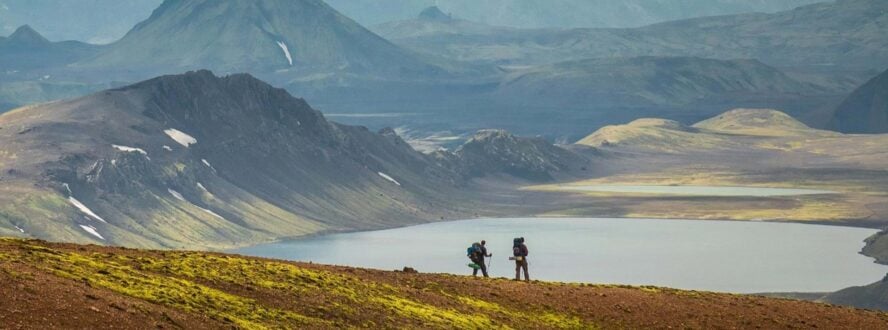
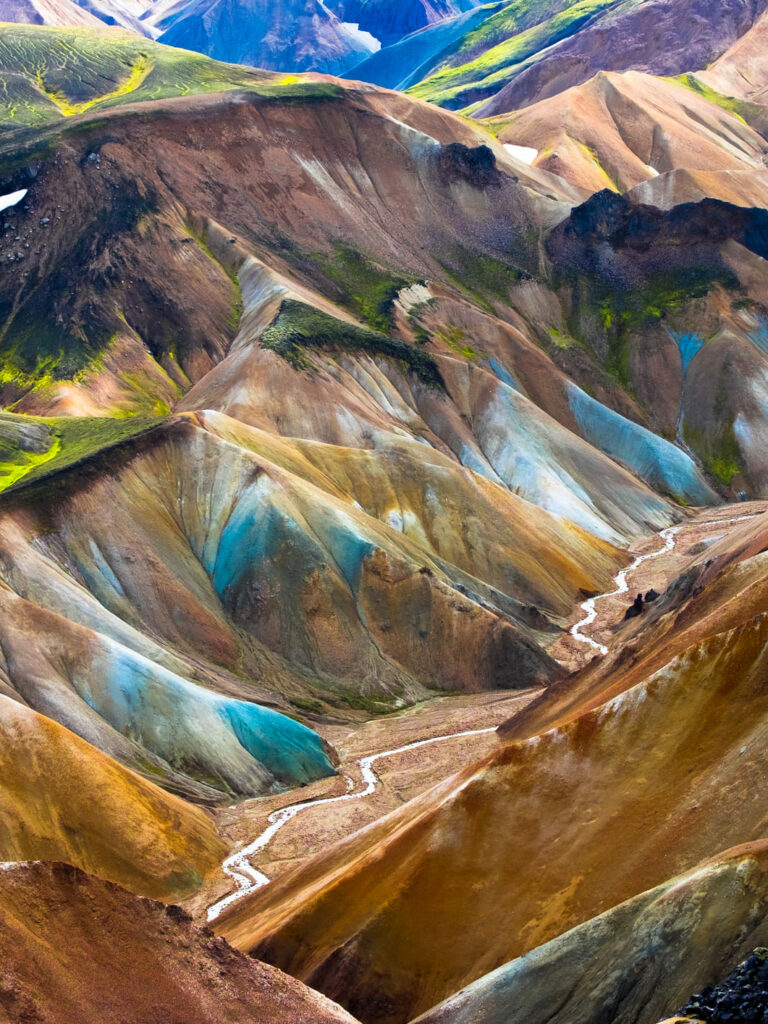
This trail runs through a landscape that’s still, quite literally, being built. The rock under your boots is younger than you’d expect, then suddenly far older than you could imagine, all within the same afternoon. The mountains change color depending on chemistry buried a hundred feet down. Somewhere on day 4 or 5, the view stops people mid-step on this trail. Even the ones who’ve climbed real mountains before.
I’ve spent years trying to explain why that happens. I still don’t have a clean answer. What I do have is 50-something trips’ worth of stories, near-misses, and small moments that never made it into a brochure, and I’d like to walk you through them.
Why I Became a Laugavegur Trail Guide
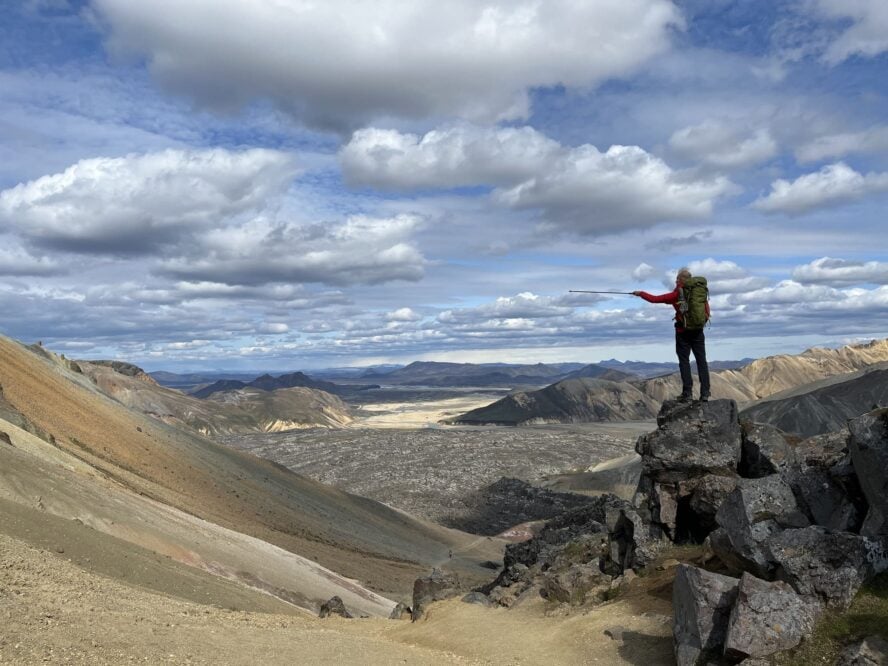
I was born in Iceland, though I spent one year as a small child in Canada. My family was outdoorsy in the loose way many Icelandic families are, no real gear, no real plan.
Something shifted in 2002. I walked the Camino de Santiago and discovered hiking as a passion. Then I lost it for a decade, partying through my 20s, backpacking European cities more than mountains.
I rediscovered it in my early 30s, working in Iceland’s national parks, watching tour groups pass through, thinking, I could do that. A short course later, I was working with a guiding company, in 2014. I’ve been a Laugavegur trail guide ever since.
My second or third year on the job, I got sent to Greenland on short notice. I’d never been. Nothing prepares you for standing on a mountain you’ve never seen, with 15 people trusting you to make the right call. That’s a huge joy, and also a weight. The paths weren’t marked the way ours are today. That trip decided things for me.
The Deep Story Behind Landmannalaugar
Before I take you through the trail, you should understand where you’re standing. As a Laugavegur trail guide, this is the part I probably explain the most, and enjoy explaining the most. Iceland sits on the Mid-Atlantic Ridge, where the plates of North America and Europe pull apart. Most of that ridge hides underwater. Iceland is the one place it surfaces completely.
We sit above a hotspot, similar to Hawaii or Yellowstone. The oldest recorded eruption from it dates back roughly 250 million years, when the continents were still fused as Pangaea, triggering a mass extinction that helped set the stage for the dinosaurs.
An eruption happens here on average once every four years, and geologists estimate a quarter of all lava produced on Earth in the last thousand years has come from this island. You’ll see evidence of it everywhere on this trail.
Why the mountains change color beneath your boots
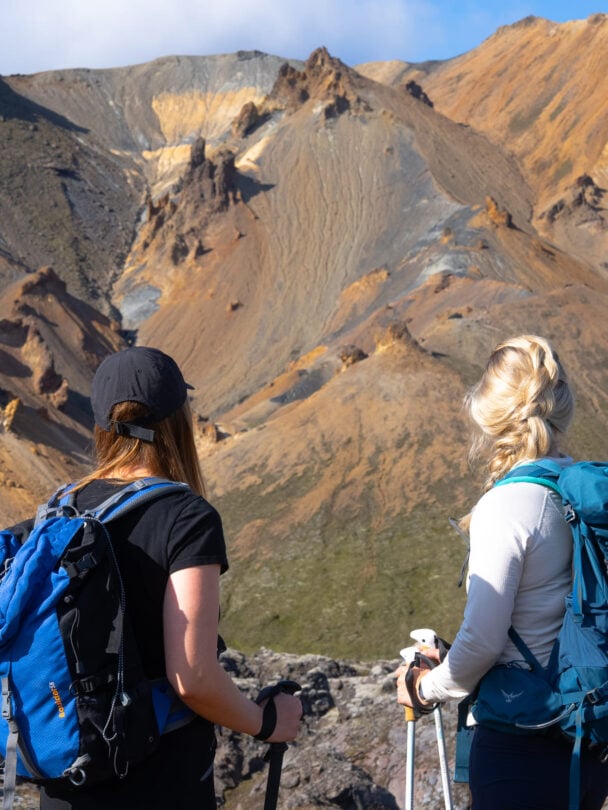
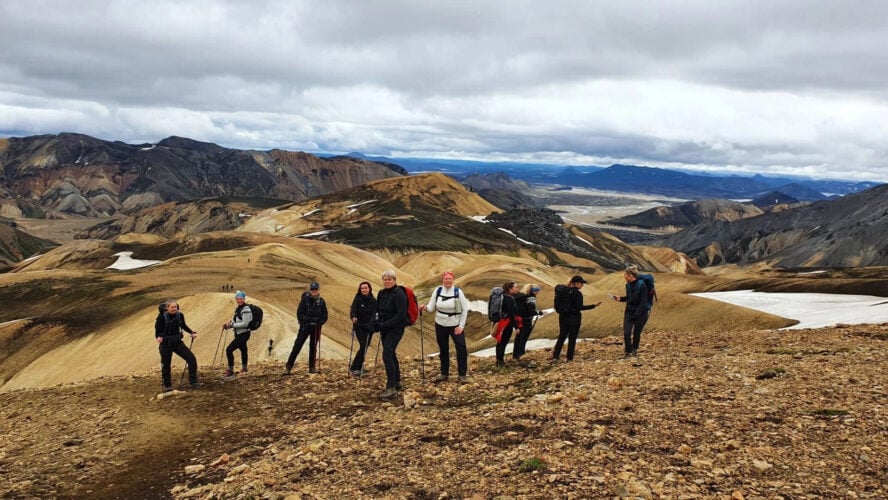
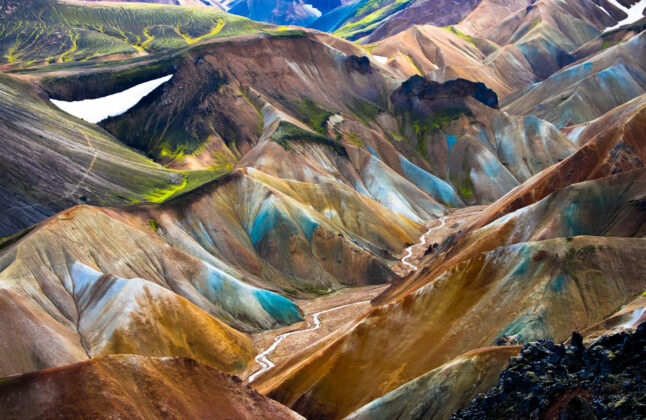
Most of Iceland is basaltic, similar in composition to the ocean floor. But the southern aspect of the highlands, where Landmannalaugar sits, is different. Here, the rock is rhyolite, which happens when magma lingers in the chamber long enough to cool slowly, picking up extra silica.
Tiny shifts in that chemistry produce wildly different colors. One mountain reads blue. The next reads red. It isn’t a filter or a trick of light. It’s chemistry, sitting right there in the rock.
Landmannalaugar Hiking: Where the Trail Begins
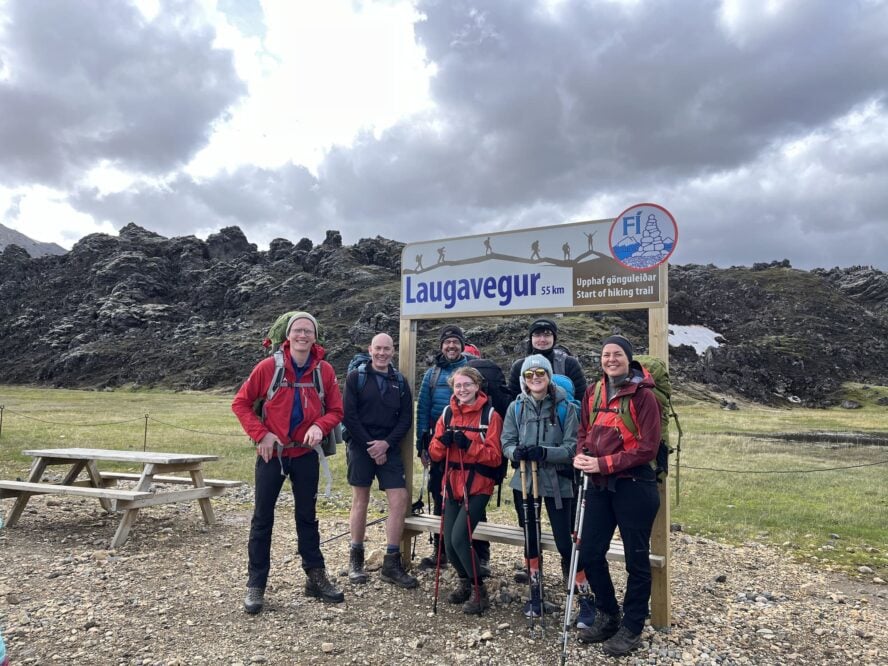
Landmannalaugar sits inside Fjallabak Nature Reserve, in the south-center highlands, and it’s where nearly every Laugavegur hike starts. Any Laugavegur trail guide will tell you it’s the best possible introduction to what’s coming. The name Landmannalaugar translates loosely to the people’s pools, and once you arrive, you’ll understand why.
How to get to Landmannalaugar
Landmannalaugar is reachable by F-roads that require real clearance and, ideally, a guide or a proper 4×4. Most guided trips meet in Reykjavík and handle the drive in, a few hours depending on conditions and how many stops you make along the way.
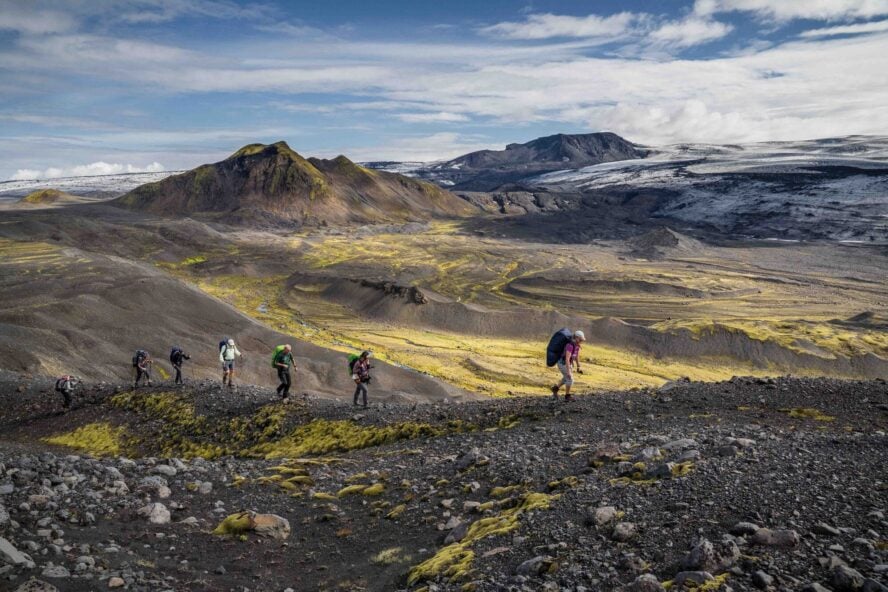
The first two days cross the Torfajökull caldera, a volcano that erupted roughly 700,000 years ago. You climb from the valley floor and walk across the caldera itself, sleeping somewhere in the middle of it on night one. It’s a tough start, but the color carries you. A blue mountain here, a red one there, an obsidian lava field underfoot, all before lunch.
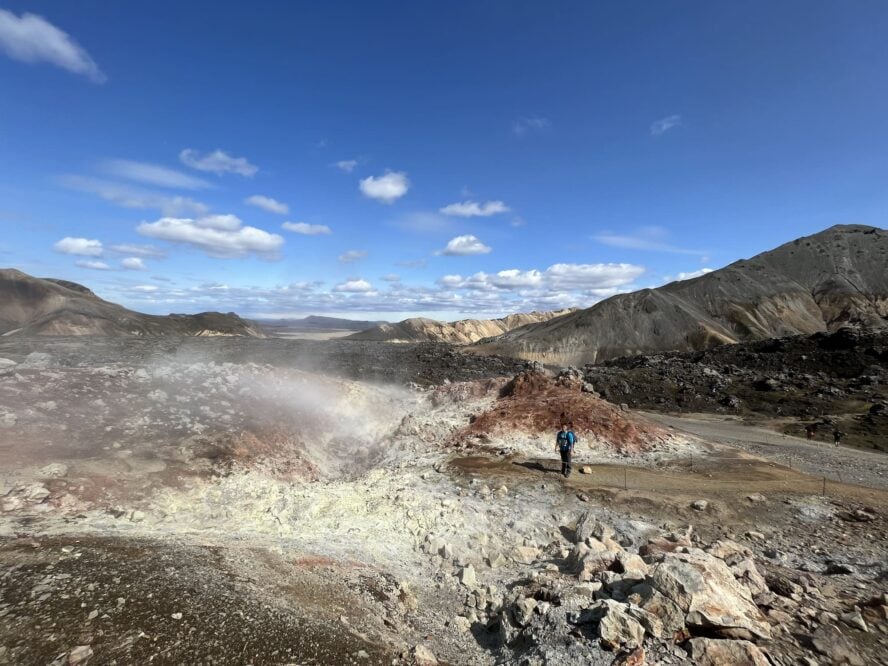
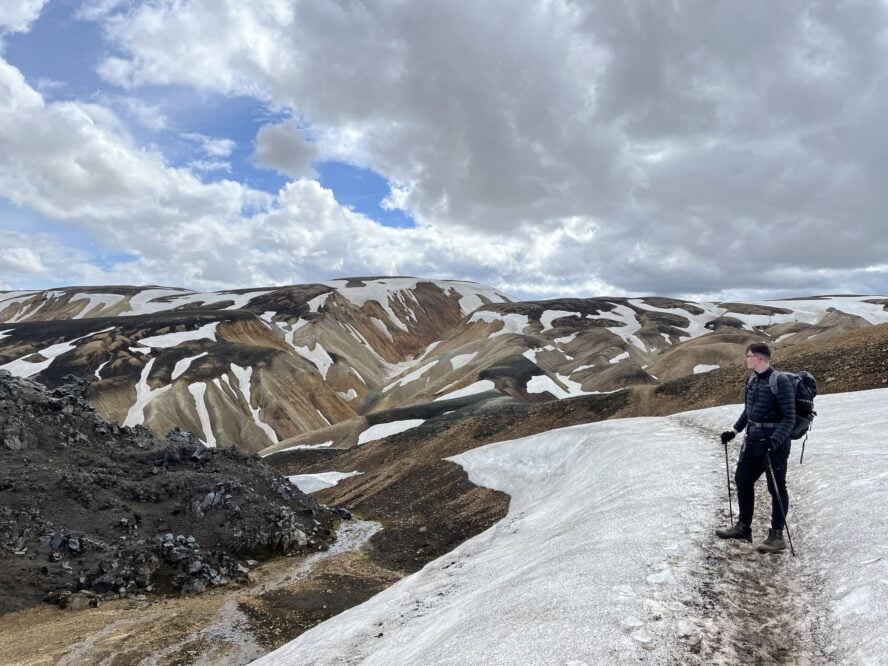
Keep climbing and you reach geothermal ground: steam vents, bubbling pots, colors that shouldn’t exist in nature. If you’re walking in June or early July, expect snow up top. By late August most has melted, though the ground underneath can be trickier than the snow itself.
Where Are the Hot Springs in Iceland?
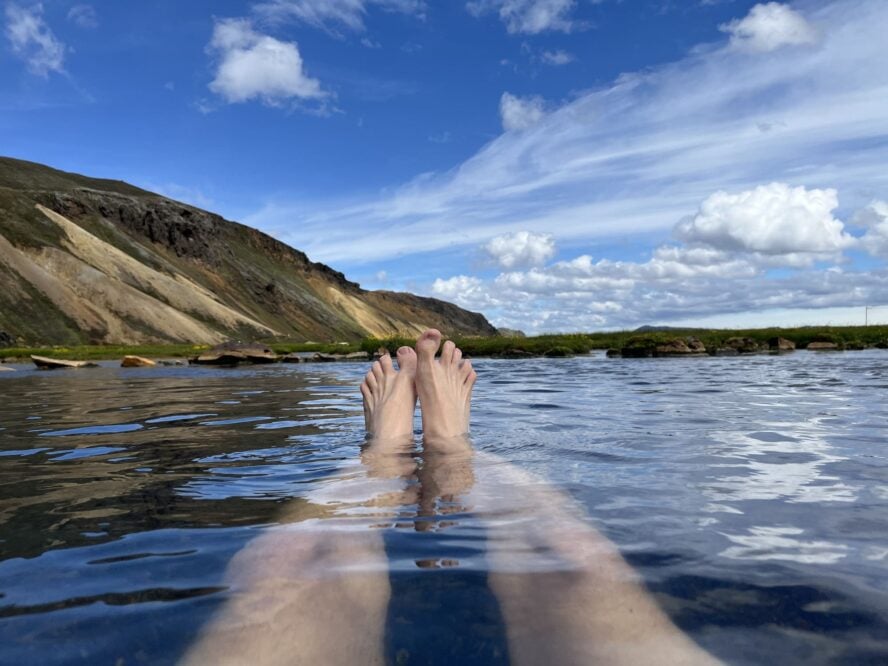
Before you even start hiking, there’s a ritual worth knowing about. At Landmannalaugar, a cold river and a hot geothermal stream run close enough together that you can find your own perfect temperature between them, maybe a hundred meters from the hut, trail leading right to it.
I have a hard time convincing people to get in before the day’s hike starts. They think through the logistics, where to change, since there’s just a small shelter, no spa amenities. Part of my job as a Laugavegur trail guide is talking people into it anyway. By the end of the day, though, I usually get most of my group in. The ones who skip it tend to regret it a little.
This isn’t unique to the trail. Iceland has ample geothermal water across much of the country, and we’ve built a culture around it. In the 20th century we started harnessing that energy into public pools, and they’ve become genuine social ground, places you go not just to swim but to sit and talk to strangers about politics and weather.
A friend of mine, an expat who lived here for three years, told me the Icelandic hot springs and pools were the only place she felt comfortable striking up conversation with someone she didn’t know. Like a bar, except everyone’s in swimwear and nobody’s had a drink.
Trekking in Iceland: The Days Between Landmannalaugar and Þórsmörk
After the caldera, day three flattens out. Black sand desert, moss-covered mountains rising on either side. As a Laugavegur trail guide, this is the day I have to talk up a little, since it feels almost like a rest day, not because it’s easy, but because you’re not turning a new corner every five minutes the way you were on day one and two. To me it feels close to a pilgrimage.
The last day of the official route descends into Þórsmörk. Most groups spend an extra day there before heading back, and if you’re running the six-day version, you’ll add a hike out to Fimmvörðuháls, up to Móði and Magni, two craters formed in the 2010 eruption that shut down European air traffic for a week.
River crossings aren’t as scary as people think
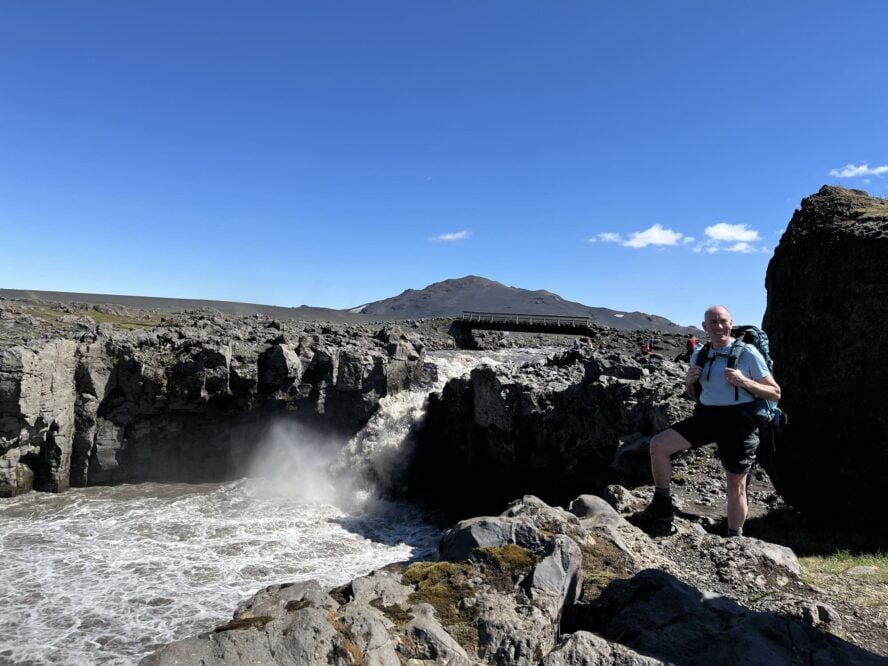
A lot of people arrive nervous about the river crossings, and I understand why the idea sounds intimidating. Every Laugavegur trail guide hears this question before day one even starts. In practice, it’s three or four crossings, sometimes rougher after heavy rain, but mostly just above your ankles. Rarely past the knee. When it runs higher, we hold together and use specific footing techniques.
The bridge into Þórsmörk itself has wheels, because the glacial river beneath it moves constantly, and the whole structure gets repositioned to match. Once, a group waded a small stream, only to watch the crew pull the bridge away seconds before we reached it to reposition it elsewhere. We didn’t even need to have crossed what we’d just crossed.
The rule about the moss, and why I mostly follow it
Iceland’s moss grows painfully slowly, and it’s fragile in a way that’s easy to underestimate. We ask people not to walk on it, and I hold that line hard when I’m guiding 15 people behind me.
That said, it’s soft underfoot and it calls to you. If you’re going to test it, bare feet do less damage than boots.
Why Þórsmörk Is My Favorite Place in Iceland
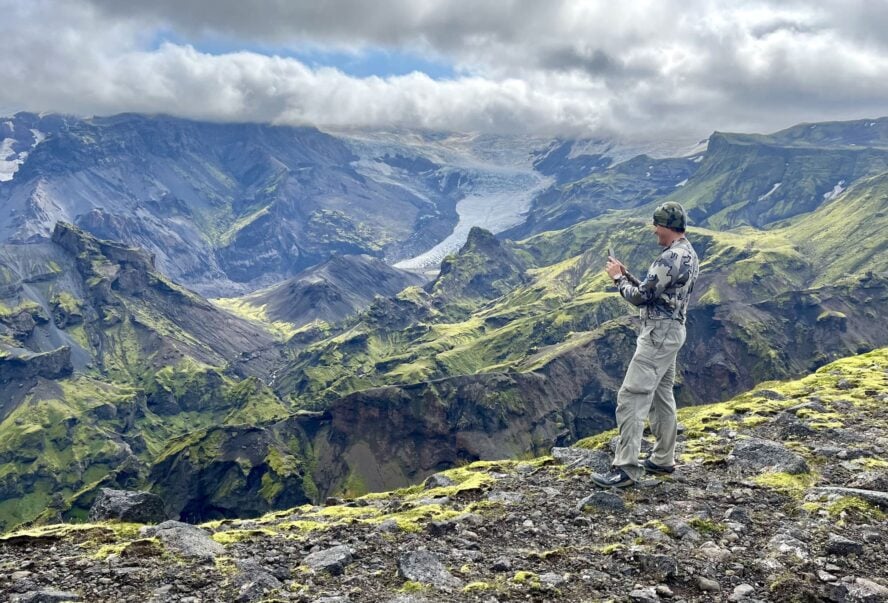
For almost a century, sheep haven’t grazed in Þórsmörk, which means it grew a forest most of Iceland never got to keep. That alone would make it special to me. Trees aren’t exotic where you’re from, maybe. Here, they are.
It’s personal, too. My parents met in this valley. My dad worked there, my mom was touring through. I’ve returned every year of my life since, worked as a cabin warden here once, met my first serious girlfriend here. The landscape itself never runs out of new corners, gorges, canyons, ridgelines, valleys folding into each other.
How to visit Þórsmörk
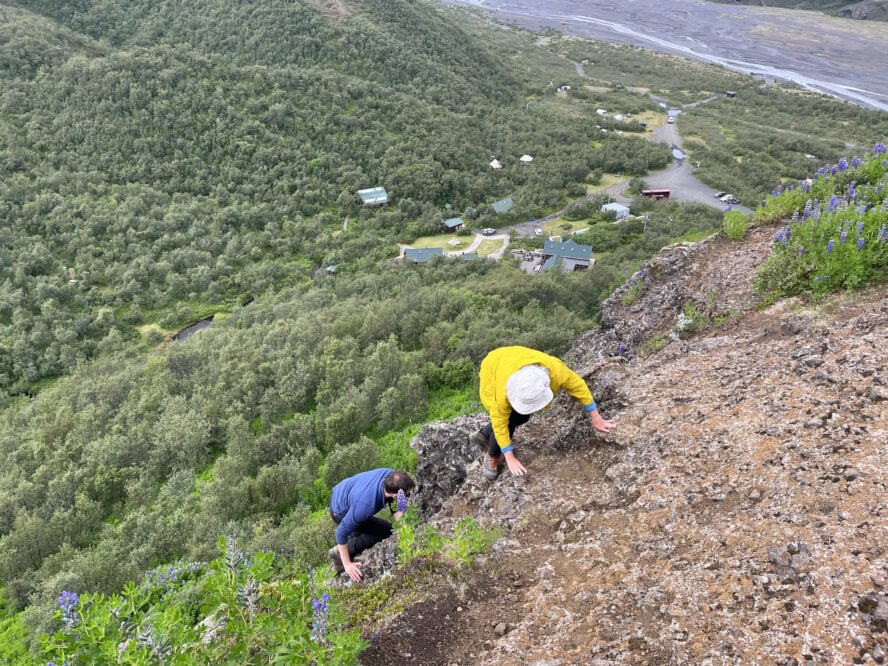
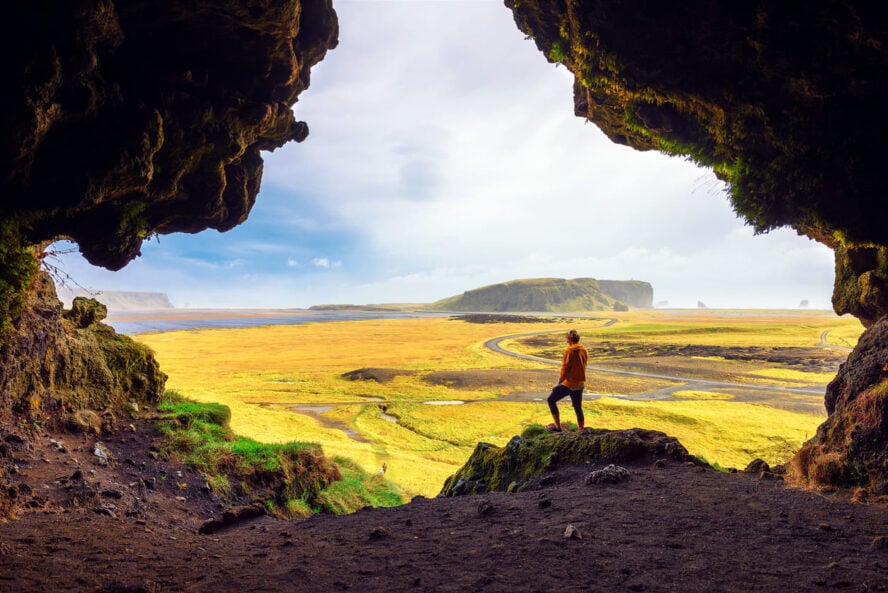
Getting here means crossing the Krossá river, which shifts constantly, so reaching it without local knowledge is its own small adventure. Most people arrive either on foot, as the trail’s final stretch, or by super jeep from Reykjavík if they’re visiting on its own.
I’m probably headed back there myself next week, alone, just to hike.
What the Laugavegur Trail Huts Are Actually Like
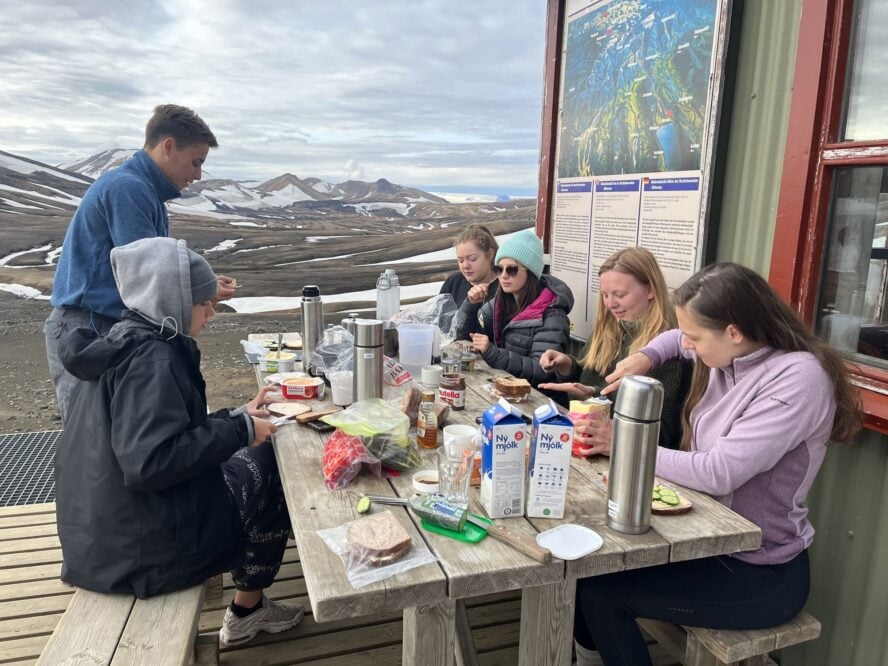
The Laugavegur trail huts were built by volunteers back in the 1970s, each one shaped by whoever built it, so none of them match. They’re small, remote, and full of character. You’ll sleep on mattresses, often bunk beds, sometimes closer to strangers than you’d expect. It works better than it sounds.
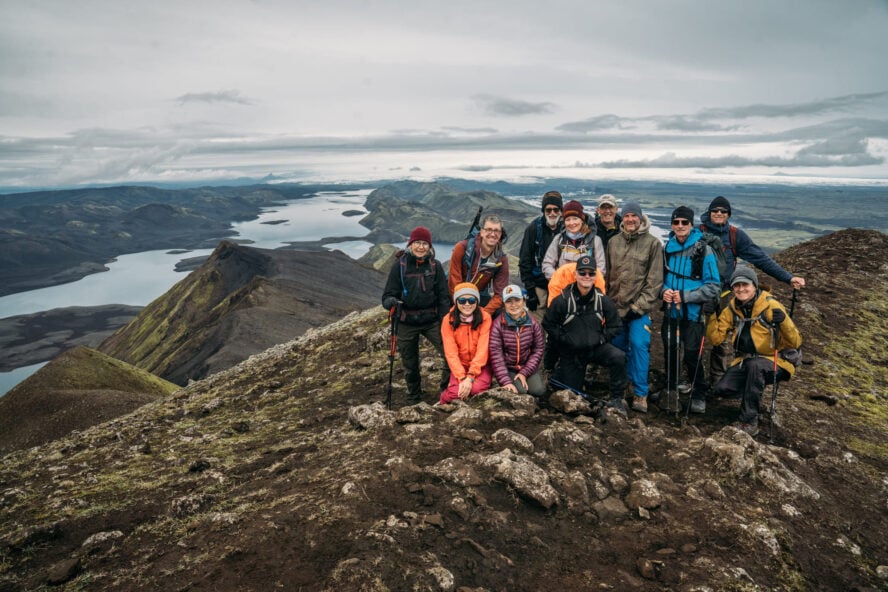
Groups run around 14 or 15 people, though the huts themselves hold anywhere from 50 to 70, split across different rooms. As a guide, I try to introduce people early, because whoever you meet in that first hut tends to reappear at every stop after. Those early connections become the backbone of the whole trip.
We handle food and luggage transport if you’re hiking with a group, which means what you carry each day is genuinely light. Most huts don’t sell much beyond the odd candy bar, and few sell alcohol, so anything you want beyond that takes some forethought.
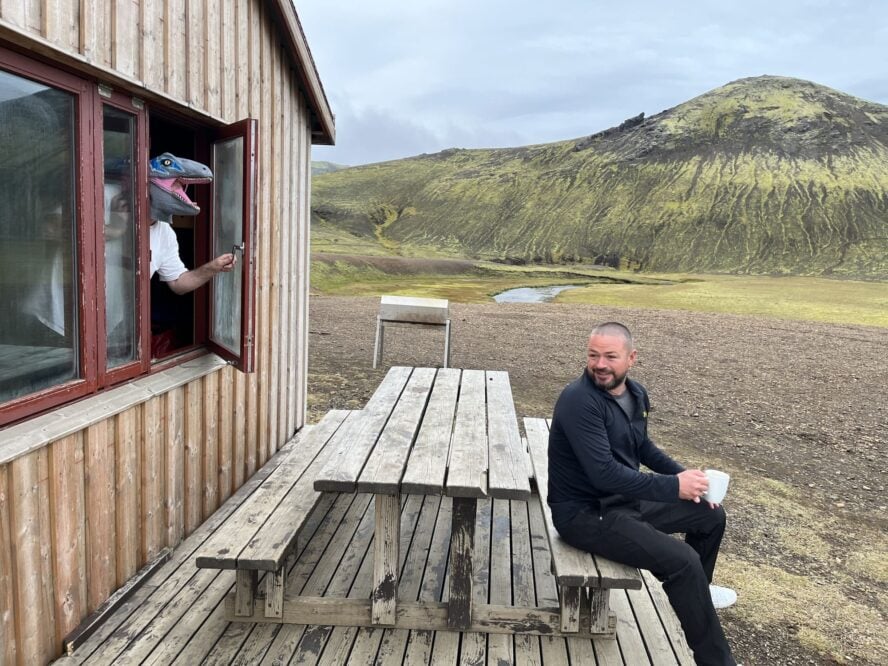
I once had a client bring a dinosaur mask the whole trip. Not required. Definitely appreciated.
A quick word on Iceland’s weather
There’s a saying here: if you don’t like the weather, wait 15 minutes. On a multi-day hike, you’ll almost always hit one difficult day, wind especially, since people are often surprised by how strong it gets.
That’s the kind of night that flipped my tent, the one I mentioned at the start. We manage it carefully, but I won’t pretend it never happens.
How Difficult Is the Laugavegur Trail?
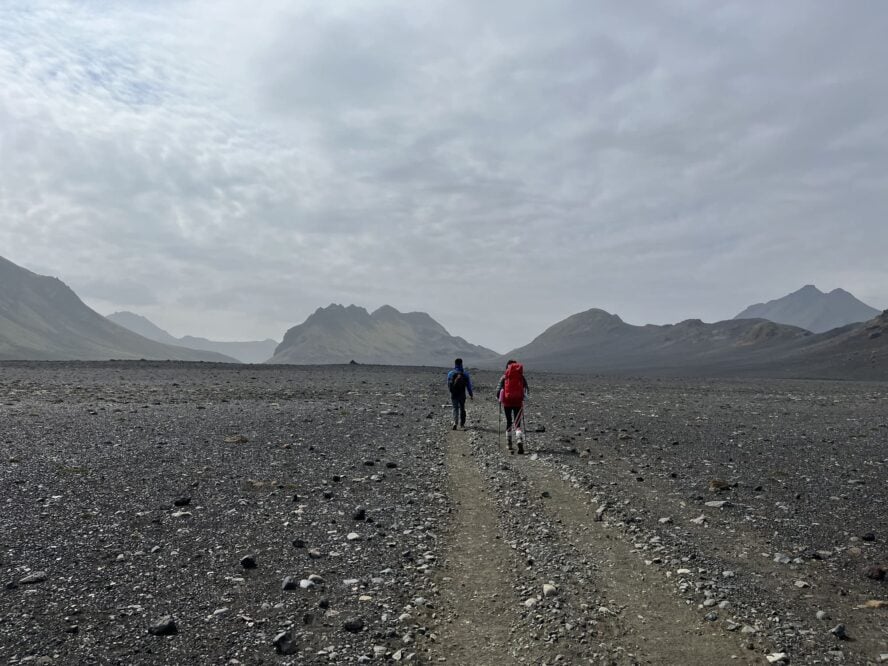
People ask me this constantly, and the honest answer, as a Laugavegur trail guide who’s fielded the question hundreds of times, is: it depends less on fitness than on preparation. The first day carries about 500 meters (1,640 ft) of elevation gain over 14 kilometers (8.7 mi). It’s not a stroll, but with long breaks, it takes five to six hours, no rushing required. I’ve never had someone unable to finish it.
I’ve guided everyone from total hiking beginners to a man who’d done Everest Base Camp, Kamchatka, and Pakistan’s toughest routes. He told me, completely straight-faced, that trail-wise, this was the hardest hike he’d ever done. Small, rocky paths, a route that isn’t always kind underfoot.
If you’ve never hiked five hours uphill before, you’ll spend more energy catching your breath than enjoying the view. That’s the real preparation gap, not fitness in the gym sense, but time on your feet. Bring proper rain gear. I once had someone develop mild hypothermia because her jacket leaked.
How Long Is the Laugavegur Trail?
The full route runs roughly 55 kilometers (34 mi) between Landmannalaugar and Þórsmörk, typically completed over four days, with many groups adding a fifth day to explore Þórsmörk itself. Add the Fimmvörðuháls extension and you’re looking at six days total. It was my own first multi-day hike, back in 2002, and it’s still the one I’d recommend first to almost anyone.
The following year, I hiked the Westfjords with the same group of friends. Beautiful, but every day felt similar to the last. Here, something changes constantly.
Guided Versus Self-Guided: What Actually Changes
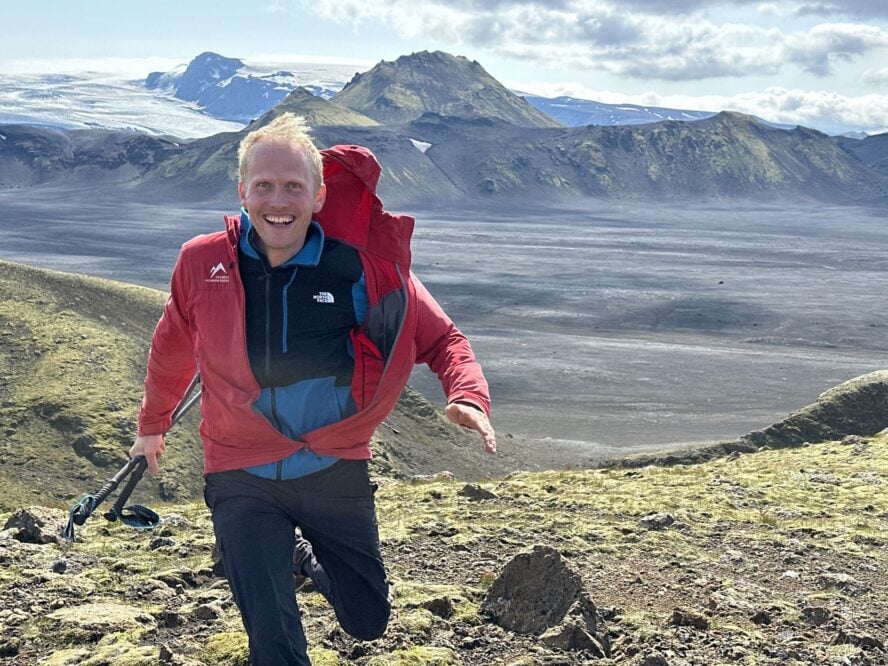
About half the people on this trail, maybe more, go without a guide. It’s well marked these days, though signal still isn’t reliable across the whole route. Going alone gives you a more solitary experience, and some people genuinely want that.
With a group, you get food handled, luggage carried, and instant companionship with people who, more often than not, share your particular love of the outdoors. It’s rare that someone’s personality clashes with the group.
What happens to people by day five
Something builds over the course of this trail that I don’t think I can fully explain. People open up. Confidence grows visibly. By the huts, in the quiet hours, people start sharing the real difficulties and joys of their lives, not just trail small talk.
Somewhere around day five, most groups have at least one person in tears, the moment I mentioned at the start of all this. Not from pain. From the view in front of them, and having nowhere left to put all that beauty.
When to Hike the Laugavegur Trail
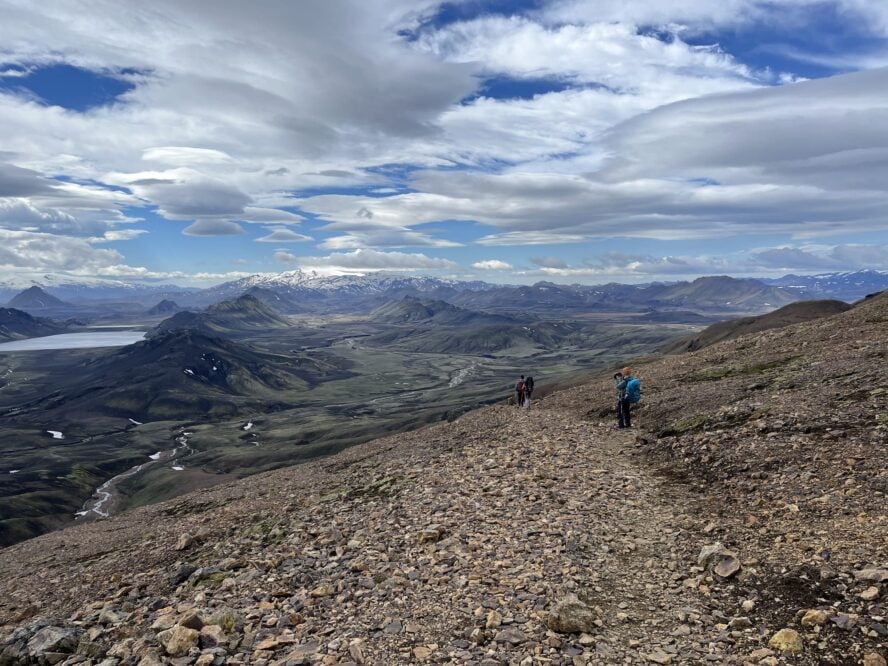
The trail generally opens in June and stays walkable through September, weather depending. Trekking in Iceland during peak summer means near-constant daylight, genuinely useful when you’re covering long days on foot. July tends to bring the most stable conditions. Late June and late August offer a quieter trail, if you’re willing to trade a slightly higher chance of snow or crowds for solitude.
Whatever window you pick, come with a proper windstopper and rain jacket. A little wind and a few drops of rain rarely ruin a day out here. Heat, oddly, is harder to hike in than a light drizzle.
What This Trail Has Given Me, Trip After Trip
People ask what’s changed after guiding this trail so many times. Somewhere in there, I started noticing things I hadn’t the time before. A new gully. A different light on Brennisteinsalda.
I’ll tell you about the man from earlier, the one who’d done Everest Base Camp and Kamchatka and called this trail the hardest thing he’d hiked. On day five, climbing a snowy section near the end, the view stopped him mid-stride. He didn’t say anything at first. Then he told me it was the most beautiful thing he’d ever seen, and his voice broke on the word beautiful.
That’s the part nobody warns you about. Grown men who’ve stood on real mountains, who’ve done the serious, dangerous stuff, come out here and cry over a view anyway. Not from fear. Not from exhaustion. From simply having too much beauty in front of them and not enough room left to hold it.
I’ve stopped trying to explain why day five does that to people. Sixty trips in, I’ve just learned to expect it, and to let it happen without making a big thing of it. We’re a small country, around 400,000 people, most crowded into Reykjavík, the rest scattered thin along the coast. Nobody really lives in the highlands. Maybe that’s why they’ve stayed so wild, and why walking into them still feels like discovering something, even on trip #60.
You go on a hike like this and find things in yourself you didn’t know were there. That’s not a line I picked up from a brochure. It’s just what keeps happening, tour after tour, and it’s why the view on this trail can still make a grown man cry.