I was still tying my bootlaces when I heard the screaming. A woman from another group was floating down the same river we had just crossed. I will get to how that ended. First, you should know why it can happen at all.
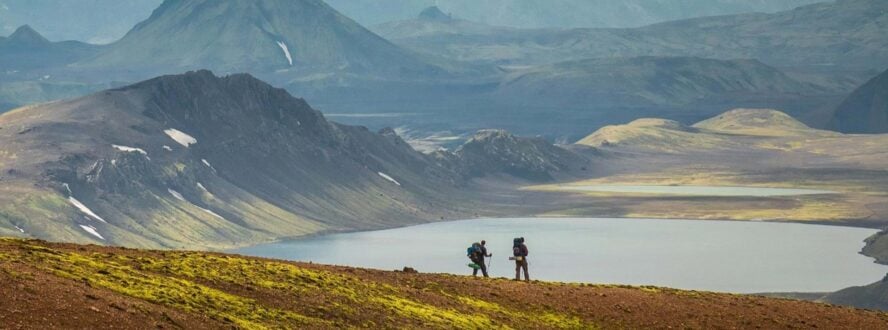
An Iceland backpacking trip through the highlands is not a scenic walk between waterfalls. It’s days of carrying everything you own on your own back, sleeping in remote mountain huts, and crossing rivers that change by the hour. We tell our groups we know these rivers. That is not entirely true, and the highlands make sure nobody forgets it for long.
My name is Albert. I am a Senior Polar Guide by PTGA, an AIMG glacier guide, and a Wilderness First Responder, based in Reykjavík. My partner Monica and I have spent more than a decade taking people into the Icelandic highlands on foot, carrying everything they need on their own backs. This is what that decade has actually taught me.
What an Iceland Backpacking Trip Actually Demands
On day one, someone always hands me a bag that weighs more than it should. I open it, pull out half of what’s inside, and set it on the floor. “You won’t need this,” I tell them. Nobody argues twice.
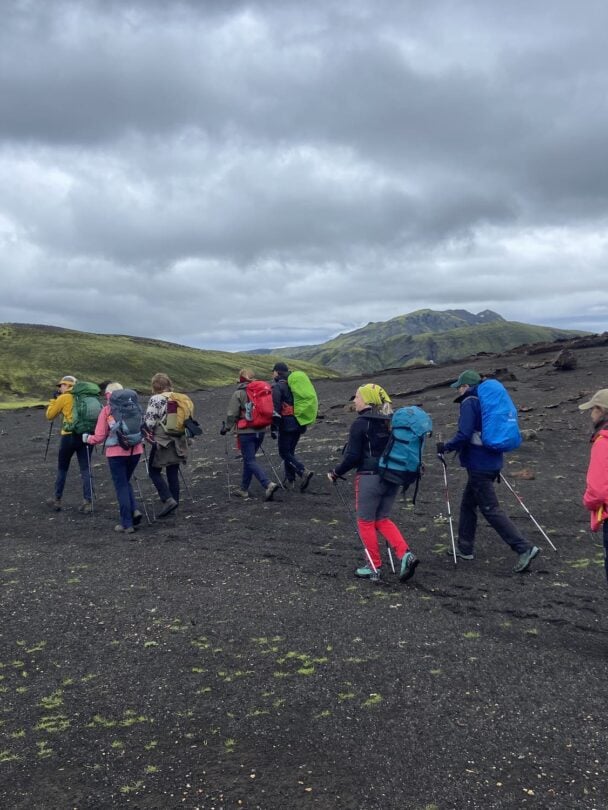
People picture backpacking in Iceland as a scenic walk between waterfalls. It is not that. There is no support vehicle carrying your duffel bag ahead to the next hut. You carry a fully loaded backpack the entire way, every one of the 150 km (93 mi).
My own pack usually weighs around 7 to 8 kg (15 to 18 lb). Clients carry a bit more, closer to 8 to 10 kg (18 to 22 lb), once food and gear are accounted for. That is the whole point of this kind of Iceland backpacking trip. You move under your own power, with nothing waiting for you but the next hut.
What to bring backpacking in Iceland
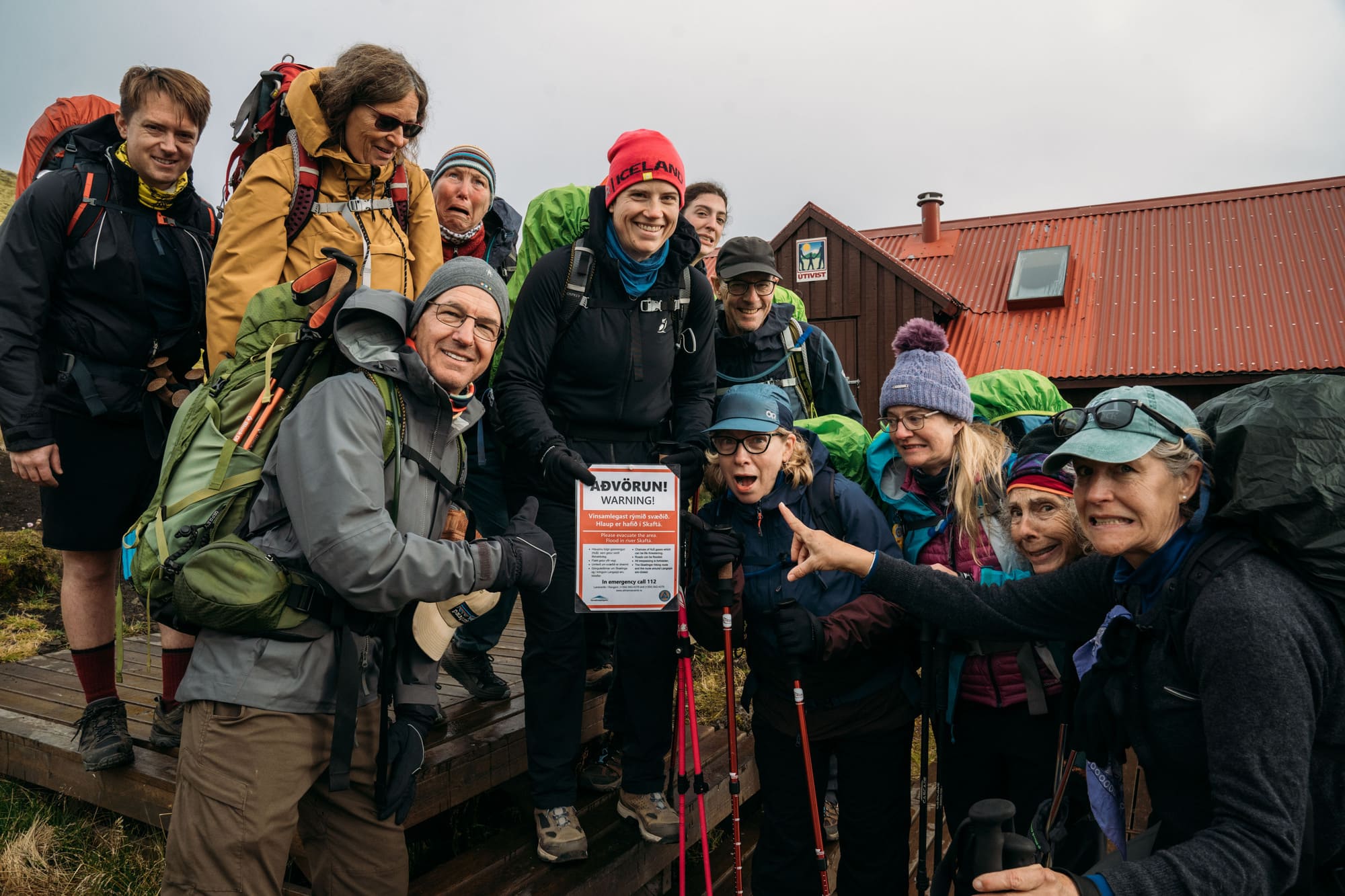
I keep the list short on purpose. One pair of hiking pants, one pair of waterproof Gore-Tex pants, and you are covered. You will smell by day three. Everyone does. That is not the point.
A 35 to 40 L backpack is enough. Bring closed-toe sandals for river crossings, trekking poles, and a three-season sleeping bag rated for 5 to 10°C (40 to 50°F). The huts are heated, so you do not need anything heavier. Everything you pack has to survive the whole Iceland backpacking trip, not just look good on day one.
On day one, I do a full gear check with every traveler, and I am not shy about pulling things out of a pack that will only slow someone down.
Iceland River Crossing Days Happen Almost Daily
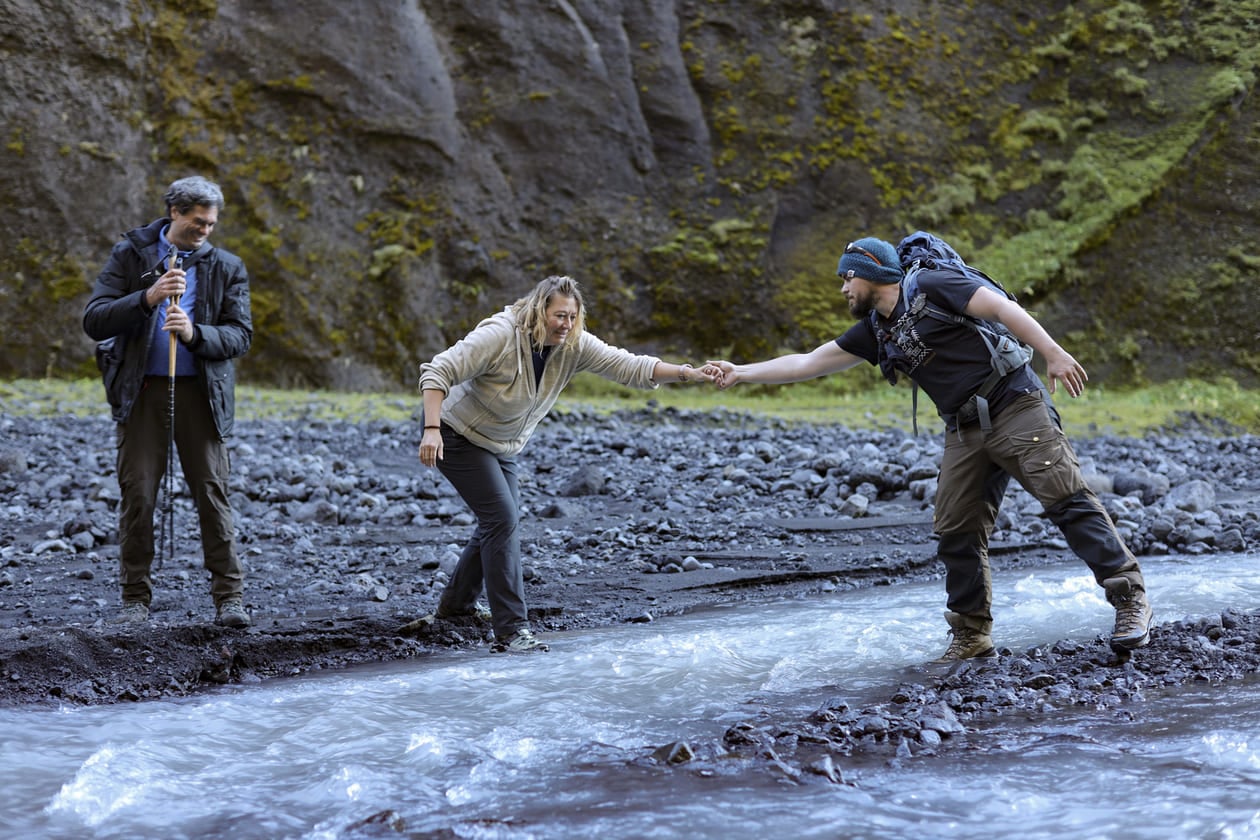
We cross rivers on nearly every single day of this route. Some barely reach the knee. Others are wide, cold, and carrying sediment straight off a glacier. A river crossing here is never routine, even after doing this for years.
In 2023, at the Þröngá River near Þórsmörk, a crossing that is usually one or two shallow channels turned completely white and swollen with glacial silt. We found the widest, safest line and got my group across, cold legs and numb toes, but safe. A guide from another group took the narrower, faster route instead.
That is when the screaming started, the moment I mentioned at the beginning. Two of my hikers had run back toward the river. A woman from the other group was floating in the current. We pulled her out. She was fine, just soaked through and shaken. Nobody who was there that day crosses a river the same way again, myself included.
The rule that came out of that day
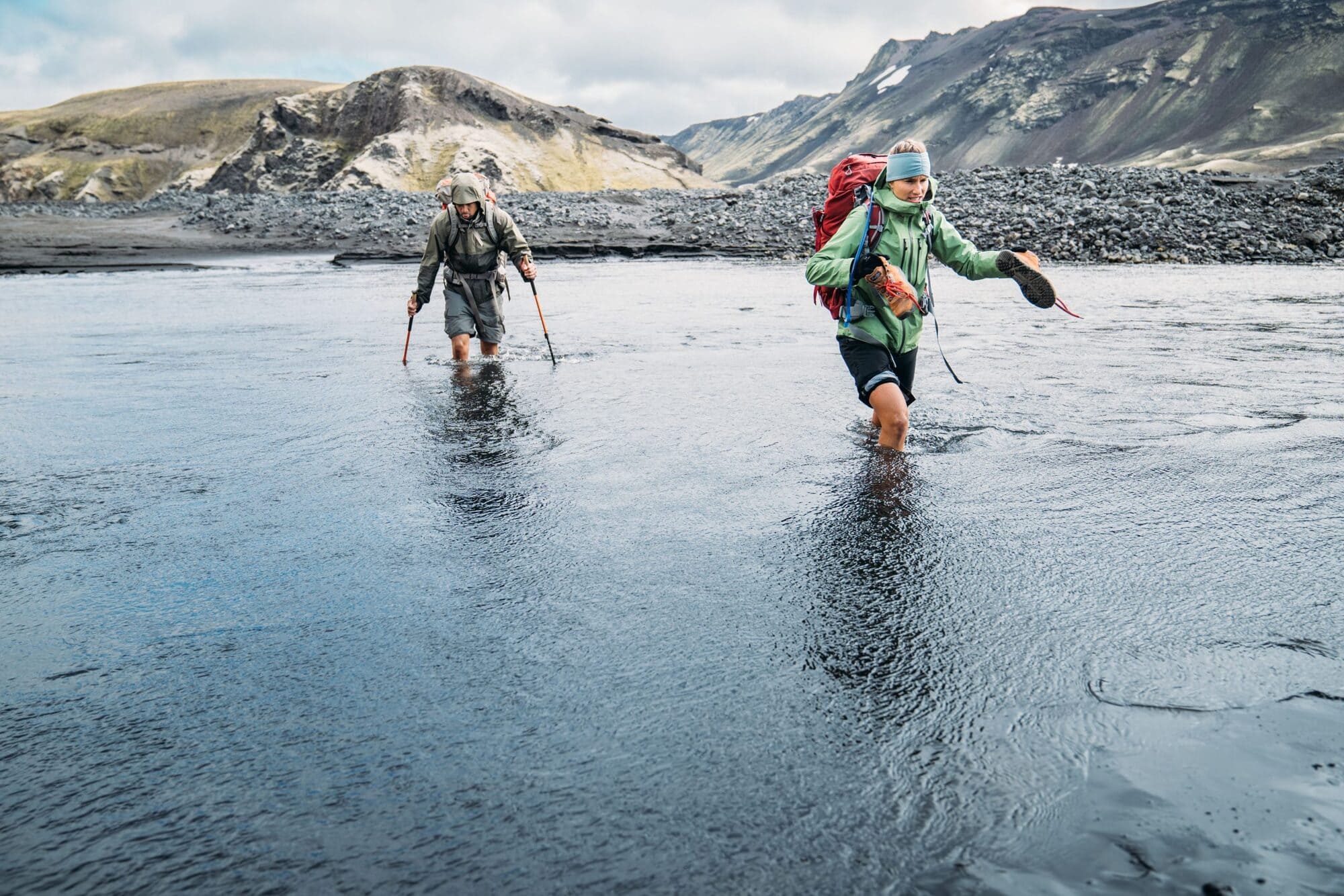
I tell every group the same thing after that. Wait for your guide to check the line first. We say we know these rivers, but the truth is nobody really does. They change by the hour, and that kind of humility keeps an Iceland backpacking trip like this one safe.
For the biggest crossings, I always have people go in threes rather than pairs. Three bodies hold a line steadier than two. One valley on this route has dozens of shallow braided streams over about 2 km (1.2 mi). My groups renamed it the Thousand River Valley. On a sunny day it is almost fun. In cold rain, it is a different kind of test.
How the Hidden Trails Came to Be
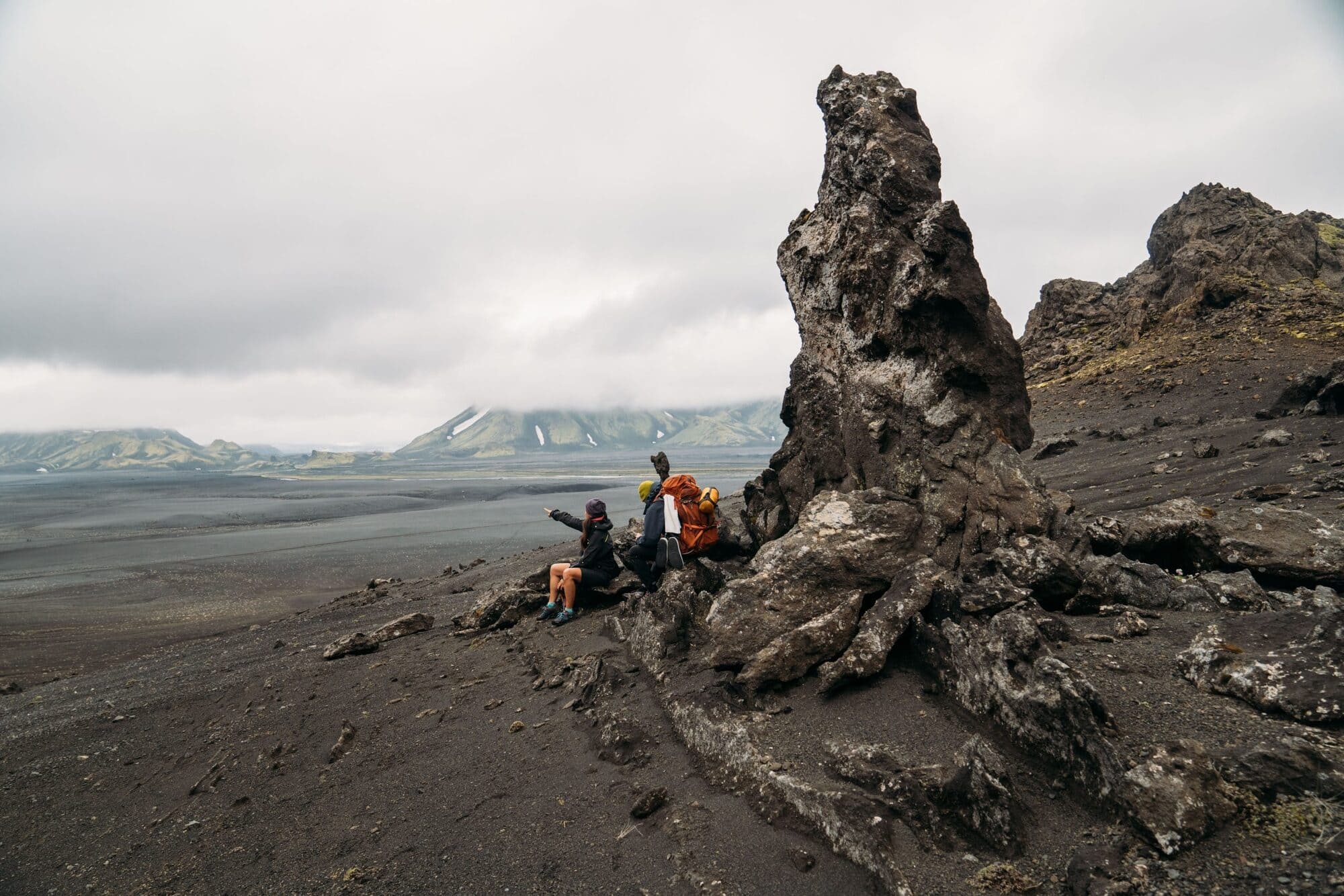
Before any of this, I spent a season as a hut warden for the association that runs the huts along the Laugavegur Trail, closing out the season near Landmannalaugar. In the slow evenings, I pulled out old maps in the warden’s cabin and started tracing routes that nobody had connected before.
Months later, Monica and I tried it ourselves. Instead of the usual 12 days, we did the whole distance in four or five, right after the season closed, in what was genuinely the worst week of the year. Orange weather alert, driving rain, wind that did not let up. We made it the full distance, boots soaked through and grinning ear to ear.
The warden had feared she would need to call a rescue. Instead she just looked furious with worry.
Turning a wild idea into a real trip
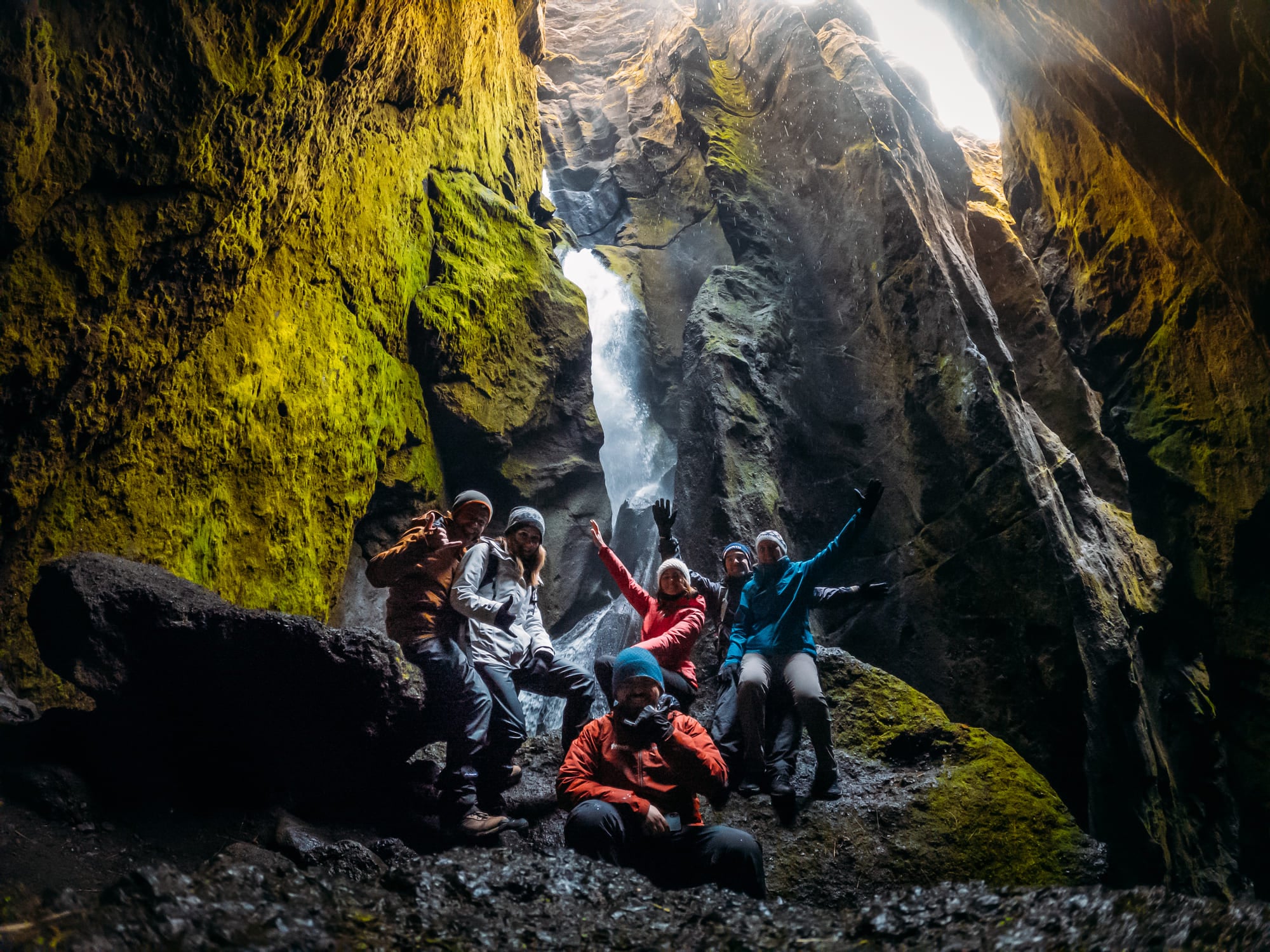
We came back thinking this could actually work as an Iceland backpacking trip worth offering to other people. Linking it to the final stages of the Laugavegur made sense once we saw it on the map, tying in the black desert, the canyons, and the birch forests of the valley the Norse named for their god of thunder.
Why do what everyone else does when something more remote was sitting right there. That first exploration even got picked up by an adventure magazine afterward. We called the whole thing the Hidden Trails.
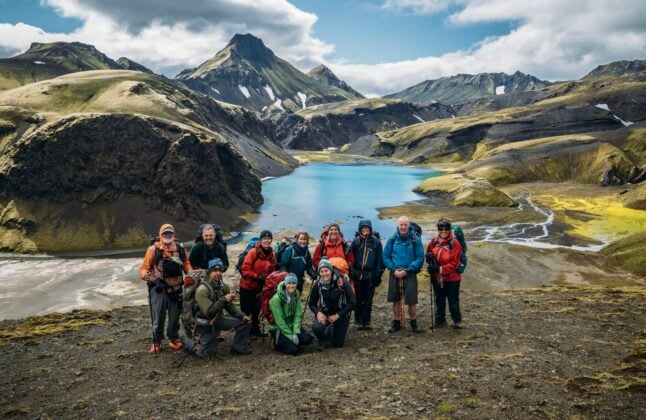
The route now runs from Landmannalaugar, where we spend two full nights before pushing into terrain almost nobody visits, and finishes on the last two days of the Laugavegur itself, from Álftavatn to Emstrur and on to Þórsmörk. Þórsmörk hiking on those final days feels completely different once you have spent a week and a half getting there the long way.
Multi-Day Hiking Iceland’s Highlands, Day After Day
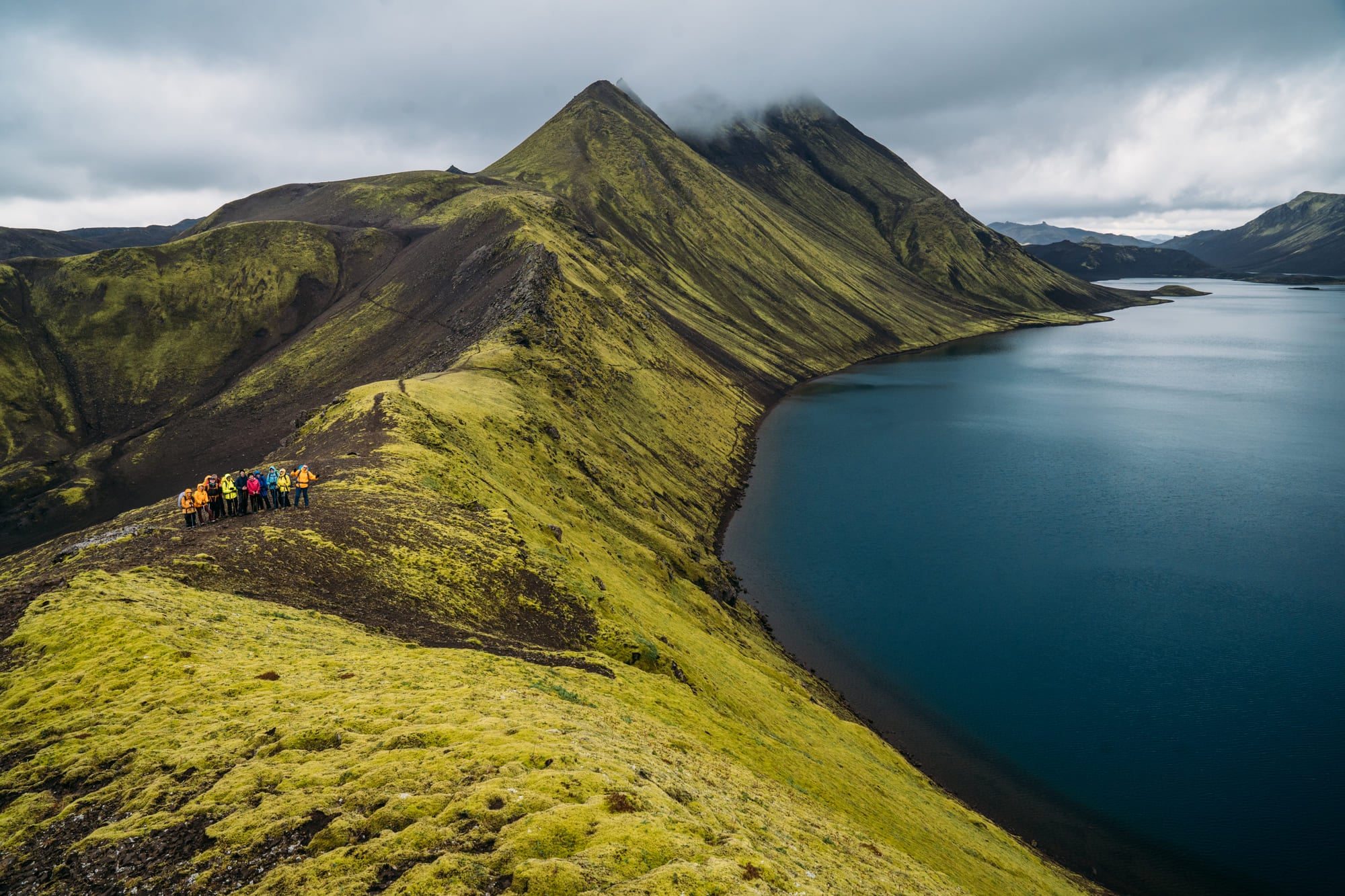
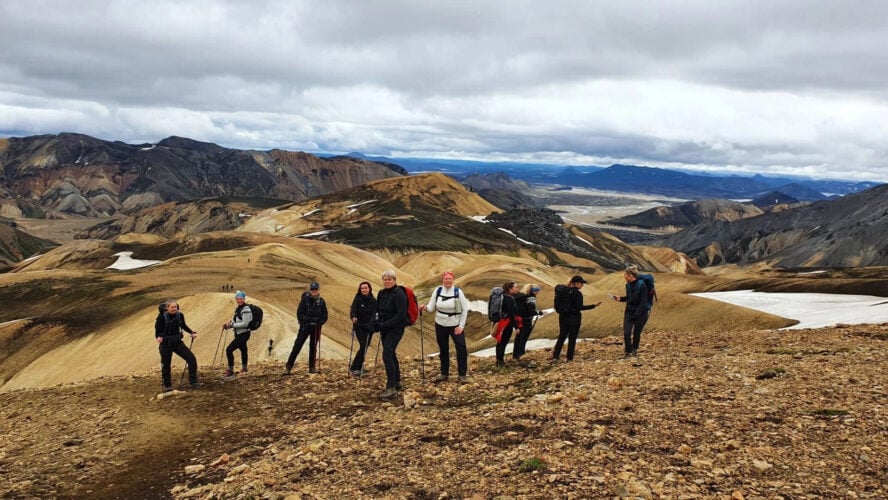
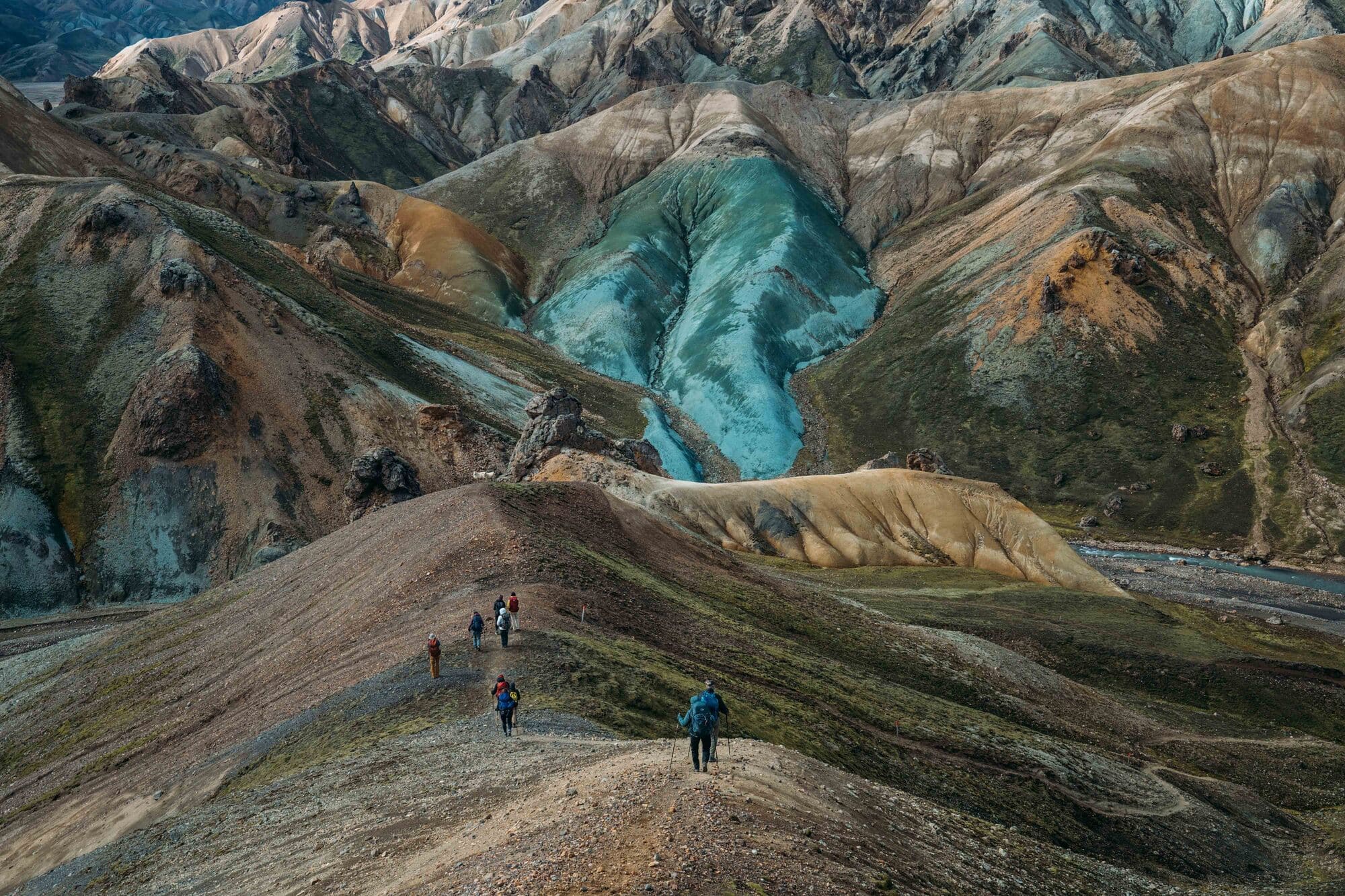
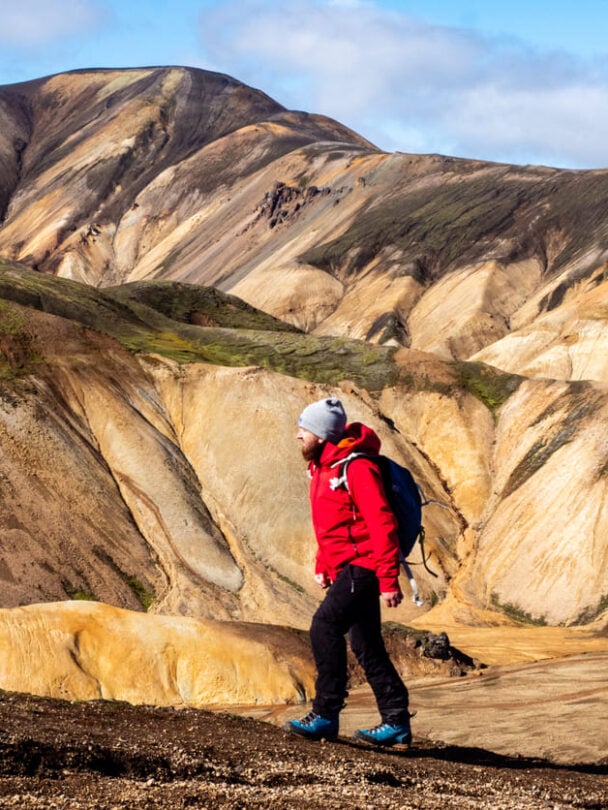
Multi day hiking in Iceland on this route means distances between 6 and 25 km (3.7 to 15.5 mi) a day, averaging around 15 to 20 km (9 to 12 mi), for 5 to 8 hours of walking. The highest ground we cross sits around 1,100 m (3,600 ft). That does not sound like much on paper. It is not about the elevation at all. The real test is loose scree, wind, and a total absence of marked trail underfoot.
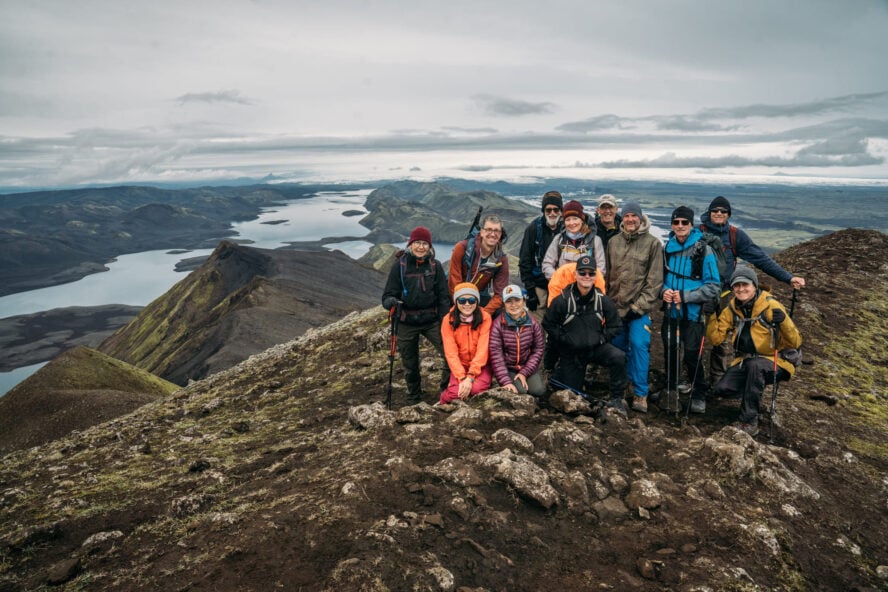
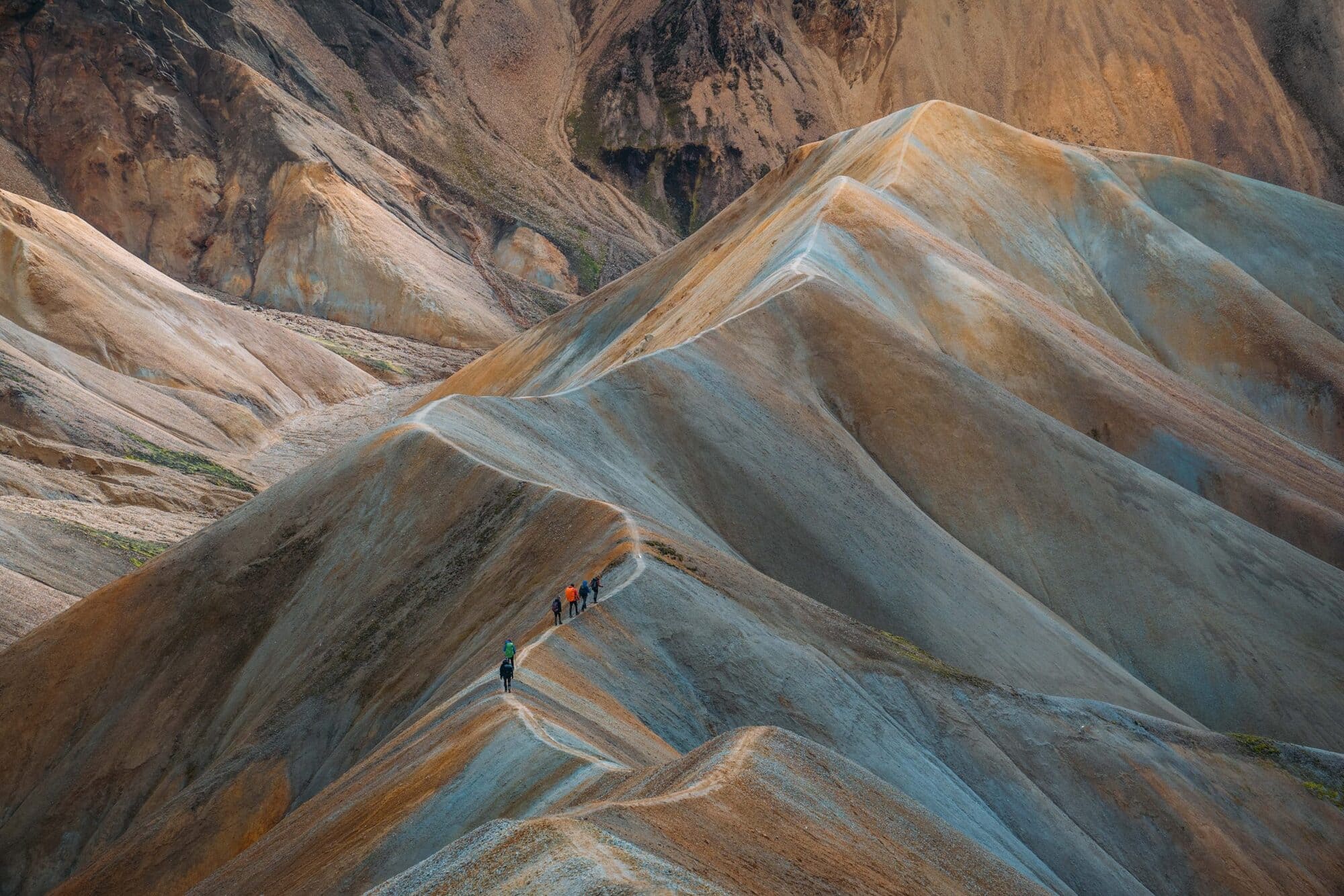
One ridge my groups nicknamed the Back of the Dragon looks tame from a distance and turns out to be anything but, dropping away sharply on both sides. Sveinstindur is a similar story. There is no marked trail up it, just the footprints of whoever passed before you, cutting through sand and volcanic rock.
The mountain is not tall, but it takes hours, and by the time you reach the top it feels like you have climbed something enormous. From the summit, Langisjór spreads out below in a blue that does not look real, one of Iceland’s longest lakes at around 20 km (12 mi) end to end. Standing up there, with the lake spread out and nobody else in sight, is worth every one of those hours.
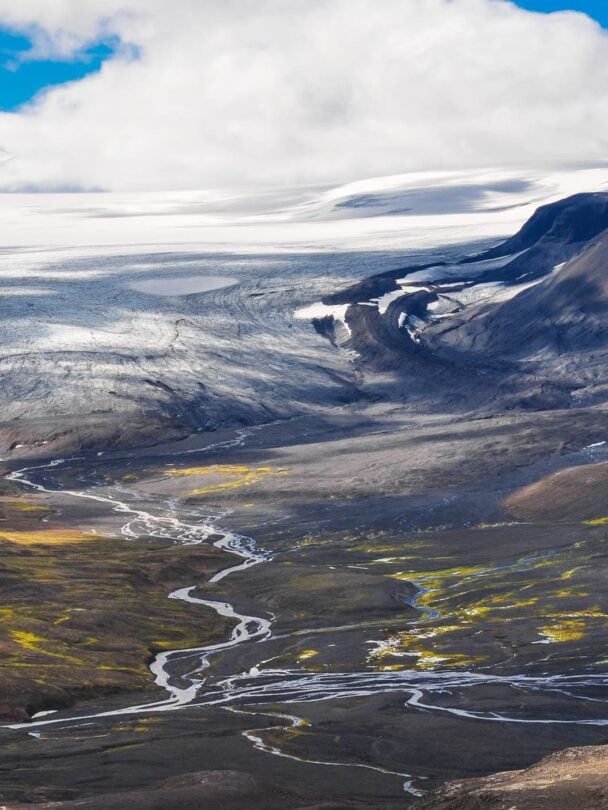
Last year I had a group do our shortest day, 6 km (3.7 mi), as something close to an active rest day. That same week, the river we crossed that morning had risen fast with glacier melt by the time Monica’s group reached it two days later.
Her group ended up doing nearly 20 km (12 mi) that day and 25 km (15.5 mi) the next just to stay ahead of it. An Iceland backpacking trip like this rewards flexibility more than any fitness plan you show up with. You can plan the distance, but the terrain always has the final word.
Where You Sleep: Iceland Trekking Huts
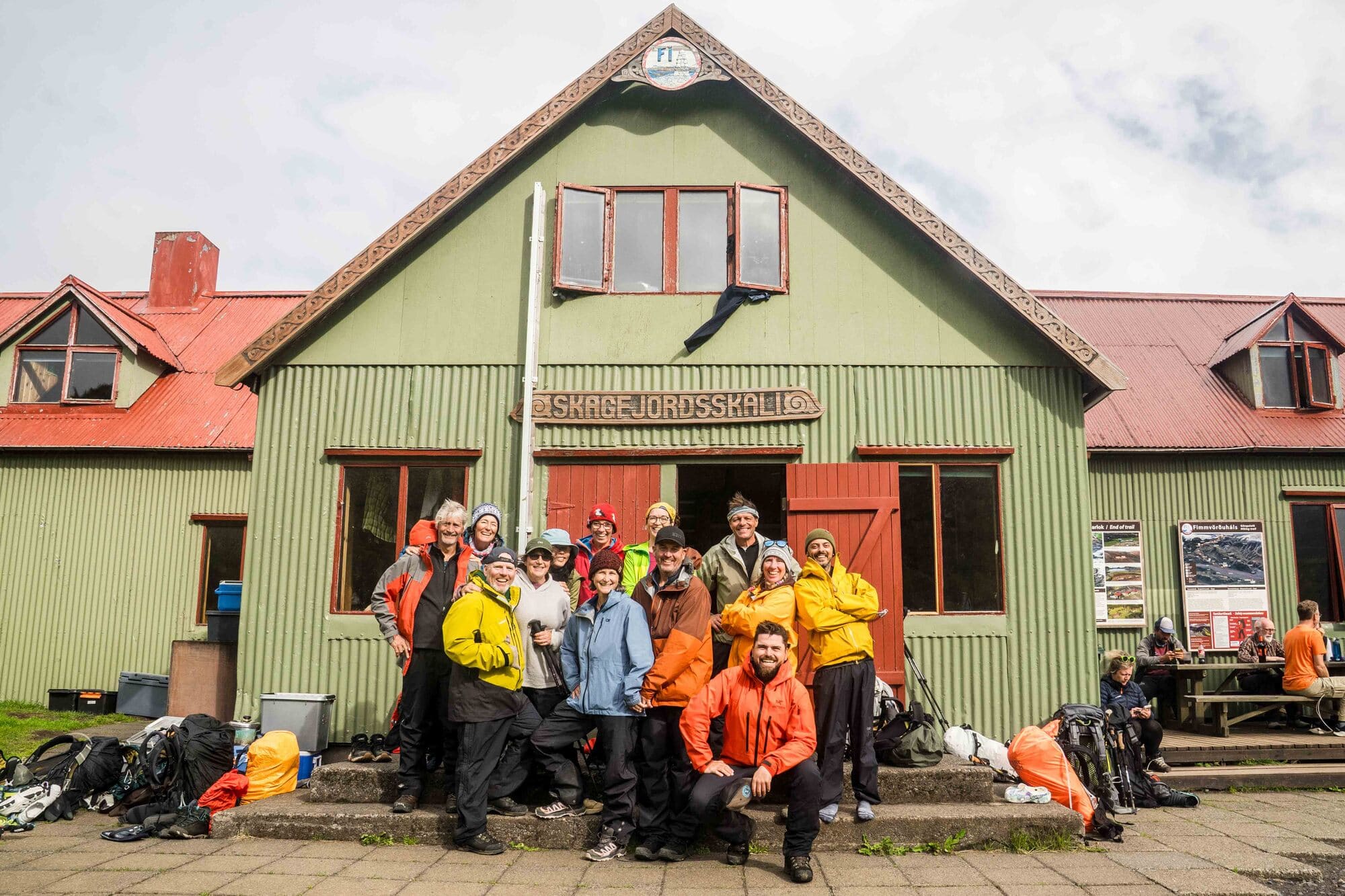
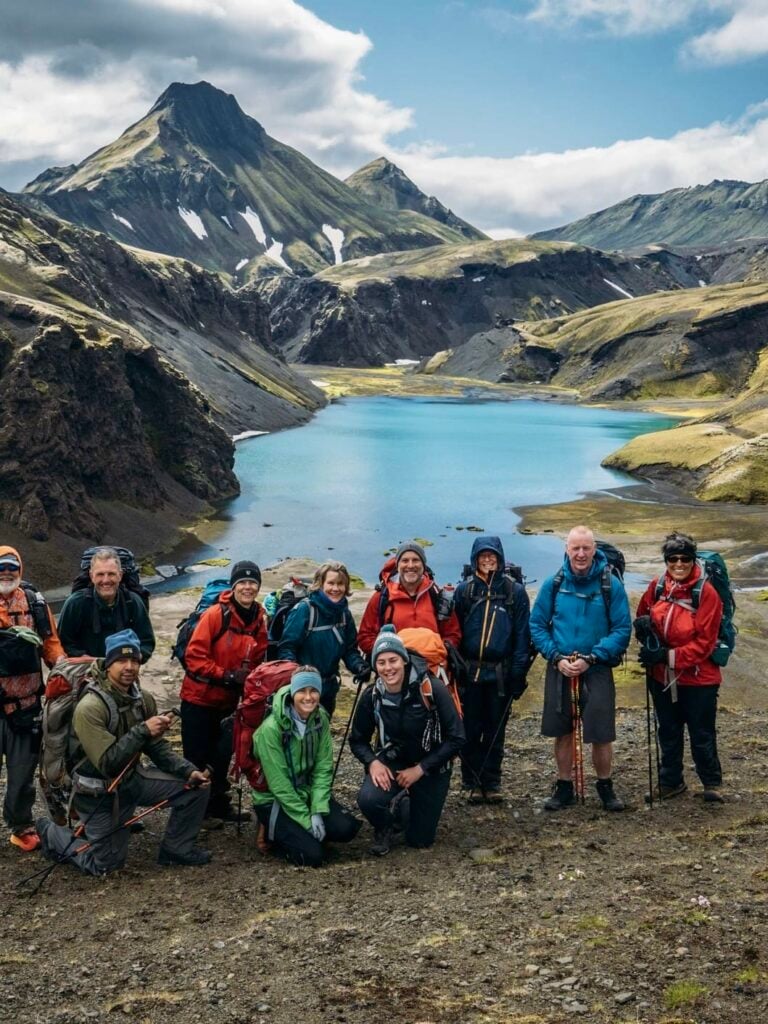
The huts on this route range from large, well-equipped buildings that sleep 60 to 70 people to small remote huts that hold around 16 at most. My groups of 12 or 13 fill nearly every bed in the small ones.
Only one hut on the whole route has geothermal heating. The rest are heated by other means, and they stay genuinely warm even when it is snowing outside. Three of the huts have no showers at all. You get used to it fast. The small huts strip everything back to a kitchen table, a dining bench, and one outdoor toilet, and people tend to love them even more for it.
People sometimes compare our huts to French mountain huts, and I think that is really about the food. Monica and I cook every meal ourselves. A big pot of rice, lentils, or pasta goes around the table, and afterward everyone pitches in on dishes. Nobody is a guest being served. Everybody is part of the group getting the job done.
How to book huts in Iceland
If you are planning your own multi-day route along the Laugavegur or through the highlands, huts book out fast, often the season before, through the Icelandic hiking association that manages them. On a guided Iceland backpacking trip like ours, that entire headache disappears. We reserve every bed along the route months ahead, so you show up and walk.
What is food like in Iceland’s highlands?
People expect freeze-dried meals on a trip like this. A few years back, two clients from Canada told me exactly that before we started. I have run trips in places like Baffin Island, stuck with dehydrated food for 12 days with no resupply, and that experience left me done with that kind of cooking. On this route, I do something different.
What actually ends up on the table
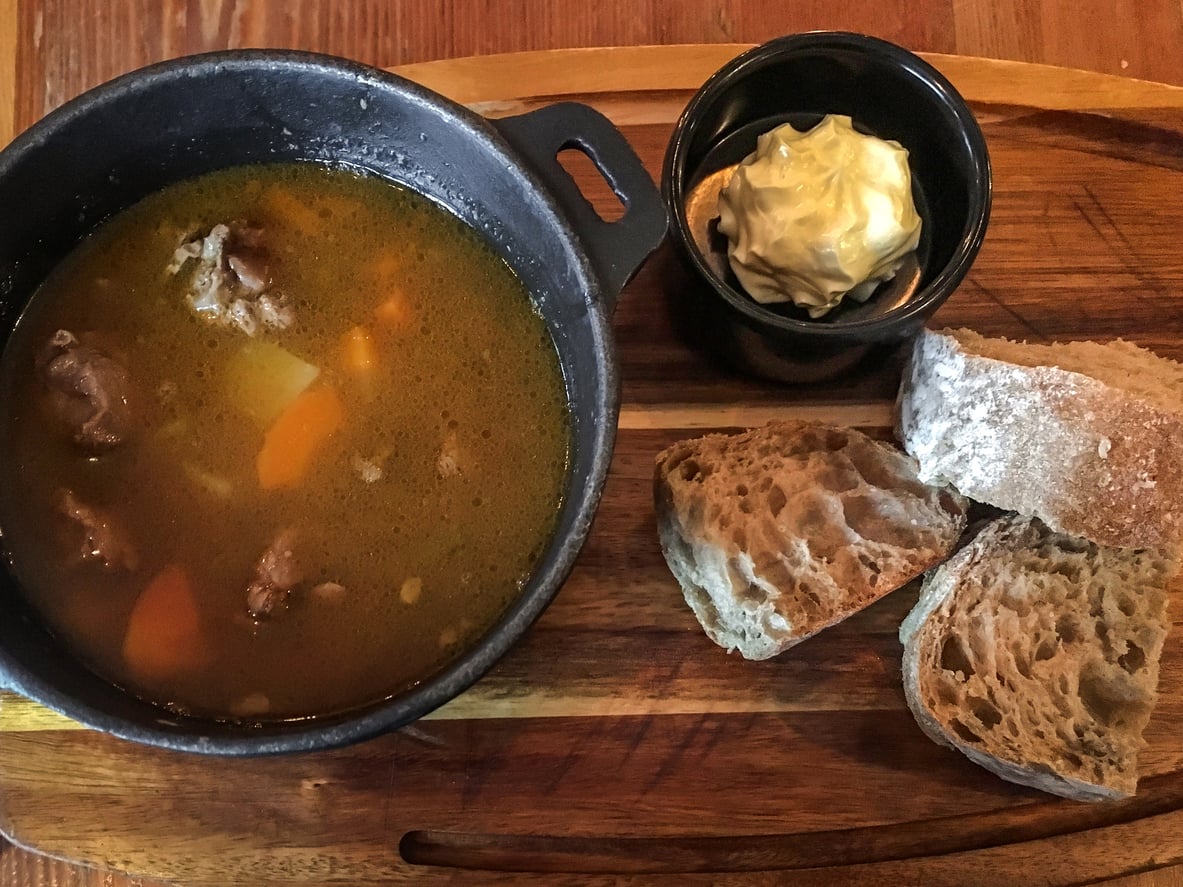
We bring in fresh vegetables and fruit timed so everything still tastes good three days into a hut stay. My favorite dish right now is rice with mushrooms, vegetables, and duck, made from French confit duck cooked in its own fat. On the night I make that, other groups in the same hut are usually eating from a bag, and I always cook extra because someone always asks.
We put real effort into dessert too. Sometimes it is just chocolate if people are wiped out. Other nights it is a mocha mousse with whipped cream, and watching someone who just walked 25 km (15.5 mi) sit down exhausted and then get handed that plate never gets old.
Vegetarian options are always available, though we cannot do vegan given how the meals are built around fresh dairy and meat. Good food matters more on this kind of trip than people expect. It is often the only real comfort left by evening. Let us know your dietary needs ahead of time and we will make it work.
Hot Springs and How to Avoid the Crowds
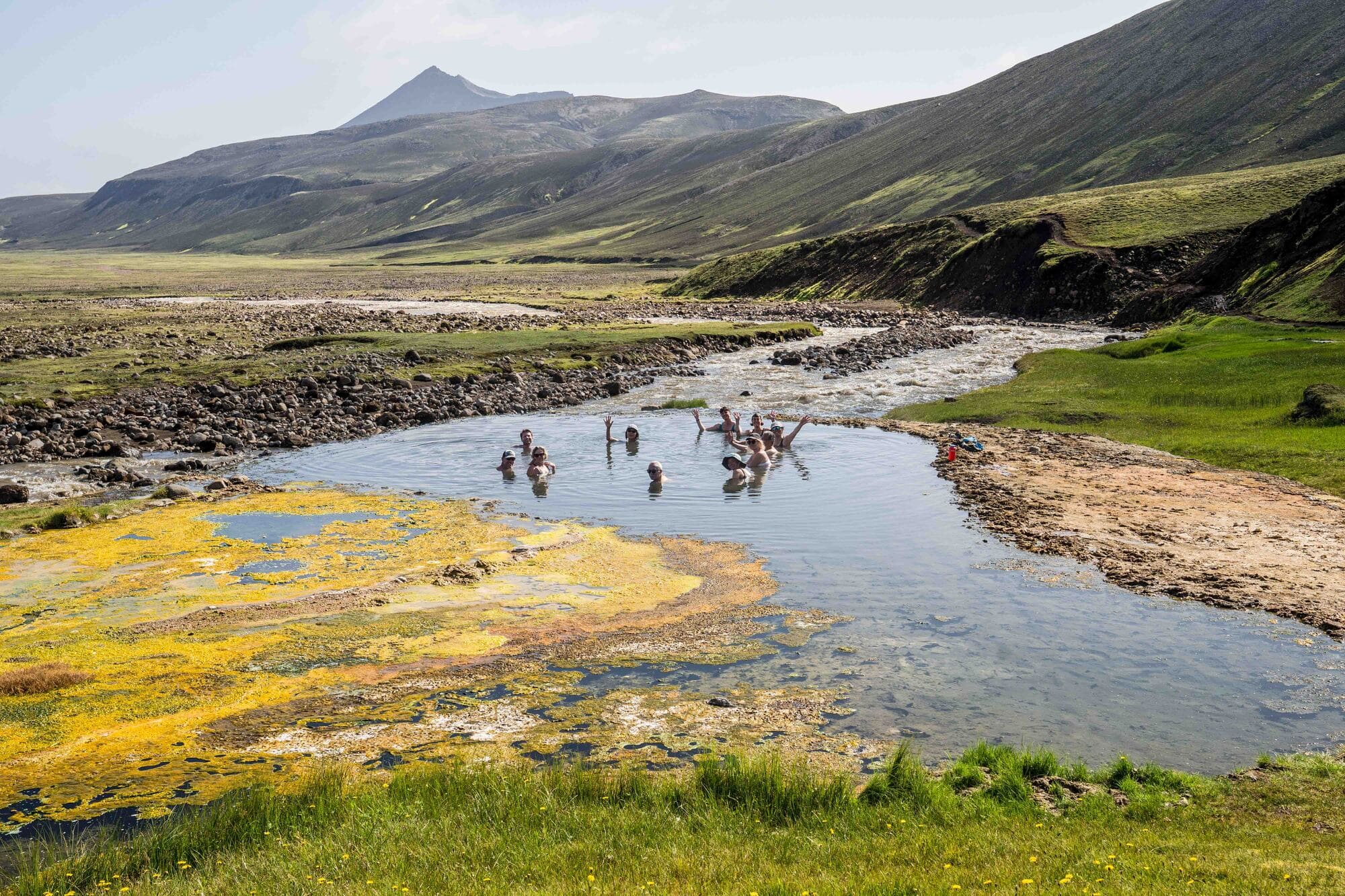
There are two natural hot springs on this route. The first is at Landmannalaugar itself. The second sits near Strútur, about 1.5 to 2 hours from the hut, called Strútslaug. Water runs around 38 to 40°C (100 to 104°F), and if the weather holds, we soak for half an hour before moving on to dinner.
I once visited Landmannalaugar in winter with a group of six or eight, water at 38°C (100°F) and snow all around us at minus 18°C (0°F) outside. It might be the best hot spring experience of my life. In summer, that same pool holds 30 to 40 people at once.
How to avoid the crowds in Iceland
Timing beats everything on an Iceland backpacking trip through a popular region like this one.
Go early, before breakfast, not after dinner when everyone else has the same idea. On day one, once a group has had enough of shared trails, we sometimes take a longer detour, adding a few extra kilometers, to a spot with a view of the Mýrdalsjökull glacier and not another soul around. It runs closer to 24 km (15 mi) instead of 16 km (10 mi) that day, and every single time, it is worth it.
What makes a great Iceland tour guide?
I did not start out wanting to guide. Advertising and photojournalism were what I actually studied, and four months into an advertising job I knew it wasn’t for me. A friend invited me to help run logistics in South Greenland one summer, and that changed everything. I came back knowing I did not want to sit in an office again.
My family has always been outdoorsy, so maybe it was inevitable. One cousin instructs skiing for Red Bull. Distant cousins have filmed expeditions in Antarctica and Patagonia. We all trace it back to my grandfather, who came from Slovenia, a properly outdoorsy country in its own right.
The trip to Nepal that changed things
I met Monica in the field in Iceland in 2018. The next year, we crossed paths in Nepal with a Sherpa guide named Onchu, who pushed us to start something of our own. That is how this whole project began. Iceland guided trekking done properly means knowing the terrain well enough to read it before it turns on you, and knowing when to stop and check a river before anyone steps in.
A guide is never really finished training. There is always a level above the one you are on. What keeps this job exciting after 50-plus trips on the same general route is that it is never really the same trip twice. There is no fixed trail marked on the ground, so some days I take a longer detour because the weather allows it, and other days we go straight to the hut because it does not.
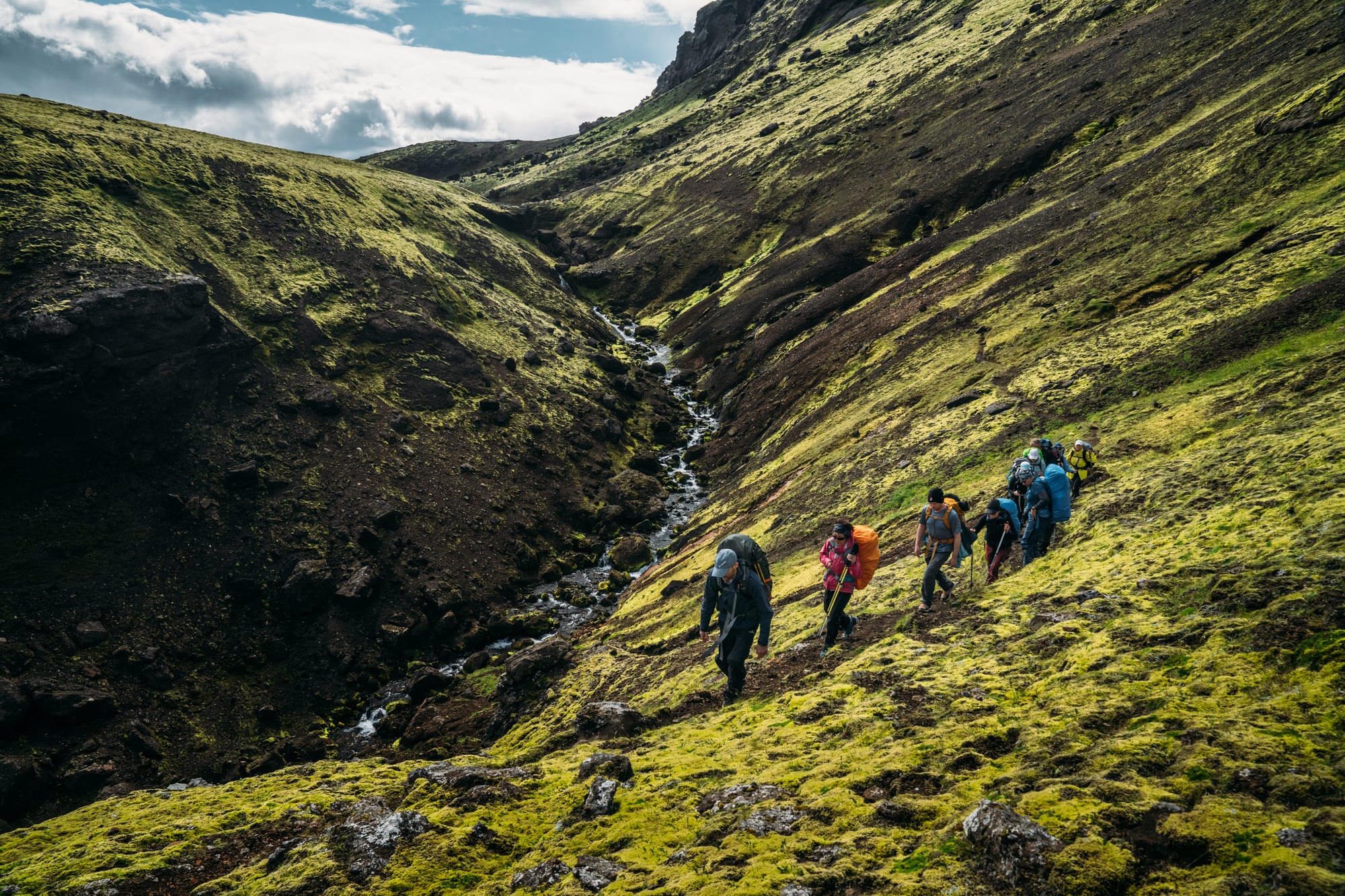
Last year we found two entirely new sections and passed them on to other guides. One of them, a narrow trail along a small river with a waterfall, we now call the Shepherd Trail. Guiding an Iceland backpacking trip for over a decade changes how you see the terrain. You stop looking for the view and start reading the ground.
Fifty Trips, Zero Autopilot
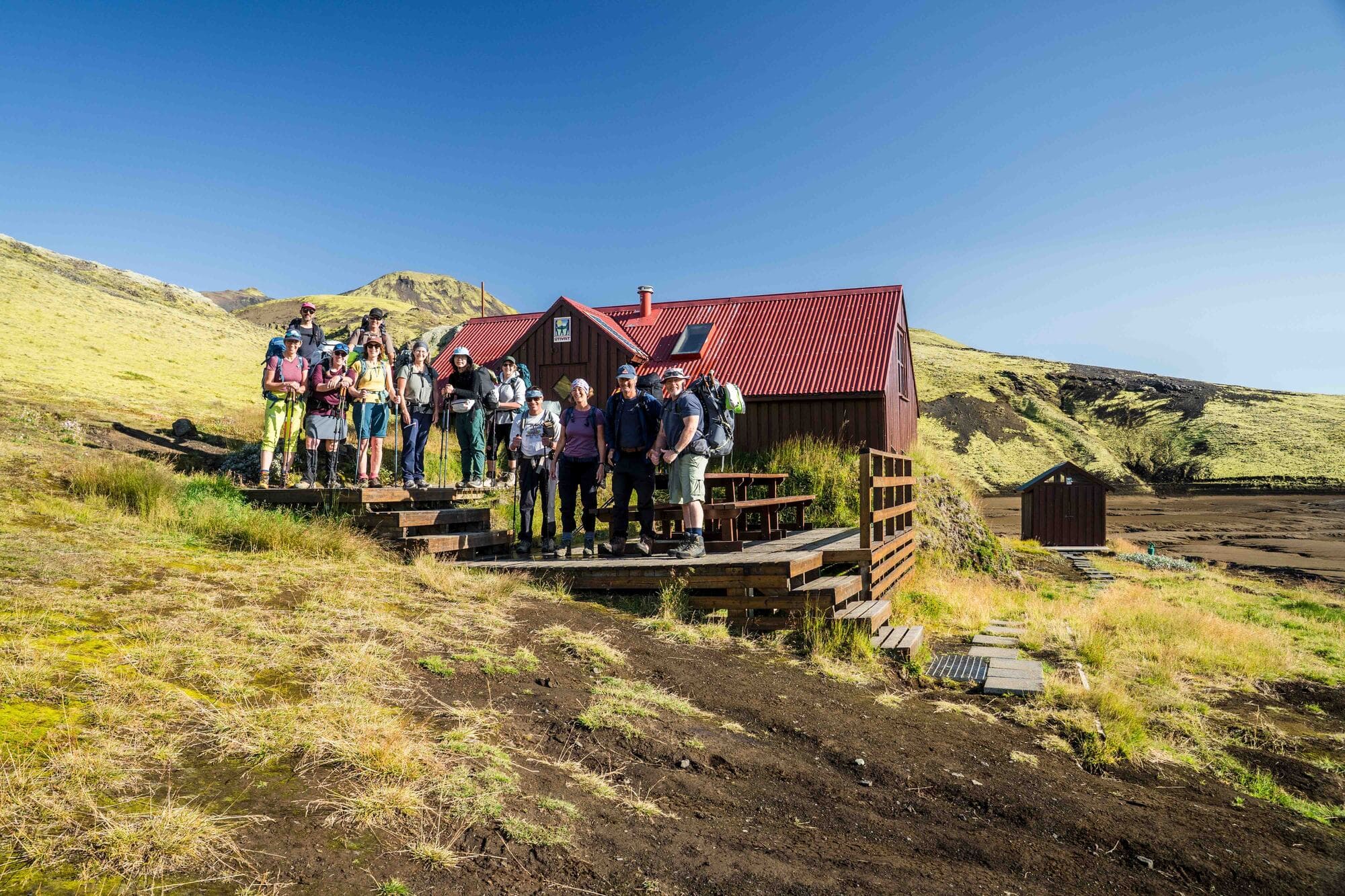
People ask why so few hikers ever reach this part of the country. It has nothing to do with secrecy. It has everything to do with commitment. You need some free time, a loaded pack, and a willingness to be uncomfortable some afternoons so you can be somewhere extraordinary the next morning.
Among the best treks in Iceland, this one asks more of you than most and gives more back for it. On the Laugavegur, you might pass a hundred people in an afternoon. Out here, you might see two people in three days. That is Iceland off the beaten path, not as a marketing phrase, but as a plain description of what the terrain and the distance filter out.
Monica and I have run this Iceland backpacking trip more than 50 times now, and the highlands have never once let us get complacent about it. A river sits differently than it did last August. A storm builds faster than the forecast promised. That is exactly why we take every single group as seriously as we took the first one.
Fifty trips in, I still think this tour is the best way to spend time in Iceland. If you can carry your own pack and handle a few uncomfortable afternoons, the highlands are ready for you.