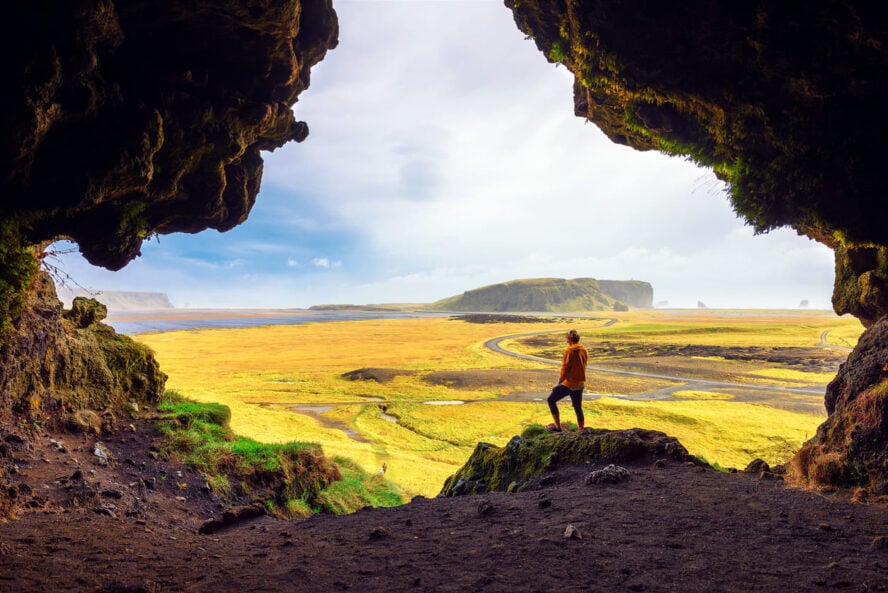
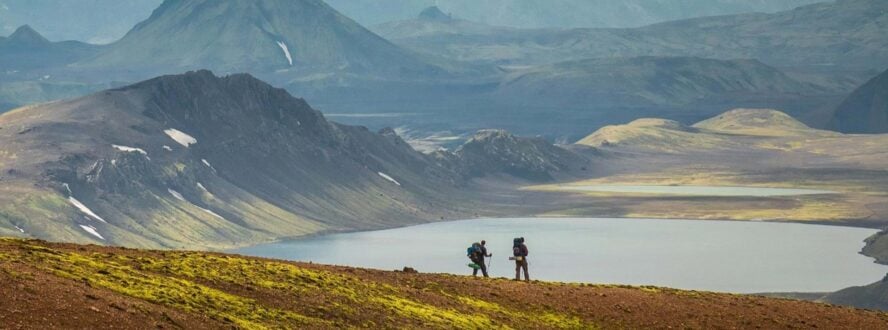
On this trip, at some point, you will stop walking and just stare. Not because you planned to. Because the canyon wall in front of you is shifting from black to deep red, there is obsidian scattered on the ground like spilled glass, and the moss is a shade of green that does not seem physically possible. You will stare, you will take a photo that does not capture it, and then you will keep walking.
I have been guiding the hidden trails Iceland keeps in its highland interior for several years. The route covers over 150 km (over 90 mi) across 12 days, starting at Landmannalaugar and heading in a completely different direction from the famous trail.
Through a volcanic canyon whose 939 AD eruption may have given the Norse people their entire concept of the end of the world. Past a lake not discovered by outsiders until the 19th century. Across terrain so remote you will go days without seeing another hiking group.
My name is Albert, and I’m a mountain and glacier certified guide based in Reykjavik. I will show you everything I know about the version of Iceland most people never reach—the part that does not appear in travel magazines.
Landmannalaugar and the Icelandic Highlands
What are the Icelandic highlands?
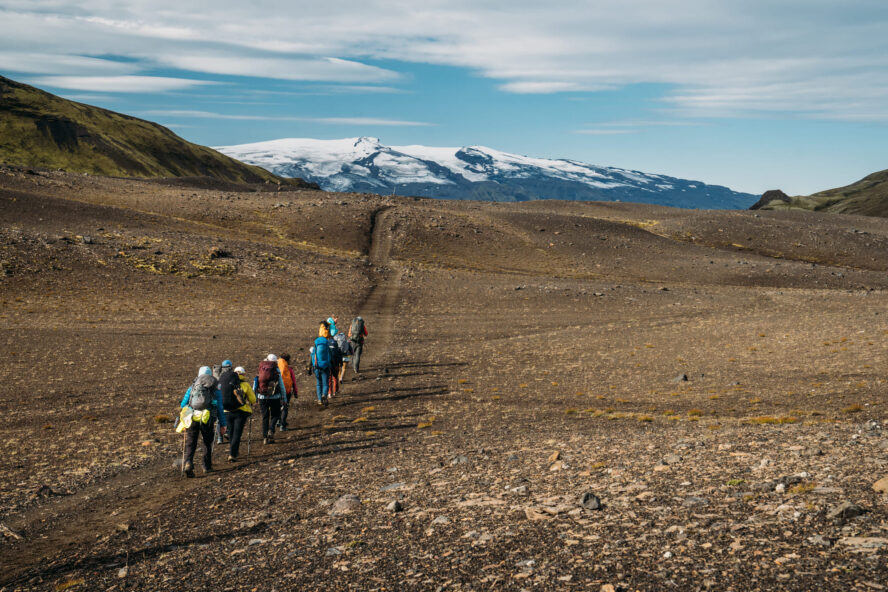
The Icelandic highlands are the uninhabited interior of the island. No towns. No farms. No paved roads. Approximately 50,000 sq km (19,300 sq mi) of volcanic terrain, roughly half the entire surface of Iceland, sitting between several major glaciers with no permanent human settlement.
This is the part of Iceland that does not appear on most travel itineraries. It does not have a famous waterfall or a well-marked road.
What it has is scale, silence, and a geological character so extreme it regularly makes people stop mid-stride and just look. I have guided in Greenland, Nepal, and South America. The hidden trails Iceland’s highlands contain are among the most surreal terrain I have been on anywhere.
Where are the highlands in Iceland?
The highlands occupy Iceland’s central interior, framed by the glaciers Langjökull to the northwest, Hofsjökull in the center, and Mýrdalsjökull and Vatnajökull to the south and east.
Most visitors who reach the highlands at all know the southern edge of this region, where Landmannalaugar and the Laugavegur Trail sit. The interior extends far beyond that, into terrain so remote that parts of it were not discovered by outsiders until the 19th century.
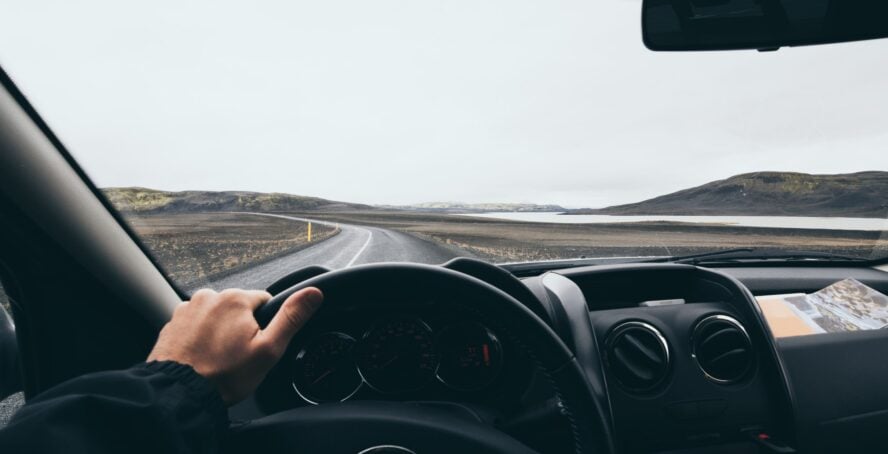
Getting there requires a modified 4×4 with 44-inch tires capable of crossing glacial rivers deep enough to flow over the hood. That is not dramatic phrasing. That is the vehicle we actually use.
The Laugavegur Trail and the Route Beyond It
What is the Laugavegur Trail?
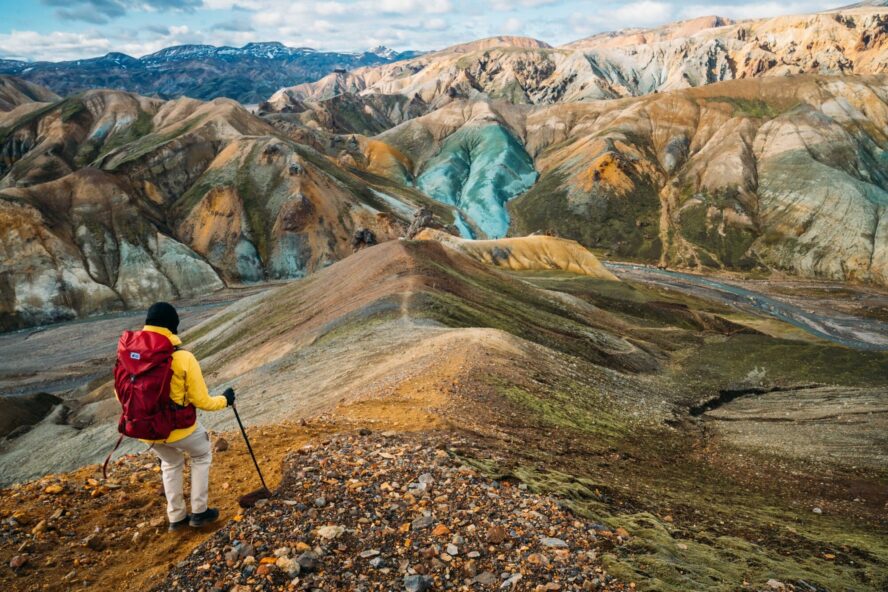
The Laugavegur Trail is Iceland’s most celebrated multi-day hike, running 55 km (34 mi) from Landmannalaugar south to Thórsmörk. It crosses rhyolite mountains, geothermal fields, black sand deserts, and glacial river valleys.
National Geographic named it one of the world’s greatest hikes, and that is a fair description. If you have not done it, it belongs on your list.
The hidden trails Iceland offers beyond the Laugavegur are not a replacement for it. They are what runs alongside and north of it, into terrain the famous trail never reaches.
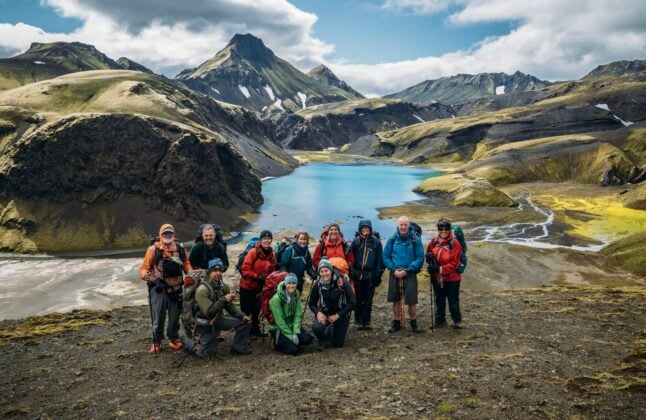
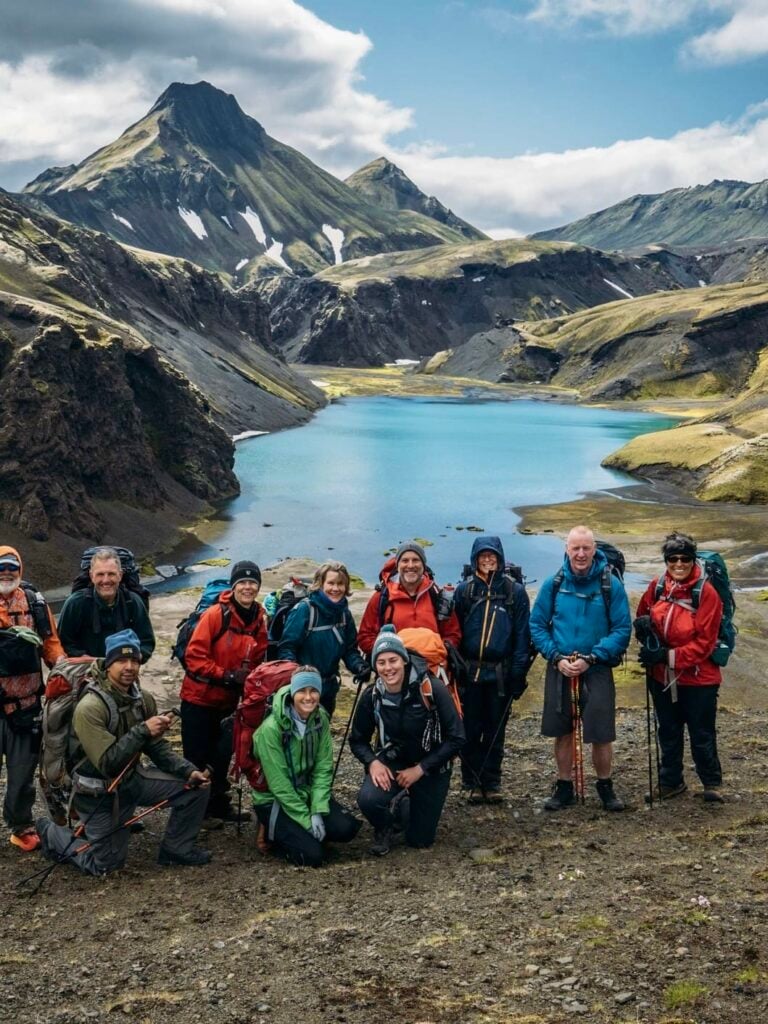
The route covers over 150 km (over 90 mi) across 12 days: two nights in Reykjavik and ten days on the hidden trails Iceland’s interior holds. We move between 6 km (3.7 mi) and 25 km (15.5 mi) per day, six to eight hours of walking. Groups never exceed 12 people because these are not places that benefit from crowds.
What You Will Actually See Out There
The rhyolite mountains and the Back of the Dragon
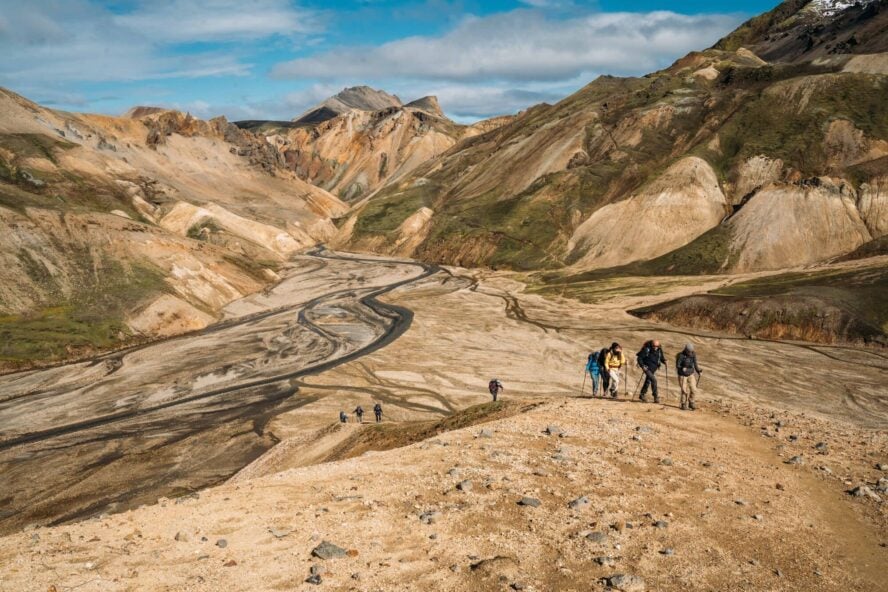
We spend two full nights based at Landmannalaugar before moving into the deeper highlands. That gives us time to explore the area more thoroughly than any passing group on the Laugavegur does.
On the opposite side of the valley from the famous trail sits a ridge of rhyolite so saturated with orange and red that it looks artificial from a distance. Some groups call it the Back of the Dragon. Almost no visitor to Landmannalaugar ever finds it.
We spend a morning up there. The views back down to the valley are completely different from anything on the marked trail. By the time we leave, people have usually already recalibrated their expectations for what the rest of the week is going to look like.
We start among volcanic craters filled with turquoise water, and the landscape changes so fast that 30 minutes into the walk you already feel like you have crossed into a different planet.
Langisjór lake and the best view in Iceland
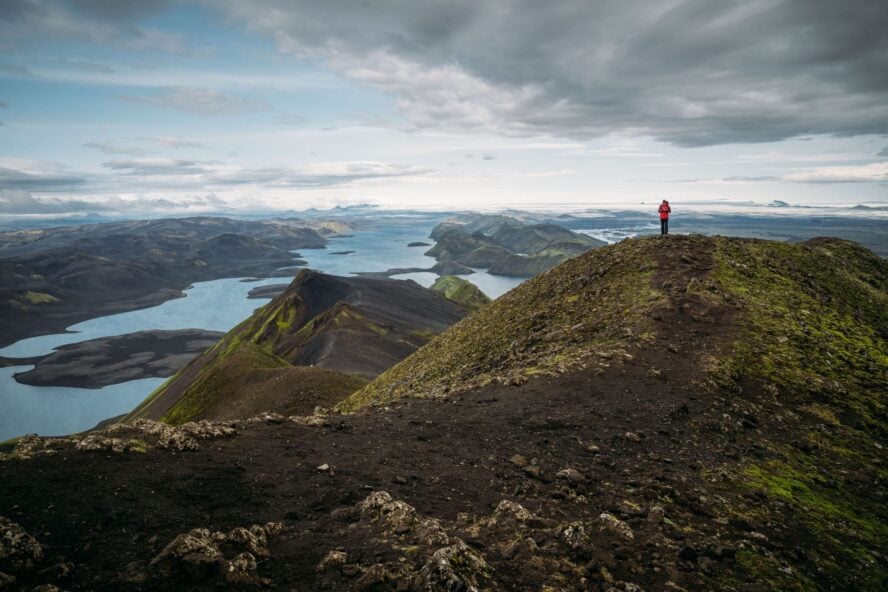
From Landmannalaugar, we push into the Fögrufjöll mountains, the beautiful mountains, and descend to the shores of Langisjór, one of Iceland’s longest lakes. It was not discovered by outsiders until the 19th century. We walk its shores in near-complete solitude, and the water color is the kind of turquoise that makes you check whether your eyes are working correctly.
The views from Sveinstindur peak above the lake are the best I know in Iceland. From the summit you see the lake below, three glaciers in the distance, and the volcanic ridges you have already crossed behind you.
On every trip, without exception, someone in the group goes quiet on that summit. I wait for that moment every single time.
The peak is named after Sveinn, the first geologist who came here to document this landscape. Standing where he stood, looking at the same lake he looked at, knowing almost nobody else had been up there in between, is the kind of thing that stays with you long after your legs have recovered.
The shepherd hut and the petrified trolls
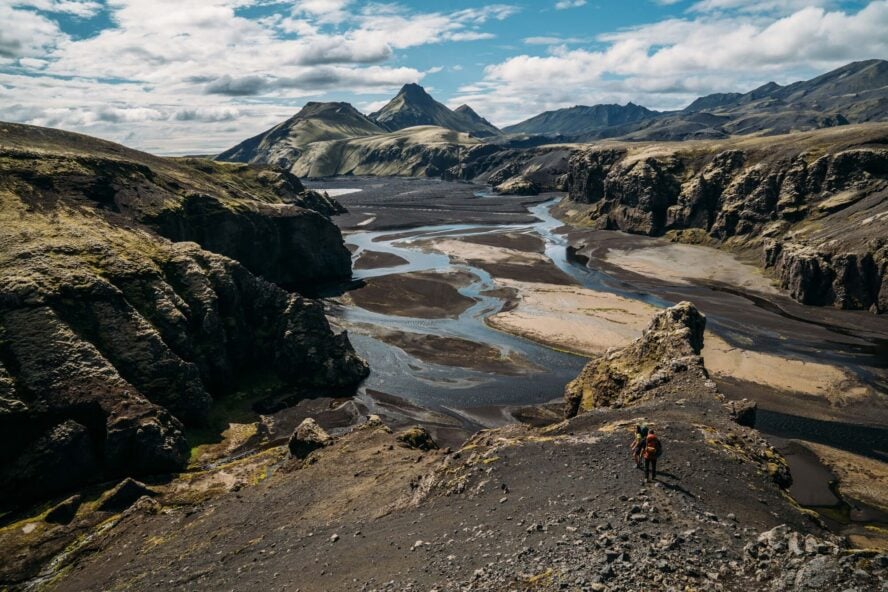
The approach to Eldgjá passes a cluster of lava formations that Icelandic mythology calls petrified trolls: enormous twisted pillars of rock standing at the entrance to the next valley, caught by dawn before they could get away.
The hut nearby is one of my favorites in all of Iceland. Shepherds used to sleep there with their horses in winter. It has been rebuilt with a proper kitchen and mattresses upstairs, but walking through the door still carries a particular weight that newer huts simply do not have.
Eldgjá: the canyon that inspired the end of the world
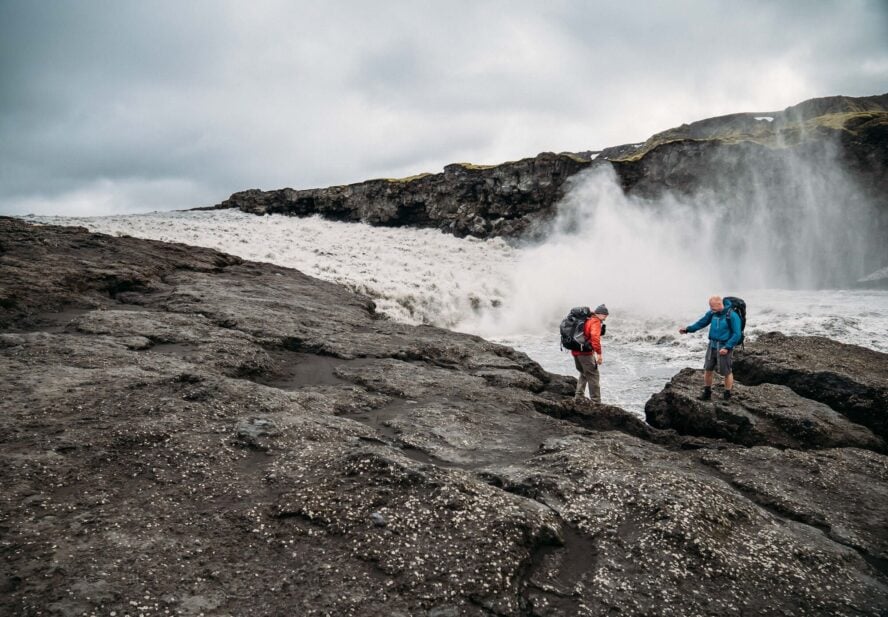
The canyon called Eldgjá, which translates as the fire gorge, is the centrepiece of the hidden trails Iceland routes we run. It is the largest volcanic canyon on the planet, formed by a fissure eruption in 939 AD so catastrophic that it caused crop failures across the Northern Hemisphere. Historians now believe this eruption gave the Norse people their vision of Ragnarok, the end of the world.
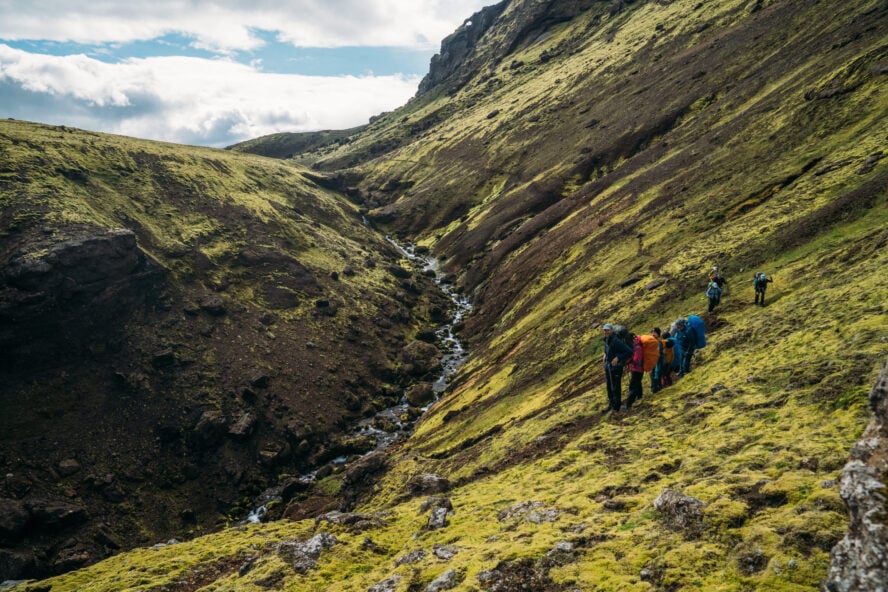
We hike through it for a full day. The walls shift from brown to green to deep red as you go deeper. In the center, a waterfall called Ófærufoss drops into the gorge and brings enough moisture to grow moss on the black rock walls. Life restarting inside a catastrophe.
What surprises people most is the scale. You can see the fissure running ahead and behind you simultaneously, and neither end is visible. You are inside something planetary. The ground beneath your feet was molten more than a thousand years ago.
In geological terms, that is this morning. Volcano hiking in Iceland gets discussed in general terms in most travel content. Standing on the floor of Eldgjá, it becomes very specific.
The Ragnarok Fires and a thermal pool that is not on the map
After Eldgjá, the Iceland highlands trek continues north along the volcanic fissure. The crack is still visible in the ground for almost the entire day.
Alongside it, the terrain combines elements that have no business being next to each other: red-tinted earth, obsidian on the surface like spilled glass, and moss in a green so bright it photographs as artificial. We call this the Ragnarok Fires. It is the most accurate name we have.
On most days, we stop at a natural geothermal pool that sits close to a cold glacial river. No signs point to it. It does not appear on most maps. You can move between the hot water and the cold river for as long as you want. Nobody else is ever there.
We have run these trips of hidden trails in Iceland for several seasons and have never arrived to find another group at that pool.
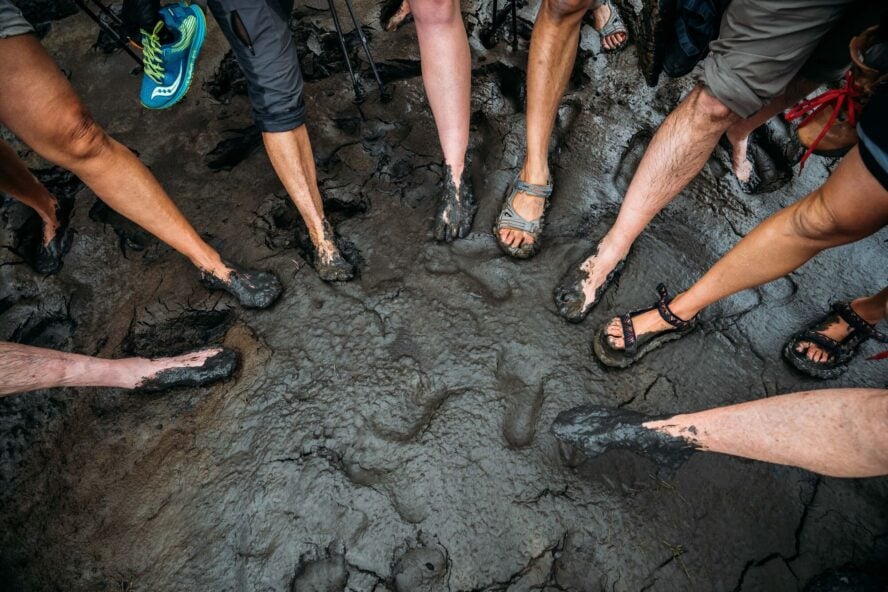
Iceland has more than 600 species of moss and during this day you will believe every single one of them is represented somewhere on the slope in front of you. And somewhere in this same section, there is also the mud.
Not a river crossing, not a canyon scramble, just pure deep highland mud that grabs your boots and holds on. I always tell people it is the best free foot treatment they will ever get.
The black desert and Thórsmörk
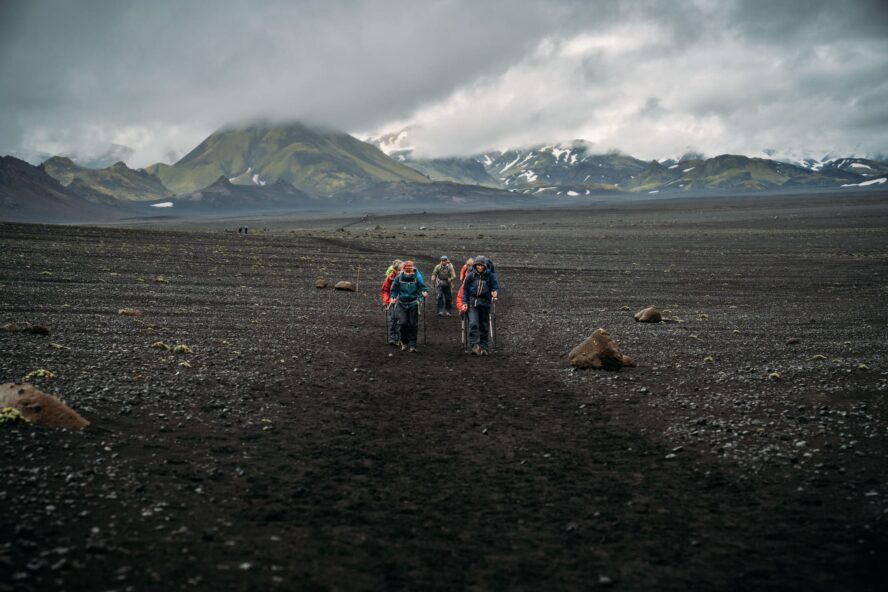
The final stretch of the route brings us to Álftavatn, the Swan’s Lake, and then into the black desert. Pink wildflowers grow out of the black sand. Glacial rivers braid across the plain. After everything you have already crossed, the contrast is genuinely arresting.
From the desert we join the final stages of the classic trekking Laugavegur trail, through ancient birch forest and beneath hanging glaciers, ending in Thórsmörk, the valley of Thor.
We finish with a barbecue using local lamb, salmon, and vegetables. It is a good way to end twelve days on the Iceland hut to hut hiking route.
What Are Some Hidden Gems in Iceland?
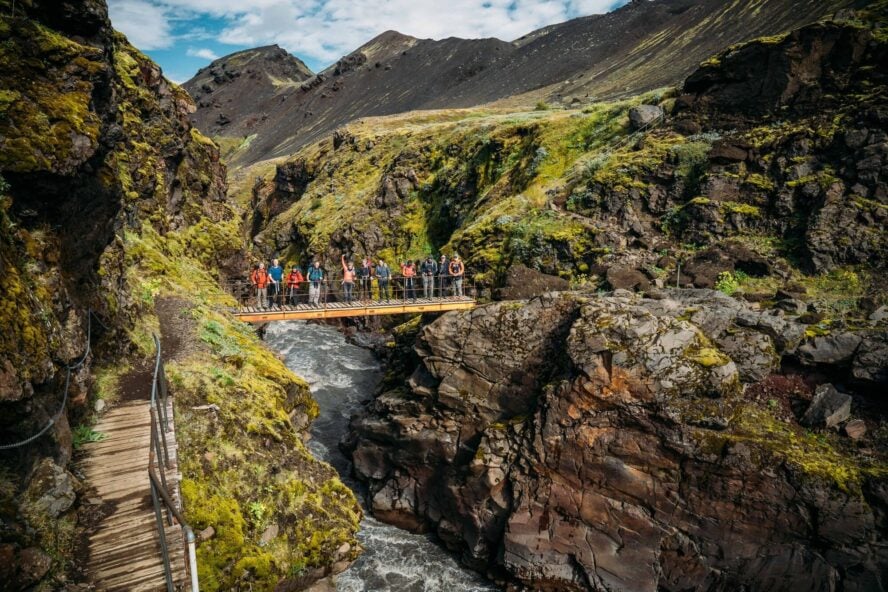
The most honest answer is that the entire Iceland multi-day hike route qualifies. Eldgjá, Langisjór, the Back of the Dragon, the Ragnarok Fires: all seriously undervisited relative to how extraordinary they are.
But the specific hidden gems in Iceland that almost no visitor ever encounters are these: the natural geothermal pool near the Ragnarok Fires with no name on most maps; the Back of the Dragon ridge visible from the Landmannalaugar hut but unknown to most guests staying there; and the old shepherd huts we sleep in on the remote sections, some barely changed since the livestock were moved out.
These places stay quiet for a practical reason. Reaching them requires a modified 4×4, intimate knowledge of the terrain, and a twelve-day commitment. That combination keeps the numbers low.
The people who make it through that filter tend to appreciate exactly what they find.
Is This Trip Right for You?
How difficult is hiking in Iceland?
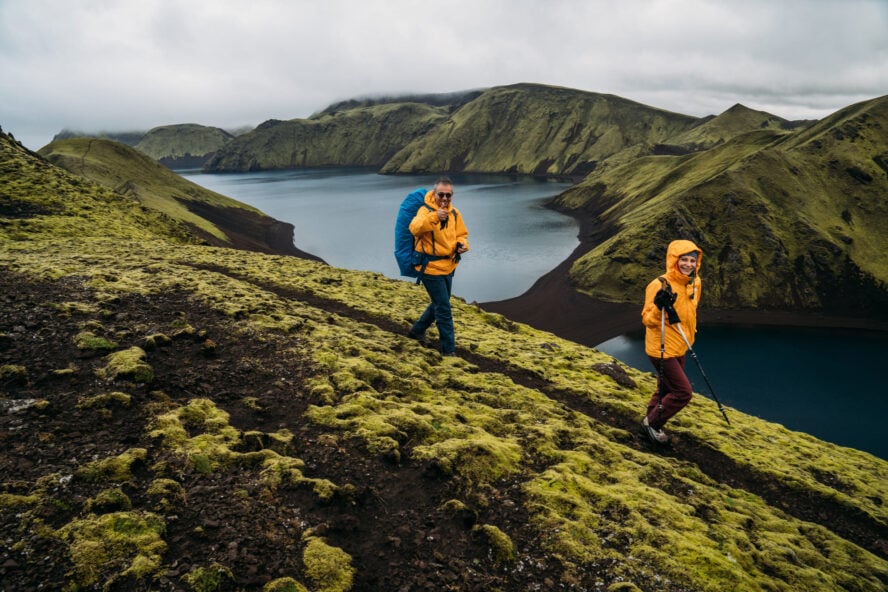
Hiking in Iceland is less technical than most people expect, but more demanding than most trips they have done before.
The hidden trails of Iceland route has no summit climbs or technical terrain. What it has is distance and consecutive days: up to 25 km (15.5 mi) per day on unmarked ground for ten hiking days in a row.
River crossings happen daily. The water comes off the glaciers and is genuinely cold. Closed-toe sandals matter because some riverbeds have sharp stones, and going barefoot is not advisable even when it seems manageable. Trekking poles help with balance in the crossings.
You do not need to be an extreme hiker. You just need to feel comfortable carrying a fully-loaded backpack in mountain conditions. If you hike regularly and recover well after long outdoor days, you will handle this well.
When can you hike the Icelandic highlands?
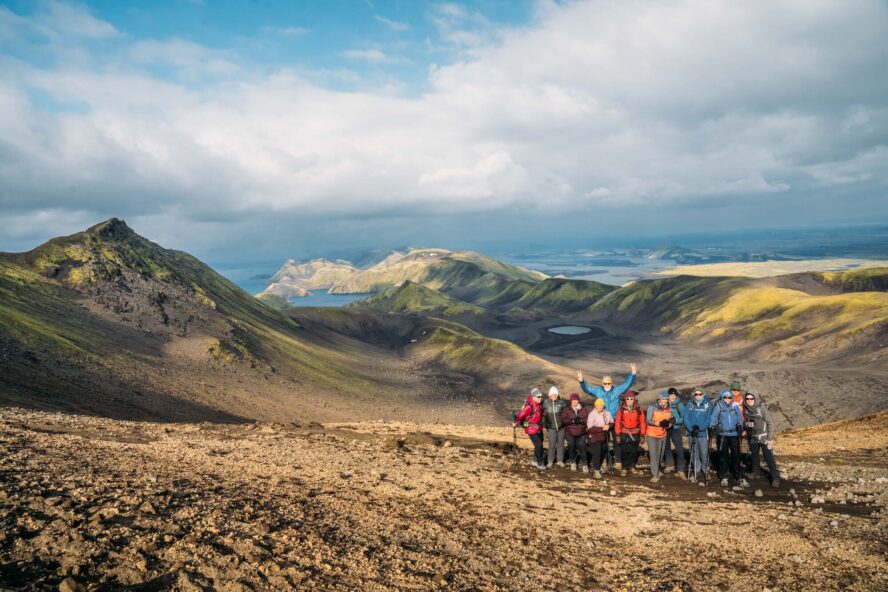
The highland roads open in late June and close in September, sometimes into early October. We run departures in July, August, and September.
July is wild and freshly thawed. August offers the most stable conditions. September brings quieter terrain and sharper light, and in some years we coincide with the sheep gathering, when farmers ride out across the highlands on horseback and by motorbike to collect the animals that have been roaming free all summer.
When that happens, it becomes something people talk about as much as the landscapes.
The weather in the highlands operates differently from the rest of Iceland. Sitting between several glaciers, the micro-climate can produce sun, rain, wind, and sleet in the same afternoon.
Every guide carries a satellite radio. If a section is genuinely impassable, we transfer by vehicle to the next hut. In all the seasons we have run this route, we have always found a way to keep hiking.
Huts, Food, and What to Pack
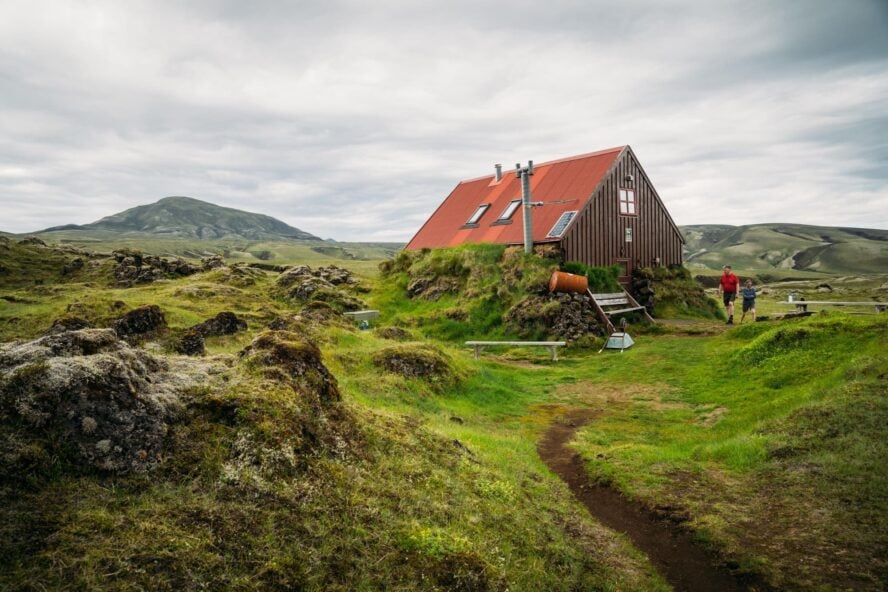
The mountain huts range from large and well-equipped with running water and showers to small and remote where you draw water from a nearby stream.
You do not need an extreme sleeping bag. The huts are heated and genuinely warm. Even in early July, when snow is still possible at elevation, the hut interiors stay warm. The cold is for outside, and outside is where all the good things are.
Monica and I handle all the food. Our support vehicle pre-loads food boxes before we enter the highlands: everything for breakfast and dinner, with fresh produce resupplied mid-trip.
I take cooking seriously and nobody goes hungry. There are always vegetarian (but not vegan) options. Let us know your dietary needs in advance and we will find a way to adapt.
For gear: waterproof jacket, waterproof trousers, warm mid-layer. This applies even in August. A backpack of 45 liters is enough.
Closed-toe sandals for river crossings. Trekking poles. A refillable water bottle: the glacial rivers along this route are clean enough to drink from directly, which still surprises people every trip.
And don’t bring a novel, you are not going to read it. You’ll be talking and laughing with the group every evening, going over the day, making plans for the next one, and before you know it, the hut is dark and everyone is already asleep.
One day in Reykjavik before the trail
Most people fly into Reykjavik a day or two before the trip starts. My advice: skip the tourist pools and find the nearest public swimming pool.
Not the Blue Lagoon. The local one, where old men argue about football in the hot pot and nobody is there for a photo. I go every evening after work. It will tell you more about Iceland than any guided city tour.
The Land That Outlaws Walked
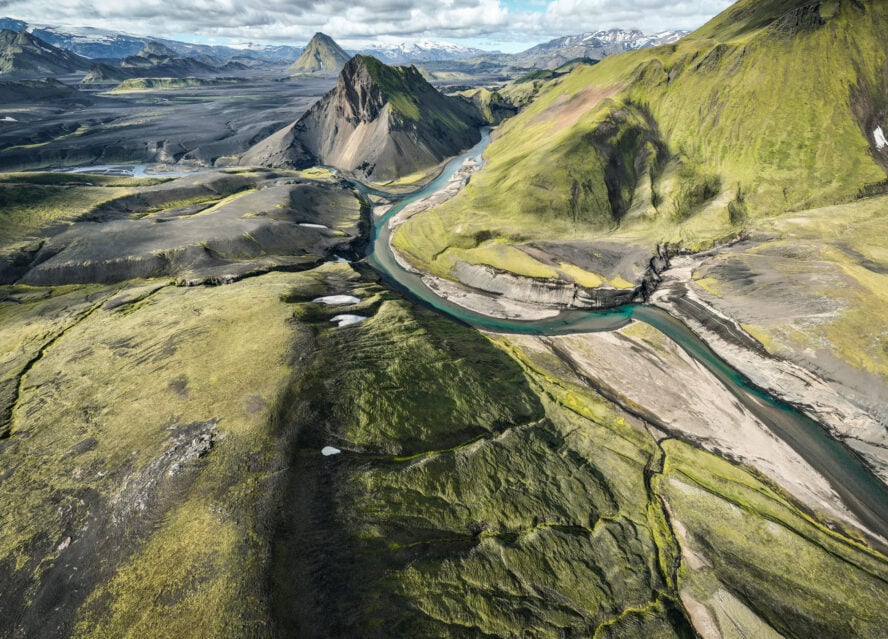
People ask me why so few hikers ever reach these places. The honest answer has nothing to do with secrecy.
For centuries, the Icelandic highland interior was where society sent the people it could not contain. The outlaws, the exiles, the ones who had broken the law at the Althingi and were banished into the wilderness with nothing but what they could carry.
They crossed these same lava fields. They sheltered in these same valleys. They navigated without markers across terrain that was, for most of recorded Icelandic history, the edge of the known world.
These routes are not a recent discovery. They are simply routes that very few people have had reason to walk since the outlaws stopped walking them. We found them because we were curious enough to go looking.
The geology has not changed. The solitude has not changed. The scale of standing between two glaciers on unmarked ground with nobody else visible in any direction has not changed.
Twelve days on the hidden trails Iceland keeps in its highland interior. Not a trail, but a landscape. Not an itinerary, but a version of Iceland that has existed for a very long time and is still, for reasons that have everything to do with access and commitment, waiting for the right people to find it.
We have been going back every season. The highlands give us something new each time.
Come find out what Iceland looks like when you go past the last trail marker.