
The first time I told my clients to swim toward the sharks, they looked at me like I had completely lost my mind. I told them: in the Galapagos, the sharks are exactly the reason you get in.
Born in La Esperanza, a small town in northern Ecuador ringed by crater lakes, I have spent thirteen years guiding people through Galapagos Islands wildlife and the rest of this extraordinary country. My career started as a naturalist in the Amazon, took me to the Galapagos for three years, and has been anchored in Quito ever since.
Last month I took my own two kids to the islands, and I still cannot get enough of it. After so many years, I have stopped trying to explain that and started just showing people instead.
Ecuador is the most biodiverse country on Earth per square kilometer. Four distinct natural regions, more recorded species per unit of land than anywhere else on the planet, and a geography that somehow manages to contain active volcanoes, Amazonian rainforest, high Andean peaks, and one of the most extraordinary island systems in the world.
This piece covers the three regions I focus on: the Galapagos Islands, the Ecuadorian Andes, and the Amazon. Put them together and I would say there is no comparable destination anywhere on Earth.
Where Is Galapagos Island
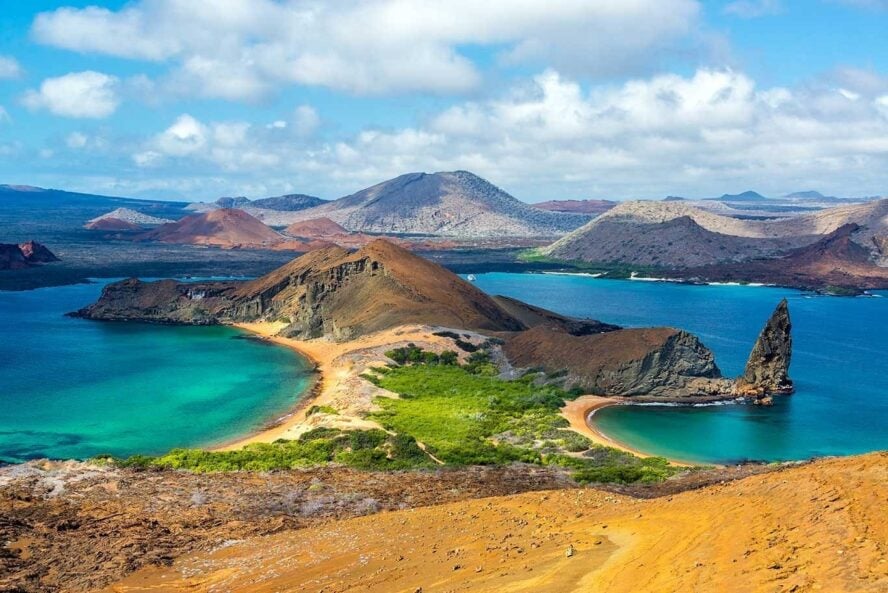
First things first: the Galapagos Islands are not a single island but an entire archipelago of 13 major islands sitting in the Pacific Ocean, approximately 966 km (600 mi) off the coast of mainland Ecuador.
That distinction matters, because each island is genuinely different from the last. Their position at the convergence of three major tectonic plates is the geological reason they exist at all, and the ecological reason Galapagos islands wildlife is unlike that found anywhere else on Earth. As an Ecuadorian territory, the islands are only reachable from the mainland by flight.
There are 13 major islands in the Galapagos, along with dozens of smaller rocks and islets. Four have permanent populations: San Cristobal, Santa Cruz, Isabela, and Fernandina. Of these, San Cristobal, Santa Cruz, and Isabela are the three we use as bases for island-based trips, each with a distinct character and its own concentration of wildlife.
Galapagos Islands Wildlife: What Makes This Place Unlike Anywhere Else
I have guided in a lot of environments, and nothing quite prepares you for how Galapagos Islands wildlife behaves. The animals here simply do not register humans as a threat, not in a conditioned way, not because they are used to tour groups. They just genuinely do not care that you are there.
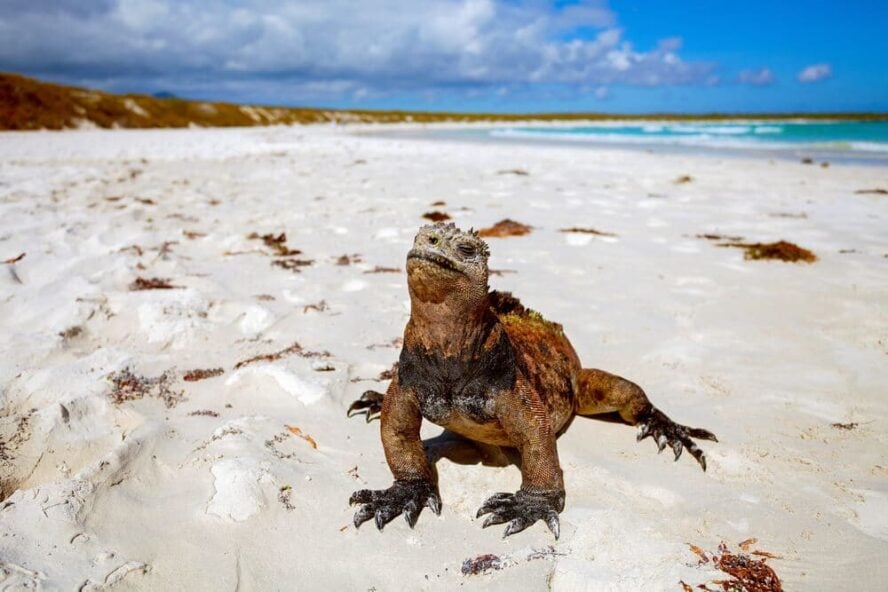
A sea lion will rest against your leg on the beach. A marine iguana will swim directly past your face mask. A blue-footed booby will land within arm’s reach and stare back at you with complete indifference. Every step you take in the Galapagos, there is something new to discover.
What wildlife is on the Galapagos Islands
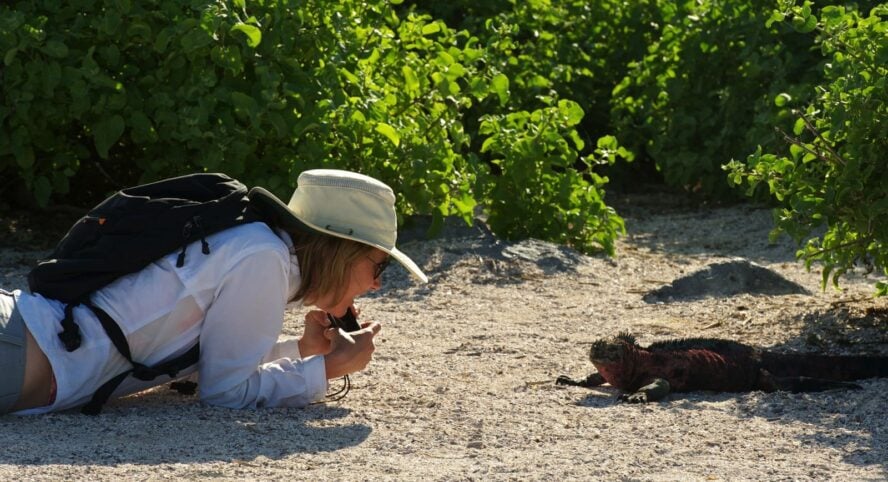
The Galapagos Islands wildlife includes dozens of endemic species found nowhere else on Earth. On land, you will encounter giant tortoises, marine iguanas, land iguanas, Galapagos sea lions, blue-footed boobies, red-footed boobies, magnificent frigatebirds, Galapagos penguins, Galapagos hawks, and Darwin’s finches.
Underwater, the list expands to hammerhead sharks, white-tip reef sharks, Galapagos sharks, green Pacific turtles, manta rays, seahorses, and hundreds of fish species unique to these waters.
What makes all of this extraordinary is not just the list but the proximity. You are not watching from a boardwalk or through a car window. You are in it, at the same level as the animals, and they are not moving away.
San Cristobal: Where sea lions run the streets
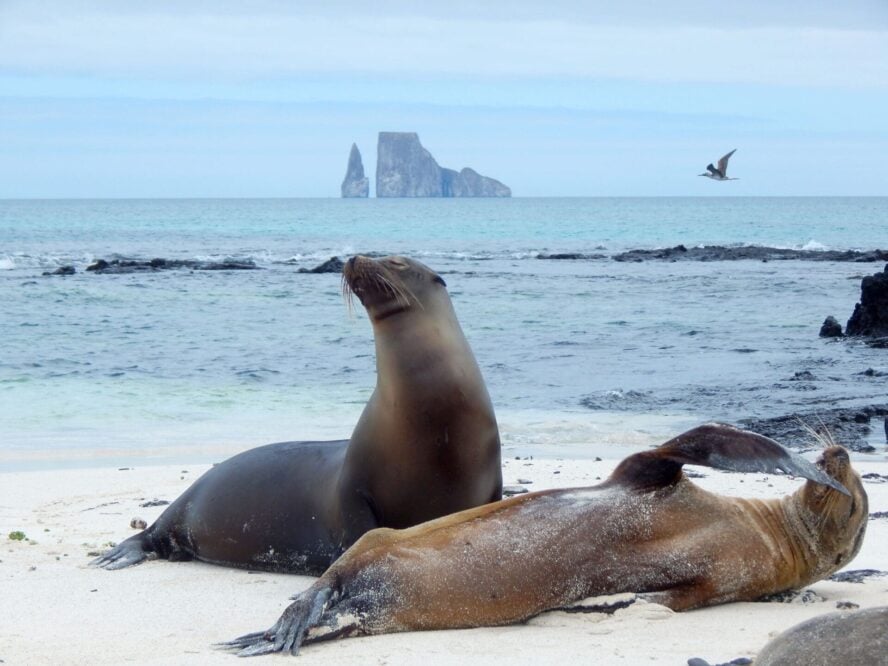
San Cristobal is the capital of the Galapagos and the island where I introduce most clients to the experience. Five minutes outside the main town, you reach La Loberia, a sea lion nursery on a beach that looks completely untouched. Lobo is the local word for sea lion, translating literally to wolf, and when you see how they occupy the beach chairs, the docks, and practically every flat surface in the harbor, you understand the name.

National park regulations require visitors to stay at least 2 m (6 ft) from the animals. The animals have a different interpretation of that rule.
La Loberia is also one of the best spots for Galapagos snorkeling directly from shore. You walk in from the beach and within minutes you are watching green Pacific turtles moving through the water beneath you. I have done this dozens of times and I never stop finding it remarkable.
Kicker Rock: Getting in the water with hammerheads
About 25 minutes by boat from San Cristobal, two dramatic lava pillars rise out of the Pacific. This is Kicker Rock, one of the five best snorkeling and Galapagos diving sites in the entire archipelago. Boats are capped at 12 passengers, which keeps the site intimate and the experience unhurried.
The Galapagos Islands wildlife at Kicker Rock includes hammerhead sharks, reef sharks, rays, turtles, and a dense concentration of fish species sheltering in the submerged lava formations.
The sharks here are not a threat to swimmers. They are the encounter you came for. Hammerheads at Kicker Rock move through the water below you on almost every dive, and the rule I give every group is the same: swim toward them, not away.
Galapagos Island Hopping: Three Islands, One Journey
How to get from Ecuador to Galapagos
The only way to reach the Galapagos from mainland Ecuador is by plane. Flights operate from both Quito and Guayaquil, with a journey time of around two hours. The islands have two main airports: one on San Cristobal and one on Baltra, adjacent to Santa Cruz.
Between islands, you move by boat, a crossing of three to four hours per leg, or by small inter-island aircrafts that cut travel time significantly and leave more of the day open for activities.
There is a Galapagos National Park entrance fee of $100 USD payable on arrival, and your bags are screened for biological materials that could introduce invasive species to the islands.
The combination I recommend most often is flying into San Cristobal, taking a small plane across to Isabela, and finishing on Santa Cruz before flying back to the mainland. Each island is genuinely different from the last, and doing Galapagos Island hopping this way means you are moving between ecosystems, not just between hotels, and encountering distinct Galapagos Islands wildlife concentrations at every stop.
What to do on Isabela Island on Galapagos
Isabela Island, Galapagos is, in my opinion, the most beautiful and most remote of the three main islands. About 2,000 people live here, the streets are not all paved, and the internet rarely works. I genuinely consider that a feature, not a flaw. I always tell clients the same thing when we arrive: you came to the Galapagos to be away from all of that.
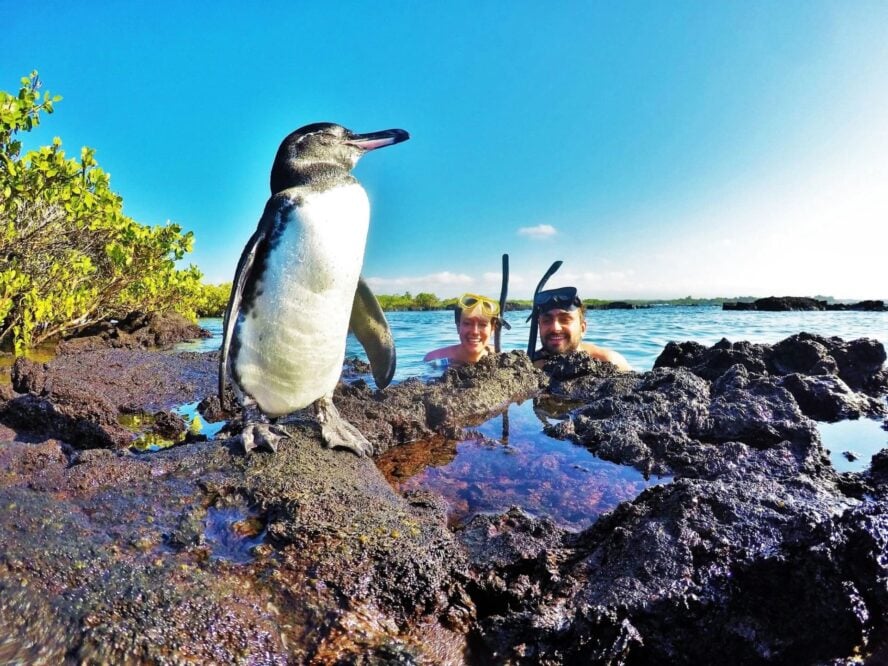
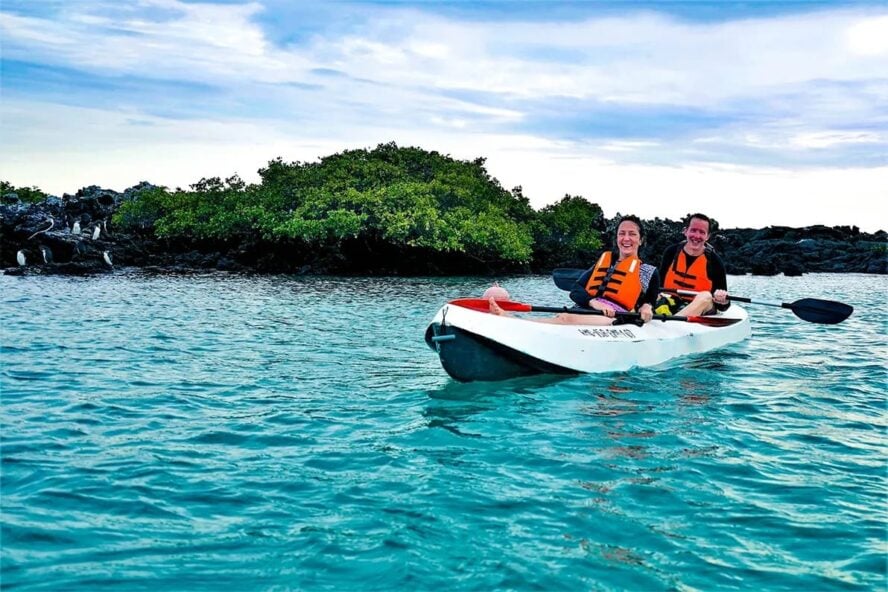
Isabela is the adventure island. You can kayak through lava formations along the coastline, passing through the sheltered grounds of small turtles, rays, and reef sharks. Snorkeling here, Galapagos penguins appear at close range, which never stops being disorienting in the best possible way.
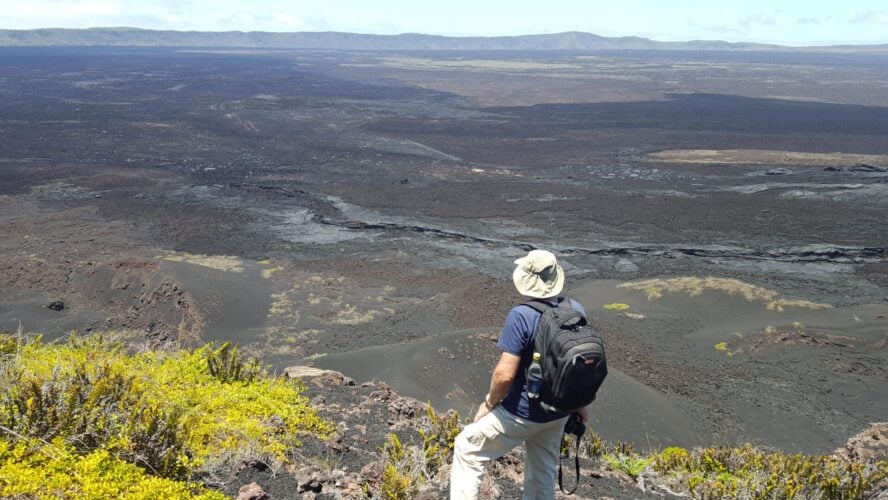
The hike to Sierra Negra volcano covers about 16 km (10 mi) round trip from a trailhead roughly 40 minutes outside of town, and the caldera you arrive at is one of the largest active volcanic calderas in the world.
Biking through the island’s interior, you will regularly need to stop and wait for giant tortoises to clear the road. The Galapagos Islands wildlife on Isabela has a rawness that the other islands do not quite match. There is more space here, more silence, and the animals seem to know it.
Santa Cruz: Where giant tortoises have the final word
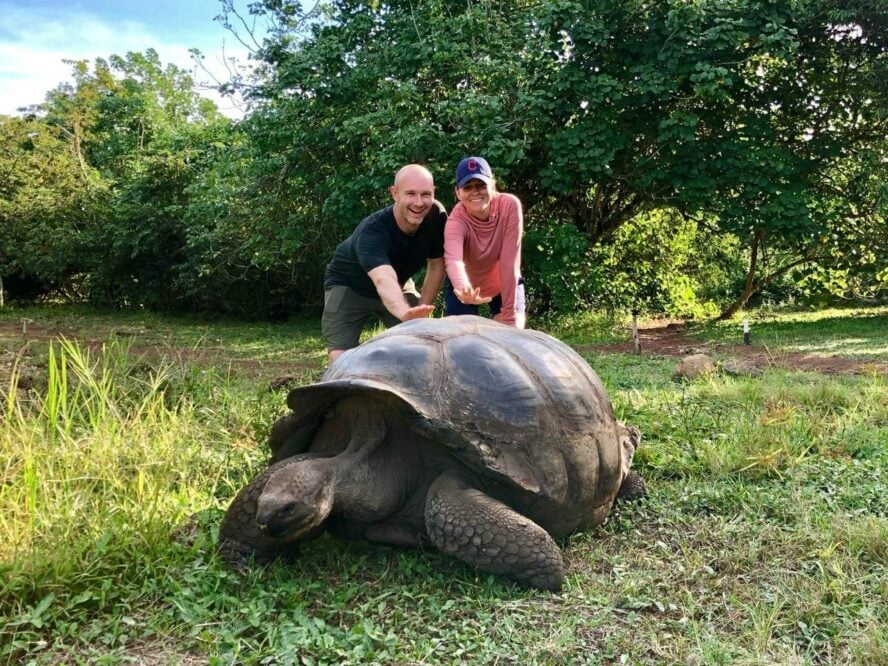
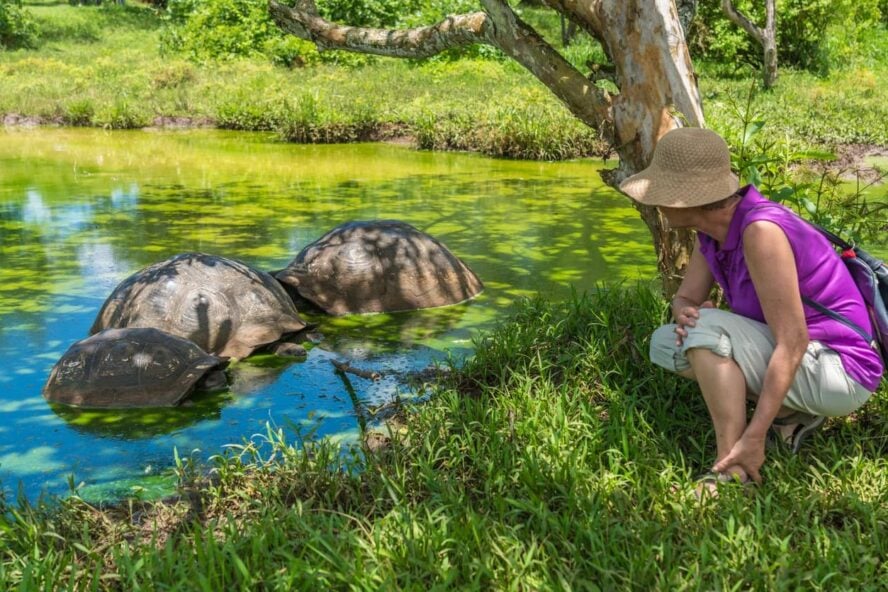
Santa Cruz is the most developed island in the Galapagos, home to around 20,000 people and the strongest concentration of visitor infrastructure. It is also the island most associated with giant tortoises. More than 3,500 individual tortoises roam the Santa Cruz highlands, and walking among them is something I recommend doing slowly.
These animals can weigh over 200 kg (440 lb) and live for more than 200 years. The saddleback tortoise, whose shell curves upward at the front, is the animal that gave the islands their Spanish name: galápago means saddle.
The Charles Darwin Research Station on Santa Cruz continues active conservation work, and visiting puts the Galapagos Islands wildlife into context in a way that no wildlife encounter alone quite can.
When Is the Best Time to Visit the Galapagos Islands
The Galapagos Islands wildlife is extraordinary in every month of the year, and I mean that without qualification. There is no season when the islands disappoint. What changes is the character of the experience.
From December to April, water temperatures reach around 24°C (75°F), seas are calmer, and visibility for snorkeling and diving is typically at its best. From May through November, the Humboldt Current pushes colder water up from Antarctica, dropping temperatures significantly, with June and July being the coldest months in the water.
The payoff is that this cooler season brings larger pelagic species closer, including whale sharks around the northern islands. My advice is always the same: decide what you most want to see, and the timing follows naturally from that.
How Many Days to Spend in Galapagos
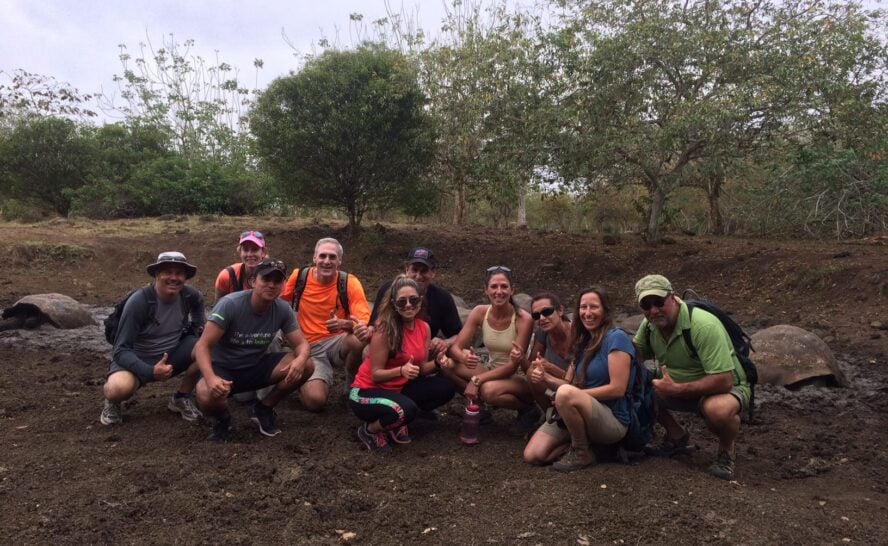
Seven days is the minimum I recommend to experience the Galapagos Islands wildlife properly across more than one island. Ten days is better if you want unhurried time on all three main islands. Most activities, from snorkeling and kayaking to volcano hikes and wildlife walks, run between four and six hours, so each day can hold a lot.
But the Galapagos genuinely rewards people who are not in a hurry. Some of the best encounters I have had with clients happened on early morning walks before the day’s scheduled activity had even started, when there were almost no other people around and the animals were simply everywhere.
Ecuador Adventure Travel: The Andes
Most people who plan Ecuador adventure travel combine the Galapagos with time on the mainland Andes, and I think that is exactly the right call. The Andean corridor running north to south through Ecuador is one of the most dramatically varied highland environments I have ever moved through. I have spent 13 years doing it and it still surprises me.
How many volcanoes are in Ecuador
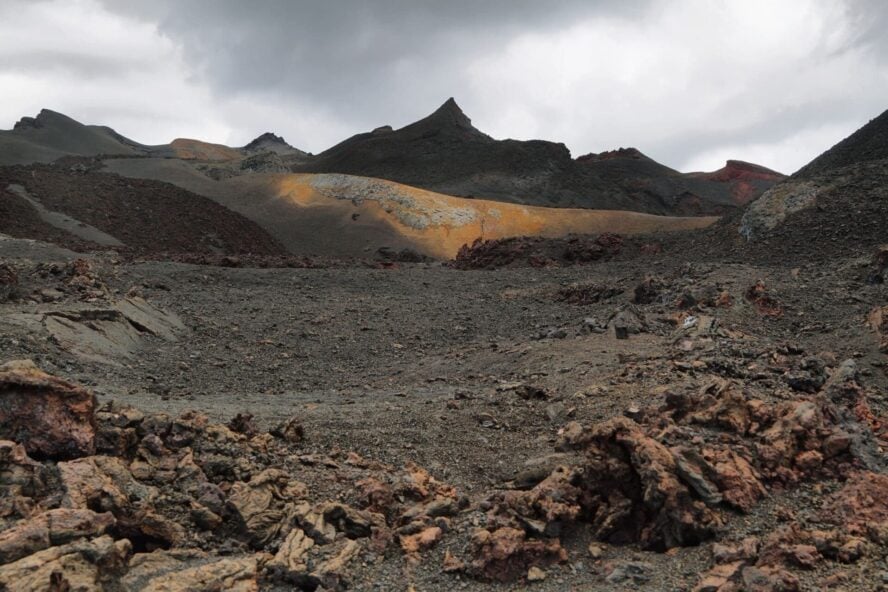
Ecuador has more than 50 volcanoes, of which approximately 15 are considered active. They run in a corridor known as the Avenue of Volcanoes, passing through the heart of the Andes. From certain lookouts in Quito on a clear day, you can see up to 16 different peaks, four of them snow-covered. Cotopaxi, roughly an hour south of the capital, is among the most visited and reopened to trekkers in January after a period of activity.
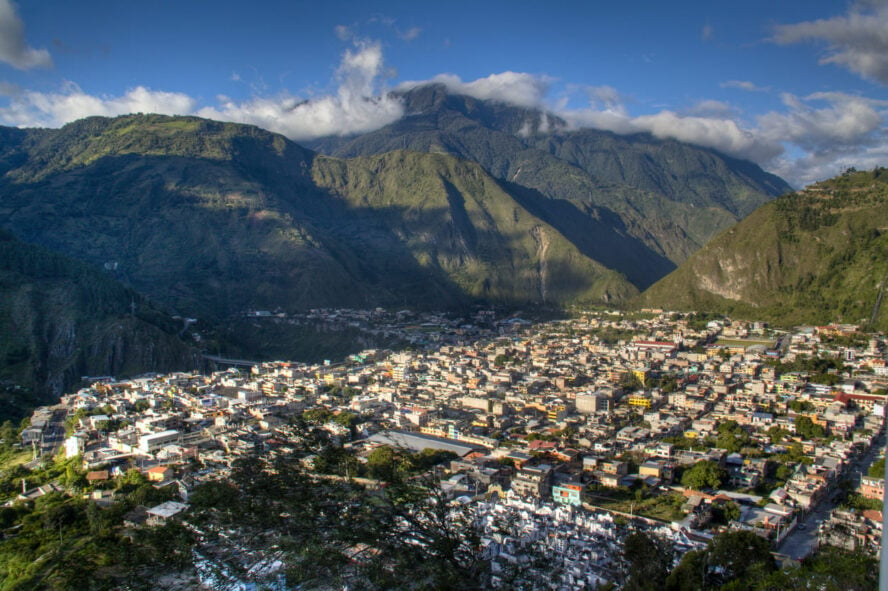
Tungurahua, whose name in Kichwa translates to “throat of fire,” erupts intermittently and is best observed from the adventure town of Baños nearby. In Ecuador, when we hear that a volcano is active, we do not evacuate. We go and find a better vantage point. That is genuinely how most people here have always lived with these mountains, including me.
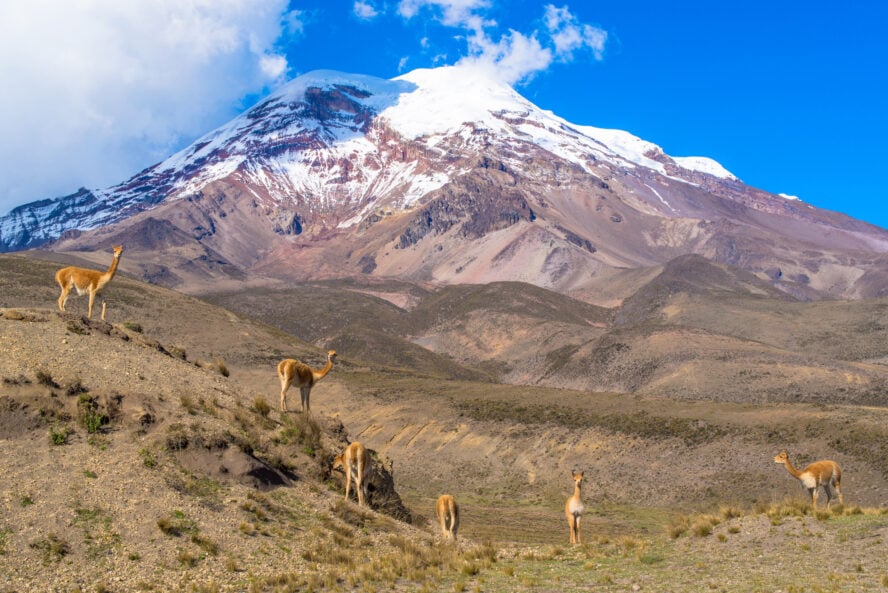
Chimborazo is the one I love explaining most. It is not the tallest mountain in the world as measured from sea level, but because the Earth bulges at the equator, Chimborazo is the furthest point from the Earth’s center, making it the closest point on the planet to the sun.
We walk clients to the base camp at 5,000 m (16,400 ft) above sea level, and you feel every meter of that altitude without needing any explanation. Cayambe, another of our major peaks, holds a distinction I have never found elsewhere: it is the only place on Earth where the equatorial line crosses active snow and glaciers.
Trekking Ecuador Andes: Crater lakes, canyon crossings, and local life
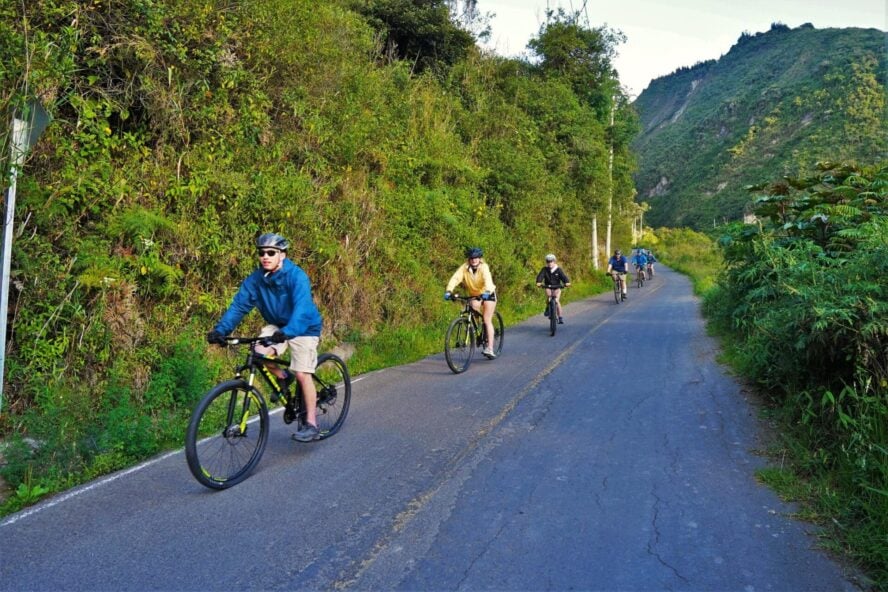
Trekking Ecuador Andes routes is not only about the volcanoes. The best routes take you through indigenous markets, historic haciendas, and landscapes that most international visitors never reach. The Quilotoa Loop includes a caldera lake sitting at 4,000 m (13,100 ft) that you can kayak across. Because Quilotoa is still an active volcano, the water inside the caldera runs warmer than the altitude suggests, and in certain spots you can watch bubbles rising from the lake bed.
Crossing the narrow canyons on the approach, with the lake appearing suddenly in front of you after an hour of walking, is one of those moments that lands differently than any photograph can prepare you for.
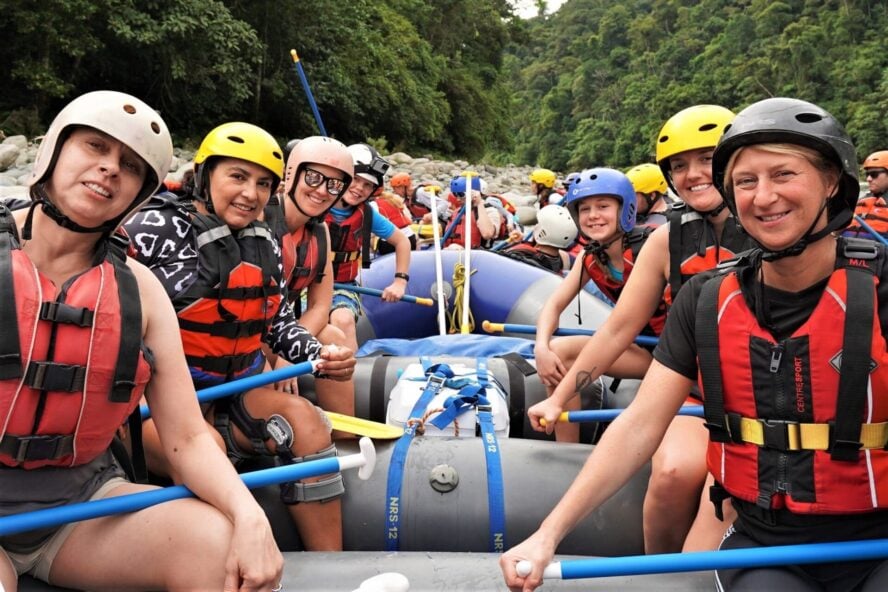
Baños, named for its thermal hot springs, sits at the junction of the Andes and the upper Amazon drainage and is one of Ecuador’s best adventure bases. From here you can raft the Pastaza River, do canyoneering on steep Andean slopes, or soak in thermal pools at the end of a long day.
I have rented a donkey from a local family to get out of a volcano. I have eaten lunch with a women’s cooperative we actively support on our routes through this region. The landscapes here are extraordinary, but the people are what makes ecotourism in Ecuador genuinely worth the extra time.
The Amazon: Ecuador’s Wildest Region
Most international visitors do not realize Ecuador has a share of the Amazon. It is a small share, about 2% of the total basin, but the concentration of species inside that area is extraordinary. Yasuní National Park alone holds over 650 species of birds, compared to approximately 700 for all of Europe. Take a moment with that.
What the Amazon actually teaches you
The Amazon rainforest Ecuador wildlife is where my guiding career actually started, and it still holds a particular place for me. I always tell groups focused on finding a jaguar or an anaconda: yes, those animals are there. In 13 years I have seen a jaguar exactly twice. What I see every time I enter the forest are the things most people walk straight past.
A hoatzin bird at the river’s edge, drying its prehistoric wings before climbing back to its roost using the claws folded beneath its feathers. A column of leaf-cutter ants stretching 30 m (100 ft) through the undergrowth. Creatures that look like the Jurassic period never ended, because in many ways it did not.
We kayak deep into the Amazon on flat, winding waterways far past where any road exists. We spend time with communities including the Waorani people, whose first sustained contact with the outside world came only in the late 1960s, and who still live primarily from the forest.
For those who want white water, we run sections of the Hatun Yaku River. For those who want to go deeper into the cloud forest fringe, canyoneering on the steep Andean slopes where waterfalls come off the mountains is its own kind of extraordinary.
The cacao at the origin of the world’s finest dark chocolate came from forests like this one. Before the Spanish arrived, it was the currency of trade here. That history is still present if you know how to read the forest.
Getting There: Practical Information
Quito is the main international gateway for Ecuador and the starting point for most itineraries. The city sits at 2,800 m (9,186 ft) above sea level, making it one of the highest capital cities in the world, and altitude can affect you even before you start doing anything physically demanding.
I recommend arriving a day or two early and moving slowly at first. Quito’s historic Old Town is a UNESCO World Heritage Site and was the very first city on Earth to receive that designation, which is a piece of context I always enjoy sharing.
Flights to the Galapagos depart from both Quito and Guayaquil and take around two hours. Most international visitors fly into Quito and connect domestically.
The itinerary I recommend most to people who want all three regions is around three weeks: four to five days in Quito and the Andes, five to seven days in the Amazon, and seven to ten days in the Galapagos. That gives you enough time in each region to slow down and actually be present. The Galapagos especially rewards people who are not rushing.
Come and see for yourself
I took my kids to the Galapagos last month. Watching them encounter Galapagos Islands wildlife for the first time, the sea lions pressing close on the beach, the penguins appearing in the water beside them, the marine iguanas drifting past their masks like small prehistoric dragons, something settled in me that I have been trying to articulate for years.
These animals are not performing. There is something quietly profound about standing inside a place where the wild world has not yet learned to be afraid of you.
Ecuador is my home, and I have spent 13 years learning how to share it properly. It is the most biodiverse country on Earth per square kilometer, and every square kilometer earns it. The Andes, the Amazon, the Galapagos: three worlds, one country, no equivalent anywhere.