00:00
Cold open
Monte:
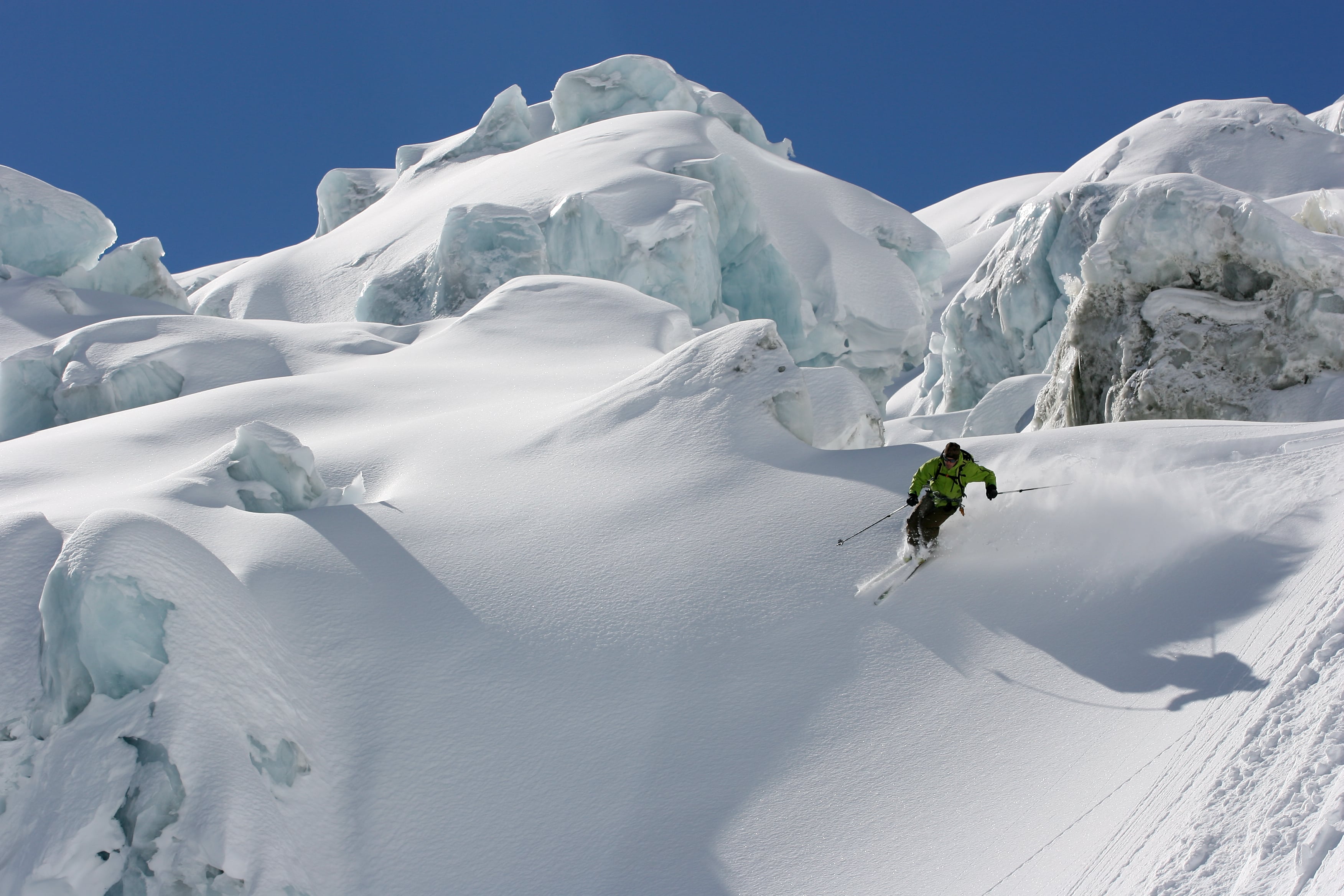
The first trip I did down there a few years ago, it was crazy, off the hook, amazing blower pow. It's kind of cool, 'cause you can ski inside the volcano on a glacier. As soon as we get out of the more volcanic area, we end up in this sort of stuff. There's all these spines and chutes, and lots of new things.
Viktor:
My Chamonix friends, if they don't find steep couloirs there, they get disappointed.
Monte:
Oh, they're there. So all this stuff here, it's all day-trippable from the resort. We had a 2:00 flight from Bariloche. We skied till noon, raced all down, did the two-hour drive, checked in the minimum amount of time, just 'cause it was such good skiing.
Back to chapters
00:46
Why ski in Patagonia in the middle of summer
Monte:
Skiing in the middle of summer is super cool. Like, just you get on the airplane at home, it's the middle of summer, you're wearing T-shirt and shorts, and a few days later you're wearing your winter gear and it's snowing on you and, you know, you're lining up a cool pow line.
Viktor:
I didn't do that, but I did a couple of trips like that where we would go surfing to Caribbeans and then just next day land in Canada and get into RV and it was like minus 28 all week. I love those kind of lifes. I kind of feel like I cheated on life when I do that.
Back to chapters
01:21
Meet Monte: from civil engineer to mountain guide
Viktor:
Well, maybe you can tell me a little bit more about you.
Monte:
Yeah. So Cole's Notes, I started guiding probably about 20 years ago now. The years pile up here pretty quick. I got into it actually after I got an engineering degree and then-
Viktor:
What kind of degree you got?
I didn't know that.
Monte:
Civil engineering. Yeah, I used to work for a company that designed and installed bridges, and it didn't take me long to realize I really don't like sitting in an office all day, every day. Anyways, so that got me thinking about other jobs and stuff like that, and honestly, it's like being a mountain guide is not well-known in Canada, and at least it wasn't well-known at all with the people that, you know, the people around me when I was growing up, and so I just didn't realize that it was an option.
But once I realized it was an option, I quit working as an engineer, went back to school, became a mountain guide, and then since then, yeah, been guiding all over the world. So I usually do, you know, a few trips every year internationally. So I'll do an Alps trip and a Japan trip definitely every year.
I've done South America a bunch and Northern Canada, but of course the bread and butter is here in the BC mountains where I'll spend most of my time. I live in Squamish, so it's rock climbing right outside the front door and great alpine climbing and skiing at Whistler and the zone around there.
Tried Kamchatka a few years ago. It didn't end up panning out. This year I'm going to go to Kazakhstan. So it's just like that discovery trip, you know, some destination that maybe isn't on people's radar but I think might be cool.
Viktor:
Yeah. Nice.
Monte:
Well, yeah. Yeah, yeah. Trips to different areas, right? It's always kind of neat just seeing what's available.
Back to chapters
03:08
Orienting the map: where Patagonia's ski zone is
Viktor:
I think maybe we can start with, when you say Patagonia, maybe a little bit of orientation. Like, you know, maybe you can open up a map on your screen.
Monte:
Yeah, for sure. So Santiago, sort of in the top of the screen there in the black circle, and there's definitely some skiing and stuff around there. Buenos Aires is on the far right of the image, and then the zone that we're talking about, sort of the northern Patagonia range is that circle down towards the bottom.
I've got another regional map here. So when you're thinking about climbing, you're more thinking Fitz Roy, El Chaltén, that zone, and that's this massive ice cap that's right here. Whereas the skiing zone is more in this area up further north for a number of reasons. One is access. It's hard accessing the mountains from the west side down lower, and the other is just the weather's better.
You know, southern Patagonia is pretty rough in the middle of winter.
Back to chapters
04:06
How the season compares to Japan and Korea
Viktor:
What's the closest in terms of climate that we know? Is it the Alps, is it Canada, or like maybe some location in US, what would be the most similar?
Monte:
I think it's somewhat unique in that they've got these big mountains. They get a great snow, but it's such a compressed season.
I would say it's more like I don't know, like Korea or Japan almost, but without... Korea doesn't get the snow. Japan gets all the snow, but Korea gets the colder temps. But it's kind of like that where Japan has a good six-week season, and that's really all it's got. You know? It's, you show up too early, there's no snow.
You show up too late, it's raining.
Viktor:
And basically the trips that you do are typically in end of August for, right, beginning of September. That's kind of the peak season for skiing.
Monte:
Yeah, it's more like spring down there. So their season, the best part of their season's sort of like August to mid-September.
Some of the bigger areas, bigger mountains, higher areas all open up in late June and be around, you know, be skiing in July. But late August into early September is generally when we run trips, which would be equivalent to like March for us. So you can kind of see desert, jungle.
Viktor:
Right.
Monte:
And the dividing line between those two are the Andes.
So all your snow and all your moisture's coming from the west side, and then the east side's in the rain shadow. What's that mean? East side's a little bit cooler generally than the west side.
Back to chapters
05:45
Altitude: 3,000 meter peaks and big volcanoes
Viktor:
And what about the altitude, like the average altitude of the ski resorts and the places where you ski?
Monte:
Yeah, that's generally, like the 3,000-meter peaks is kind of what we're skiing, 2,800, 3,000 meter, nothing too high. There's some pretty cool iconic volcanoes in the area that are higher, like Tronador, 4,000-meter peak, but they're not too high, and that's kind of on purpose for two reasons. Like if you go further north outside Santiago, you can get a lot higher, but it's a much busier area, much more condensed, and then you have to deal with altitude, and I like to be able to show up and go ski a whole bunch without running out of breath yet.
Viktor:
Right.
Monte:
The skiing's great, and so seeing these really cool mountains, they're almost, you know, in some ways like the Dolomites, just bigger. They're super cool.
Back to chapters
06:38
First turns: blower pow between the volcanoes
Viktor:
You can share and show more details. Yeah, let's talk about skiing.
Monte:
The first trip I did down there a few years ago, it was crazy, off the hook, amazing blower pow.
This is skiing up with a volcano in the background and looking across another volcano, another lake. It's what's called the Lakes District, and it was pretty neat in that the snow line was so decisive. You got above that snow line, there was snow, but you got below it, and it was dirt, and all the way around these volcanoes like you can see here, and it went from lots to nothing.
Back to chapters
07:15
Access: old-school lifts and a typical day
Viktor:
So what's the access like? You basically, if you stay in a resort, you get, have to get in a car, drive over there, get closer, or you start-
Monte:
Yeah, exactly. We're down at the lakes, and then we hop in a car, and we go up this mountain. Basically, we do switchbacks to gain, like, 1,500 meters and then hit the parking lot, and then we got on these lifts.
So we take the lifts up to gain access into the backcountry, and these are the type of the lifts. Old school, fixed grip, but get us access into some really cool backcountry.
Viktor:
What is a typical day then?
Monte:
So how I generally like to do things is if the skiing's really good on the resorts, and sometimes we can look at some photos later where it's like that, where if we're going up and it's just blower pow and amazing skiing, nobody around on the resort, we'll usually do a few laps on the resort 'cause, you know, if the skiing's just as good there as the backcountry, let's use it and get some more vertical.
Then after that, we'll dive into the backcountry, and then once we dive into the backcountry, the amount of vertical we get is like on the uphill side of things is sort of that 600 to 1,200 meters usually, depending on where people are at, the difficulty of the skinning. Like, you know, if there's boot packing, it's a bit less.
If there's not, it's simple touring, it's a bit more. And then our skiing down is typically about twice that because we're using the lifts to maximize our vertical.
Viktor:
So like 1,000 meter up to 1,000-meter-long runs?
Monte:
Yeah, exactly. So say 1,000 meter up, 1,000-meter-long runs, but 2,000 meters down.
Viktor:
Oh, right.
Okay.
Monte:
Yeah. By leveraging the lift system and that kind of thing. It's generally what we're trying to do anyway.
Back to chapters
09:03
Terrain: from beginner-friendly to steep couloirs
Viktor:
Okay. So big terrain. Yeah. A lot of stuff to ski. I would assume you can always find something beginner friendly, intermediate friendly, but are there any, like, steep, I don't know, big mountains that you can go and ski?
Monte:
There definitely is. Last year we decided to go into a steeper zone for a little bit. This is about between 45, 50 degrees.
Viktor:
Yeah, I need to tell that to my Chamonix friends. If they don't find steep couloirs there, they get disappointed.
Monte:
Oh, they're there. They're there. Yeah.
Viktor:
We went to Alaska with some friends this winter and they were like, "Yeah, you know, it's like, you know, open and big fields, like big nice turns.
We want to ski some steep narrow stuff." And I was like, "I mean, you can find it in Alaska, but that's not why you travel all the way there."
Monte:
Yeah.
Viktor:
A little bit of everything for everyone. That's nice.
Back to chapters
09:54
Bariloche, the Frey Hut and a storm
Monte:
Yeah. Exactly. So I've hopped over to the Argentinian side and into Bariloche. So this ski hill's right behind this mountain right here.
Viktor:
Okay.
Monte:
And we've skied down the other side, and on this trip we went and spent a night at this hut. It's a pretty bare bones hut, but it was kind of neat. It got us into this area, and we hit it. We ended up going in here 'cause the ski hill, the forecast looked pretty ominous. There was a lot of snow coming in with a massive storm, and the ski hill was going to shut down, close all the upper runs so that they could do avalanche control and have everything closed.
So right before that storm hit, we decided that we'd better get out of that area because we didn't want to be stuck down low on the mountain and then down where we would be at the base of the hill. There's no snow. Like, you'd be walking through bushes. So we bailed out on our hotel, came over and stayed at this hut, and then caught it right before the storm, which was perfect because then it meant nobody else was there.
They usually sleep 36 people in that hut, and there was, like, eight of us, I think, there. Yeah, right before the storm, but it was stormy here going into it. Like, it was definitely snowing.
Viktor:
Yeah. Nice.
Monte:
But yeah, like, as far as the steep skiing, flat skiing, like there's lots of options for everything. On the volcanoes, you have to...
Depends on... You have to pick your volcano, pick your aspect of the volcano, 'cause they can be a little bit more uniform. But then as soon as we get in out of the more volcanic area and into the other zones, we end up in this sort of stuff where there's all these spines and chutes and lots of neat things there.
Viktor:
And then Bariloche?
Monte:
Yeah. In Bariloche, it's a huge resort. It's like a modern Western-style resort. Yeah, exactly.
Viktor:
And the same concept, you take the lifts all the way up and then you go drop into the backcountry and... Okay.
Monte:
Exactly. So from that one, you have to skin a little bit from the top of the lifts to get into the backcountry, but not a ton.
Some people boot pack it. It's easier to skin. And then you drop into some of these lines so that we'd dropped in and we'd skied just behind this ridge, and then this is us coming back up to get another line that took us back into inbounds. So yeah, just hiking up. You can see a few people following our track up here.
You can see the hut in the background. That's the Frey Hut. So that's the skiing. So all this stuff here, it's all day trippable from the resort. This is where we took it a little too low. We were finding some really good snow, and so we skied right down low on this avalanche path. And then we're following, this is the summer hiking trail back around to get back onto the resort.
Back to chapters
12:41
On the map: mules, Antillanca and Cerro Bayo
Viktor:
Let's pinpoint it on the map.
Monte:
So this is that first mountain that we were looking at. Top of the ski lift is right there, and you can see the zig-zaggy road. So we stayed right down over here, and then drive up in here.
Viktor:
Okay. And then when you cross to Andes...
Monte:
Yeah, you bet. This is Antillanca right here, so this is that zone. And the ski hill's just this little bit, where we skied a lot of the backcountry over in here.
And then you come around.
Viktor:
So there's pretty much one road.
Monte:
Yeah, exactly, through a mountain pass. And this mountain here is one that I want to hit. What you do is you take mules up. So you get the guy with the mules to meet you, and you get all the way up into this area right here just above the trees, and then you can go up and ski all this upper stuff.
Viktor:
They what, like, they load all your gear and you on mules, and then for how long you're on the mules going up, like a couple of hours, or?
Monte:
For like a couple hours, yeah, hour and a half maybe. Yeah, exactly. So you go up, there's a little hut up here, and then the mules hang out at the hut with the wrangler.
And you just go ski for the day. And then, you know, like, it's kind of cool 'cause you can ski inside the volcano on a glacier here on Puyehue. Fool around in that area for a bit, then come back down, ride your mules back down, down into here. And then obviously this is the highway that takes us back and around to the Argentinian side.
And so this is a ski hill called Cerro Bayo.
Viktor:
Okay.
Monte:
Which is one of them on the handout.
Viktor:
How long is the drive if you do it in one stretch?
Monte:
Yeah, if you do the whole thing, it's about two hours, like Antillanca to Cerro Bayo. Not too bad. And then yeah, Cerro Bayo, it's another one of these smaller hill, smaller resort, but amazing slack country.
This resort has a lot of options to ride the lifts up, traverse out of bounds, ski out of bounds to the bottom, and then traverse back into the resort and ride the lifts again. And then down another couple hours down and around here to Bariloche.
Viktor:
As you go all the way around that bay. Is it a lake or, or
Monte:
a- That's a lake, yeah.
It's a really big lake here. Yeah. And then over here is Catedral. So it's just above the town or the city of Bariloche. And that hut we were talking about is right here, and we were looking at these spines, and this is the ski hill over here. So we skied a bunch of these spine runs and stuff over in here, stayed at the hut, and skied this whole valley in here.
Back to chapters
15:41
The Frey Hut and Argentine refugios
Viktor:
What's the name of that hut?
Monte:
That's the Frey Hut. It's like, for climbers in the summer, it is booked out a year in advance type thing. It is super popular. Little less well-known for winter skiing. But then there's, you know, there's other huts, like there's Jakob Hut over here, and then there's, you know, 4x4 shuttles.
Viktor:
But is it managed? Do they have like a host in the hut, or is it more like a shelter?
Monte:
No, it's a refugio. It'd be more like a European hut in that it's fully catered. Like, there's food, there's everything there. You just show up with your day pack. But it's not nearly as nice as the European huts in that it's more crowded, and the food's like, meh, it's okay.
It's better than carrying your own food in, that's for sure. This is Cerro Bayo, so going up the bottom lifts in the morning. So there's some fresh powder you can see on here. And this is at lunch, coming down for lunch and just, like, again, so much snow on this hill and nobody's skiing it.
Back to chapters
16:42
Cerro Bayo: an old resort nobody skis
Viktor:
So why is it that it's just far, far from, like, a bigger town, or it's not like a, it's an old resort with old lifts or-
Monte:
Exactly.
It's an older resort. It's more locals skiing there, some Argentinian nationals and Chilean nationals skiing there, but I didn't see anybody that came from the Northern Hemisphere. So a friend of mine is a mountain guide based out of Bariloche. And so I'd been chatting with him a bunch before this trip, and he said it was one of his favorite little mountains to hit, so we added it to our list and it was definitely my favorite to hit after we got back.
Yeah. We skied on our final day of this trip. It was funny, we had a 2:00 flight from Bariloche to get back to Buenos Aires. And so we got up super early in the morning, packed our car, drove up here, and we skied till noon, raced all down, threw everything in the car, did the two-hour drive, checked in the minimum amount of time before we got on the airplane, just 'cause it was such good skiing.
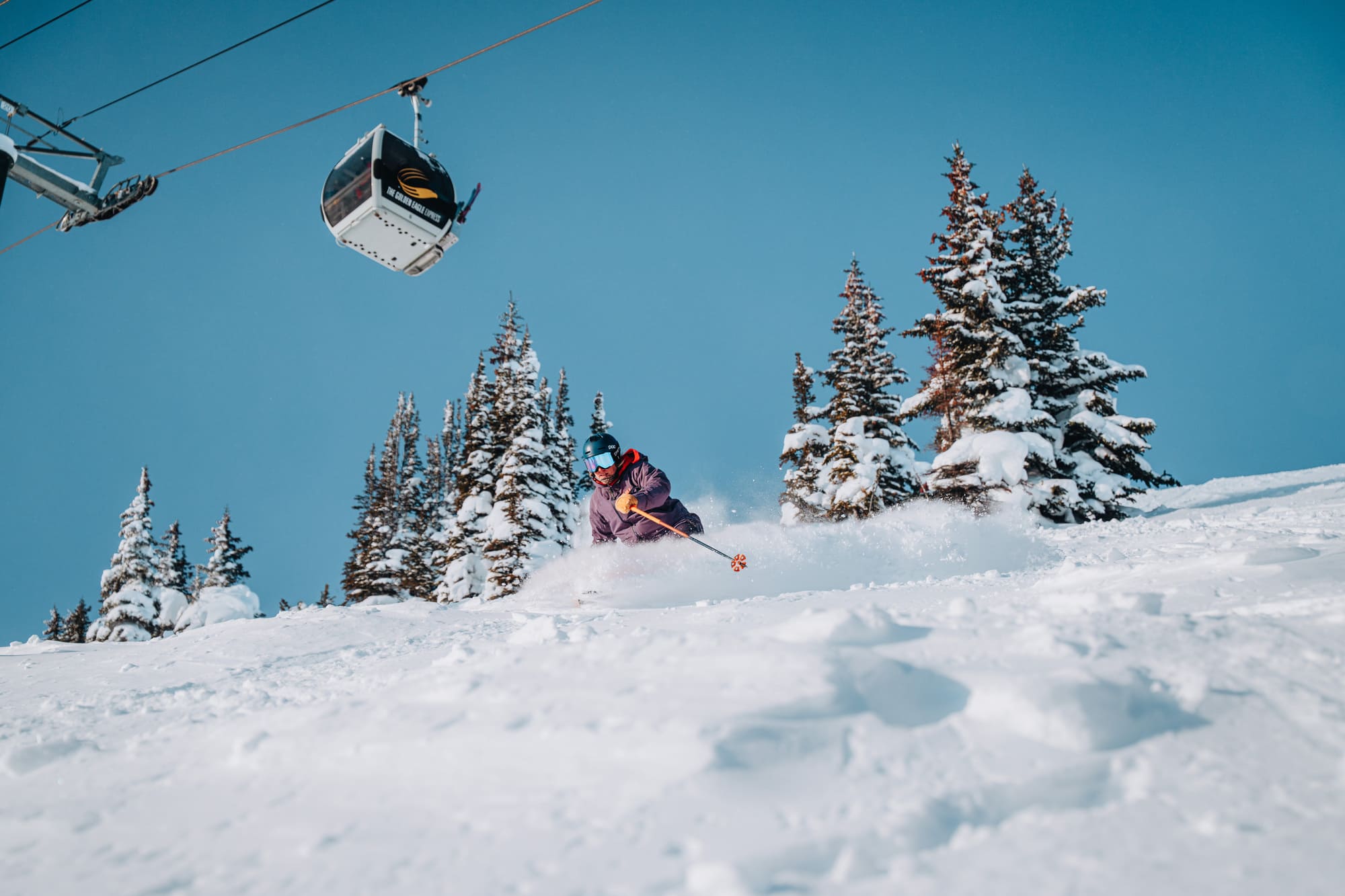
Yeah, here's, like, there's, again, we're on the resort right here and just skiing some amazing powder. You can see the lift here behind us. And then the food, like especially on the Argentinian side, the food's amazing.
Back to chapters
18:08
Food: Argentine barbecue
Viktor:
I've only been in Peru, Costa Rica so far. I want to explore those countries, and one thing that I'm, like, super excited is the culture, food, and you know, we can talk about it.
I think that's a big part of this.
Monte:
So barbecue, right? It's what Argentina's known for as far as the food goes, and this was a place, we'd just arrived in Bariloche, so-
Viktor:
That looks great. Most of the Argentinian barbecues that I've seen, like we've been in Austin, Texas, and it's usually like a super fancy restaurant.
Oh, this looks amazing.
Monte:
Yeah. And this place, like, it was kind of a cool adventure in that we arrived, checked into our hotel, everything was good. You know, it's late in the day, we're hungry, been traveling. We all walk out the front door of the hotel, and there's this amazing whiff of barbecue that just hits us, and not a word is spoken.
We all just turn and walk towards the barbecue. And yeah, it ended up that restaurant we went to just about every night on that trip 'cause it was so good. The food was one of the best places I've ever traveled in the world for food. It was so good. This was 'cause we were going into some huts on that trip and needed to bring cash, but they were having this, like, currency inflation issue.
Back to chapters
19:24
Cash and inflation: a kilogram of paper money
Monte:
So this was our load. We brought over a kilogram of paper money into the mountains-
Viktor:
Wow ...
Monte:
just to deal with the inflation issues. Like, we could have brought US, but we didn't want to commit 100% that they would accept our US bills, so just traded them all over to, you know, meeting a guy in a shady alley and swapping our currencies over.
Viktor:
So when was that?
Monte:
That would've been three years ago, so that would've been '23.
Viktor:
When I was a kid, there was like- 35 years ago in Yugoslavia, that's how we did it, you know? It was like a super strong with inflation. Everybody saved money in German marks- Yeah ... and then you would go to like a shady alley to, you know, swap that for the local currency.
That's funny. Nice. So, yeah, it is going to feel like home for me.
Back to chapters
20:15
Hotels, the Chilean side and wildlife
Monte:
Yeah. There's our hotel in Bariloche. So it had a rooftop sauna and hot pools and stuff. It was kind of fun. And then, yeah, just as far as on the culture end of things, the hotel in Bariloche was right across from this really cool cemetery that you could walk through, but it was falling apart a little bit, so there was, like, open sarcophagi and it was definitely interesting to see.
If we flip over to the other side, to the Chilean side, the food was definitely not as good on the Chilean side as it was in Argentina, but it was still great. Here we are on the mountain. We went to this one place and had these pisco sours-
Viktor:
Oh, yeah ...
Monte:
every day on when we were done our ski touring for the day.
They were so good. And then the hotel that we stayed at in the one zone, it's the Puyehue Hotel, and this is it in the background. It had 15 swimming pools of different temperatures. Not all of them hot, obviously. There was a couple that were super cold. But it was such a really cool old building, like this old estate or something.
It's definitely the coolest hotel I've ever been to. Just did not feel like a hotel. Had a bowling alley in there, and then this, these views out of the back of the bowling alley were super cool. We found on this trip some cool wildlife. So this is a little fox that lived at the top of one of the lifts and would search the lift line every day after people went back for food.
Viktor:
Smart.
Monte:
And then some condors. You know, they're huge birds. It was really cool to see a few of them, and they weren't as few as I thought. We did see condors a number of times.
Back to chapters
21:57
Wrap-up: ski in the summer
Viktor:
I think that was great. I think we can wrap it up, and- Yeah ... I'm, like, more excited and hopefully we can get, like, a big group of people next year.
Monte:
For sure, and go ski in the summer. You know, it's so fun taking a break, you know, when you're, it's so sweltering and hot at home and just taking a break and enjoying some cool winter weather.
Viktor:
I don't think that's something too special for you, but like this was my longest season ever. I started on December 1st and we skied till my May 20th.
Monte:
Yeah.
Viktor:
I never stretched the season so much. And I was like, okay, now it'll be really fun to like, you know, just keep skiing, you know, like through summer and then again in fall. But yeah, yeah, I think it's a fun thing to do, get your skis and get on a plane in the middle of the summer.
Monte:
Yeah. Yeah, absolutely.
Viktor:
Thank you. All right, Monte.
Back to chapters