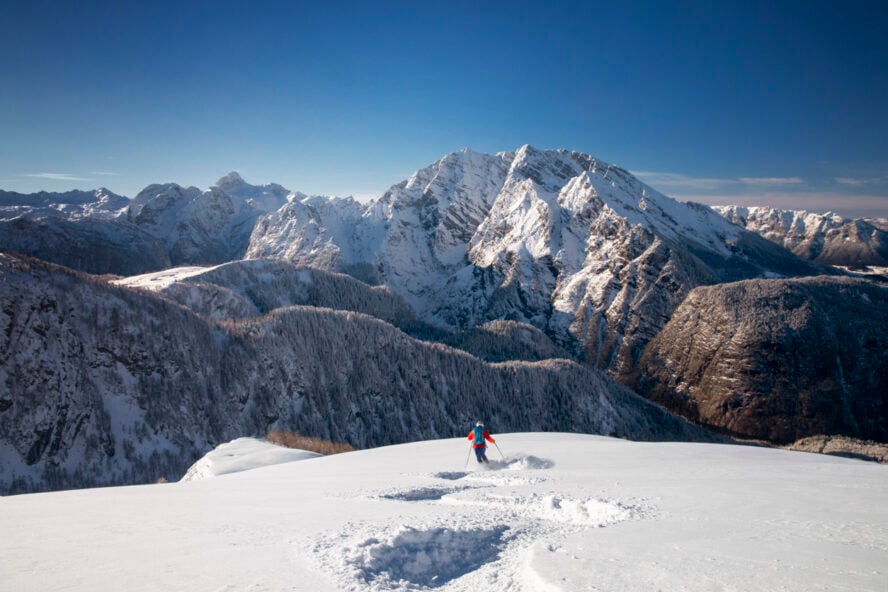
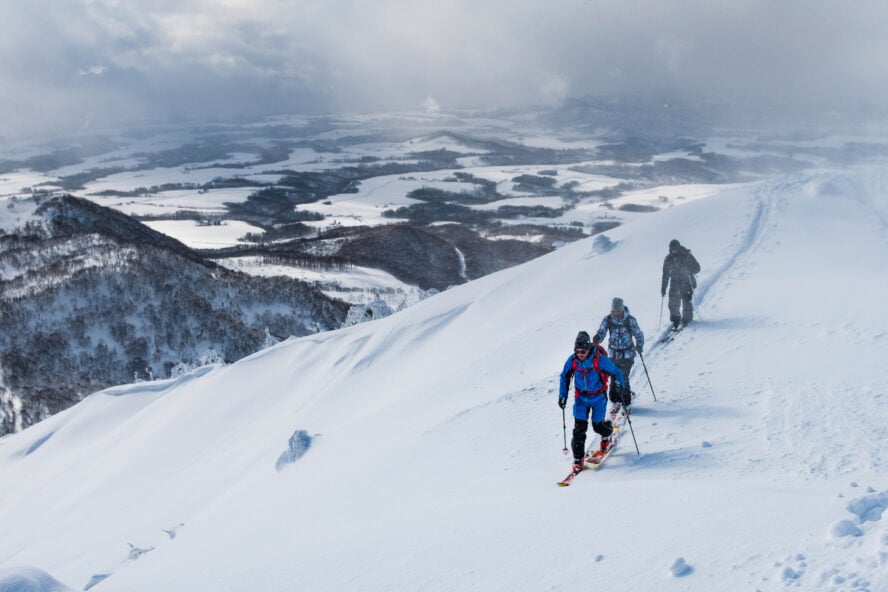
If you’ve never skied in the Alps, let me set the scene the way I do with guests the night before our first day out.
This range is an enormous playground packed into a small space: big peaks, steep faces, glaciers, and resorts that sit so close together you can change countries between breakfast and lunch. That’s why skiing in the Alps feels different the moment you arrive. It’s not just the terrain, it’s the options.
And that’s the secret most people miss. The best week here isn’t something you “book” and hope for, it’s something you build day by day, with the weather, the snow, and the mountains making the rules.
I’m a mountain guide based in Chamonix, and after almost 25 years of guiding people around Mont Blanc and beyond, I can tell you this: if you know what to look for, you can find the kind of skiing you’ll still be talking about years later… and it usually starts with one decision most people get wrong.
What is skiing in the Alps like?
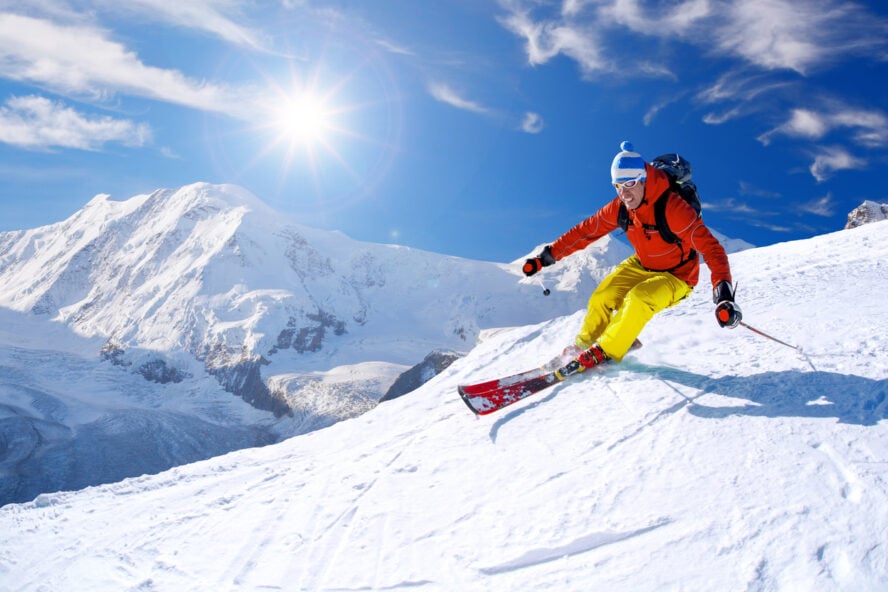
For me, skiing is skiing. If you love it, you’ll love it whether you’re in Europe, Japan, Norway, or the States. I’ve skied in California, Montana, Utah, Alaska, and plenty of places in the Alps, and the feeling of good snow under your skis is universal.
But skiing in the Alps has a few things that make it feel different the moment you arrive.
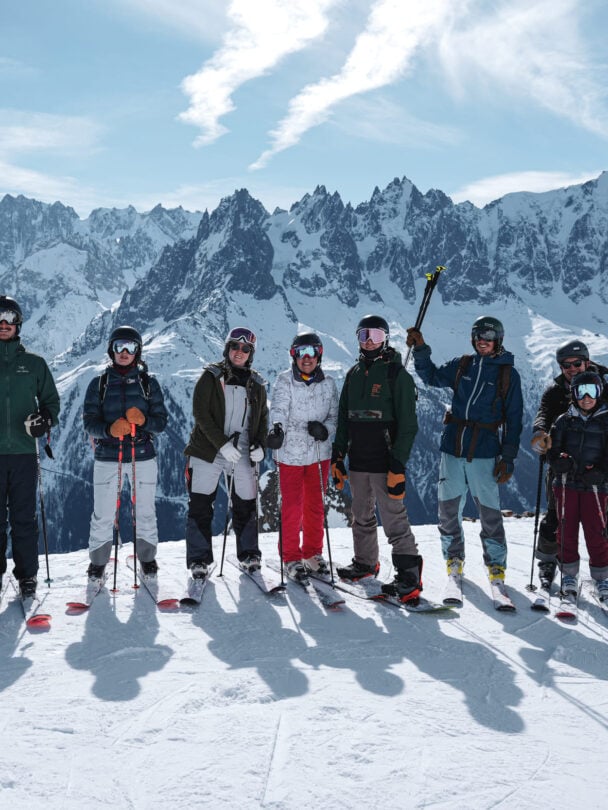

The Scale
First, the scale is real. The mountains are big, steep, and close together. In some resorts, you’re not just skiing near mountains, you’re skiing inside them. You look up and there’s a north face above you, glaciers hanging in the background, and peaks that sit well above 4,000 m (13,123 ft).
The Diversity
Second, the diversity is crazy. You can ski one valley and get one type of weather, one type of snow, one type of terrain. Then you drive 30 minutes, cross a tunnel, and suddenly you’re in another country with totally different conditions and a totally different vibe.
That’s something I love about guiding here. You’re not locked into one place.
The Culture
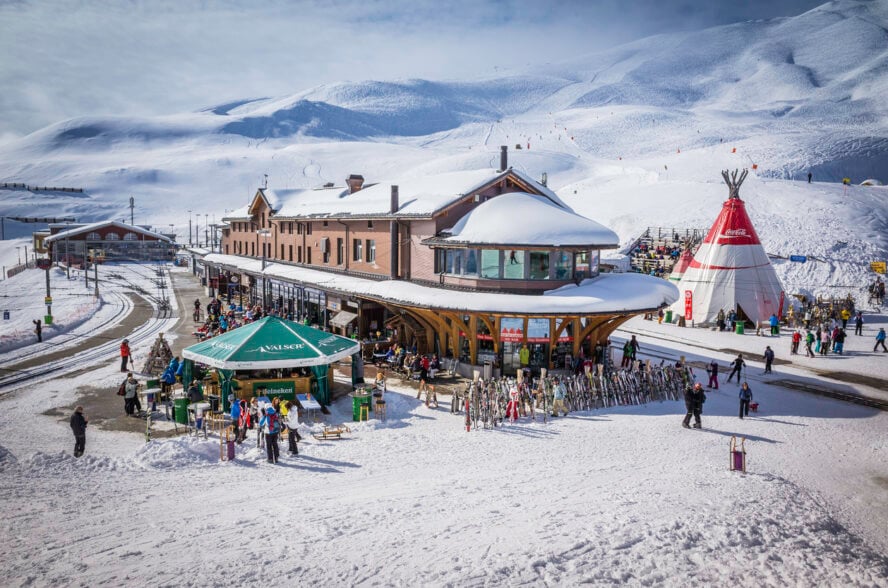
And third, the culture is part of the skiing. In Europe, the day isn’t just ski-lift-ski-lift-ski-lift. You stop for a proper lunch. You sit outside when the sun is out. You drink coffee, or a beer, or something stronger, depending on the country and the mood. And every region has its own personality.
One more thing that’s important to understand, especially if you’re coming from North America. In Europe, you can usually go off-piste whenever you want. There aren’t the same kinds of gates you see in many US resorts. There are fewer restrictions.
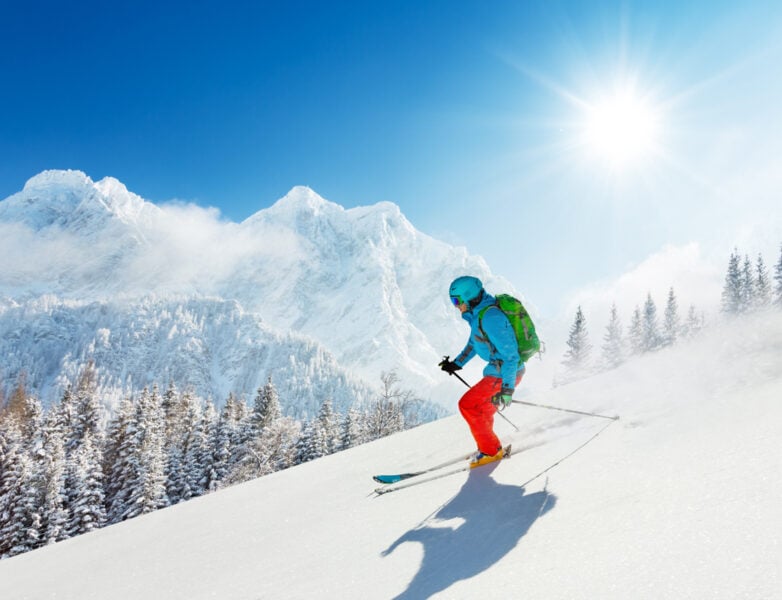
But that doesn’t mean it’s safer. It means the opposite. When you leave the groomed piste, you are on your own responsibility. That usually means avalanche terrain, and it deserves respect. You need to know what you’re doing, where you’re going, and why you’re going there. And you need the right equipment.
This freedom is part of what makes skiing in the Alps so special, but it’s also why it’s worth skiing with a guide if you want to explore beyond the piste safely and confidently.
Where to ski in the Alps?
If you ask ten skiers where the best skiing in the Alps is, you’ll get ten answers. And honestly, they might all be right.
The Alps stretch across multiple countries, and each region has its own style. So when I help guests choose where to ski, I don’t start with the most famous name. I start with what kind of trip they want.
Do you want big piste mileage? Do you want off-piste and freeride terrain? Do you want glaciers? Do you want a charming village? Do you want après? Do you want to move around and chase conditions?
Let me take you through the main regions the way I explain it, moving from east to west.
Skiing in the Dolomites
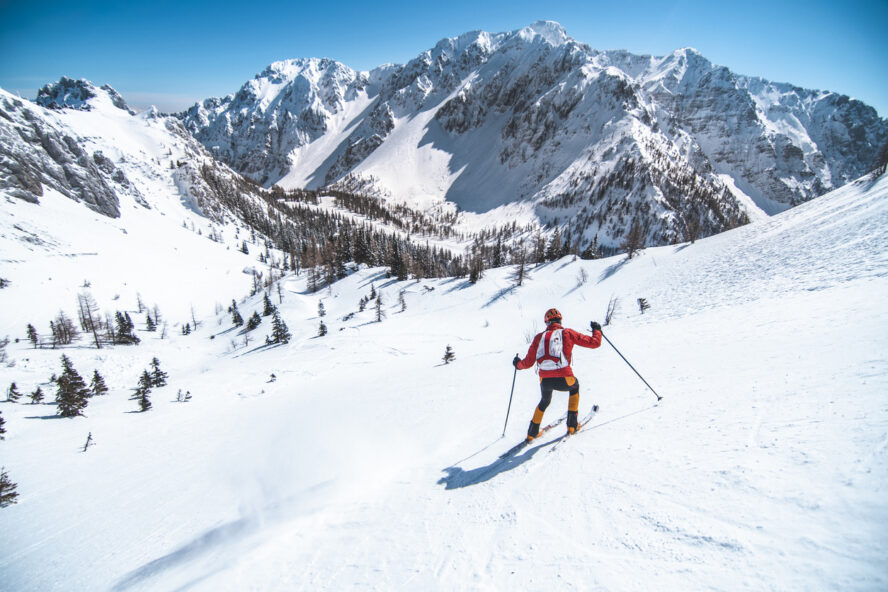
The Dolomites sit in northeast Italy, near the Austrian border. The mountains there are unique. The cliffs and towers are sharp and dramatic, and the whole atmosphere feels different from the central Alps.
Cortina is the famous name, and it’s hosting the Winter Olympics in 2026, so it’s going to be even more on people’s radar. But the Dolomites are huge. You also have places like Alta Badia and Madonna di Campiglio, and plenty of other resorts spread across the region.
One thing to know is that the Dolomites are generally lower than the central Alps. Marmolada is the highest point and goes above 3,000 m (9,842 ft), but many resorts sit around 2,000 to 2,500 m (6,561 to 8,202 ft). In some winters, snow conditions can be a little more variable.
When it’s good, it’s fantastic. Great piste skiing, great off-piste potential, and some of the best mountain restaurants you’ll ever ski into. Italy does food very, very well, and that becomes part of the experience.
For access, Milan or Venice are usually the easiest airports.
Skiing in Austria
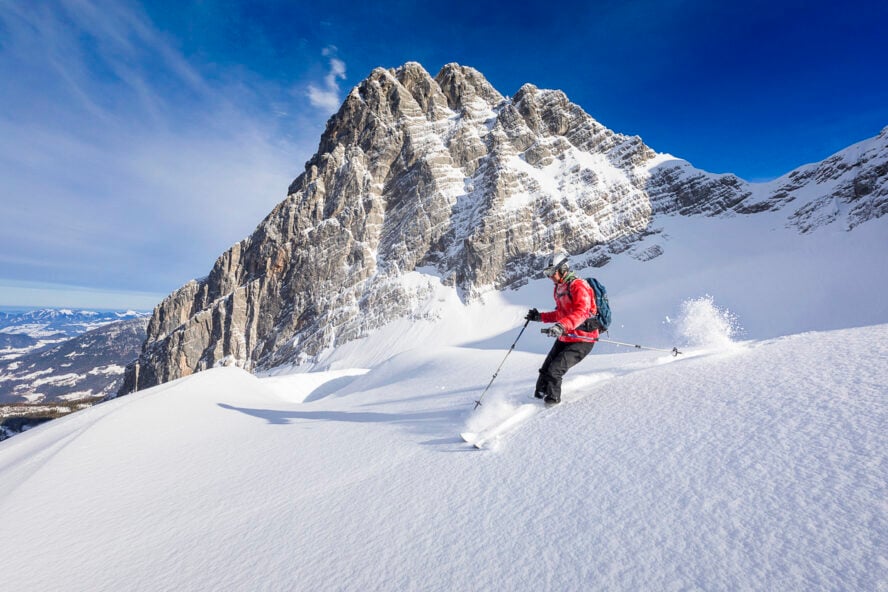
Austria is the country of skiing. Every valley, every village, it feels like it has its own lift. Sometimes it’s big, sometimes it’s small, but skiing is everywhere and it’s built into the culture.
Austria doesn’t go super high compared to places like Zermatt or Chamonix. Most resorts top out around 2,500 m (8,202 ft), maybe 3,000 m (9,842 ft) maximum. But Austria is famous for being efficient and well organized.
Modern lifts, wide pistes, and everything running smoothly. You spend your time skiing instead of sorting out logistics.
And then there’s après-ski. In Austria, après is not a quiet drink at the end of the day. It starts around 3 or 4 pm and it can go late. Somehow, everyone still skis the next morning.
Innsbruck is a great hub, and you’ve got famous places nearby like Kitzbühel and St. Anton.
For flights, Innsbruck can work, but Munich is often the easiest major airport, then you drive south.
Skiing in Switzerland
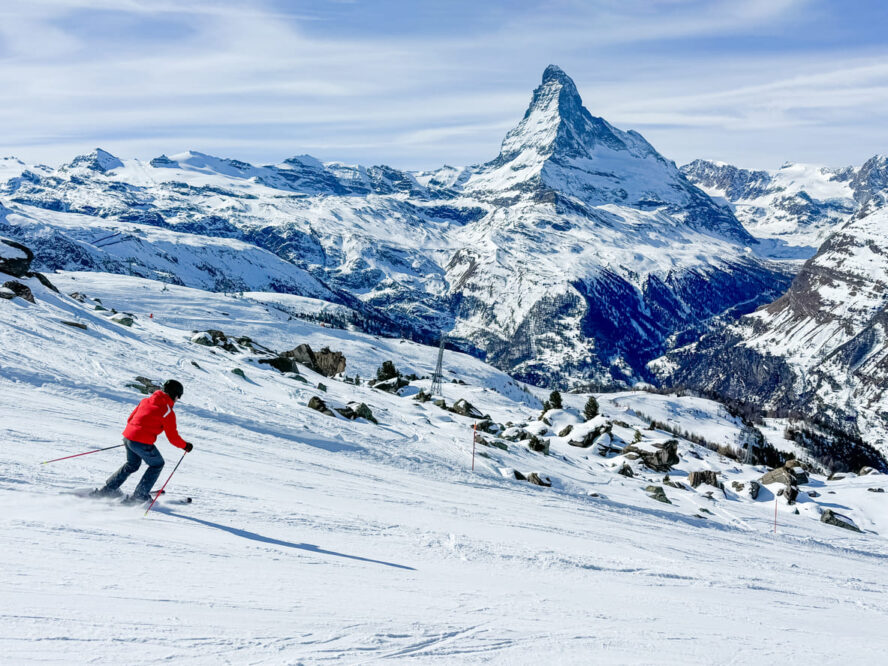
Switzerland is where the big mountain feeling really starts to show. I usually split it into two general zones, because the vibe changes.
The northern and eastern side is more German-speaking, with areas like the Grisons and the Oberland. The southern and western side includes places like Zermatt and Verbier.
Grindelwald and the Oberland
Grindelwald sits under mountains like the Eiger. It’s one of those places where you feel small in the best way. The resort is wide, and you can ski very high there, close to 4,000 m (13,123 ft).
It’s accessible by train, and the scenery is just ridiculous. Huge faces, big peaks, and that classic Swiss alpine feel.
The Grisons and Andermatt
The Grisons are amazing and not always as crowded or famous as the big headline resorts. You’ve got places like Davos, and you’ve got Andermatt, which feels like you’re lost in the heart of the mountains with white peaks all around you.
Switzerland is very easy to travel around by train, and that makes a difference if you want to explore without driving everywhere.
Zermatt and the Matterhorn
Zermatt is one of those places people dream about, and for good reason. Everybody knows the Matterhorn. You’ve probably seen it in Disneyland.
But seeing the real thing above you, in winter, when you’re clicking into your skis, it’s different.
Zermatt is huge, and it’s connected to Italy, to Cervinia. Most people don’t realize how big that whole area is. You can ski for days and still feel like you haven’t seen everything.
It’s high-altitude skiing with glacier access, and you can ski almost all year. The scenery is incredible, because you have the Matterhorn and you also have all the other 4,000-meter (13,123 ft) peaks around it.
The only downside is that Zermatt is at the end of the valley, so you’re a bit stuck there compared to a place like Chamonix where you can move easily to different zones.
Verbier and freeride culture
Verbier is famous for freeride terrain and off-piste skiing. The big freeride competition on the Bec des Rosses has helped define that vibe for years.
It’s a huge ski area, and it also has off-piste itineraries, routes that are not groomed but are marked, which is a very European concept.
Verbier isn’t the highest resort in the Alps, but it usually has great snow and excellent infrastructure.
Skiing in France
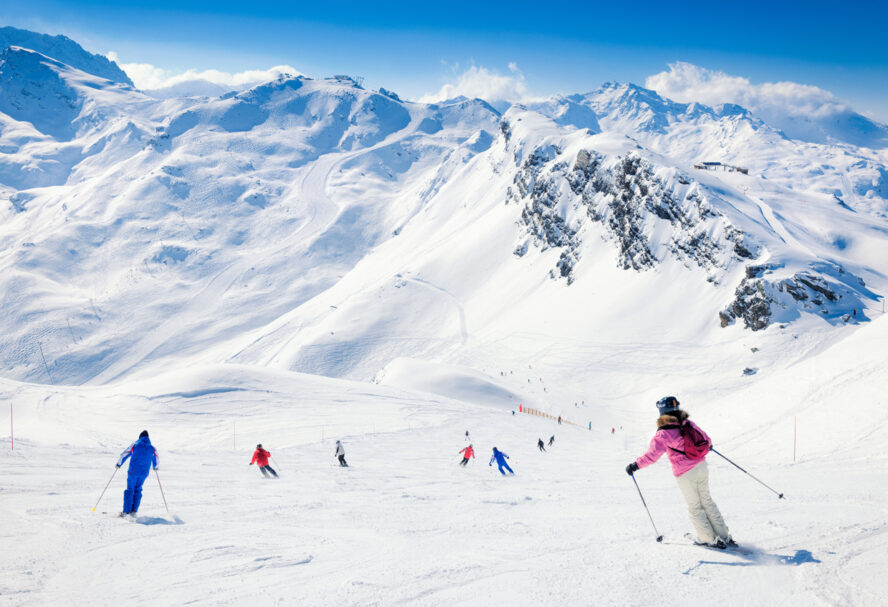
France is interesting because it gives you two very different styles of ski trip.
You have purpose-built ski resorts designed around ski-in ski-out convenience, and you have real mountain towns with history and a life beyond skiing.
The big high resorts of Savoie
Tignes, Val Thorens, Courchevel, Les Trois Vallées. These places were created to ski. They are high, which usually means reliable snow. They are huge, which means endless piste mileage.
And they are built so you can put on your skis at your door and keep moving all day.
If your goal is to ski nonstop on-piste, stack vertical, and keep logistics simple, this is where you go.
Chamonix
And then there’s Chamonix, my home. Chamonix is a real mountain town. It has history. People come here just for the view, not even to ski. The valley has a heartbeat, and you feel it. But I have to say this clearly, because it’s where people get confused.
Chamonix is not ski-in ski-out.
If you come expecting to step out of your hotel onto a lift, you might be disappointed. You need to commute a bit each day. Sometimes it’s five minutes, sometimes ten, sometimes an hour.
And then the magic happens.
Within an hour, you have such an amazing playground with such diverse possibilities that it’s incredible. You can chase weather, chase snow, and shift plans quickly. And what makes Chamonix special is what sits around it.
You’re close to Italy. You’re close to Switzerland. In 30 minutes, you can be in Courmayeur on the south face of Mont Blanc. In about an hour, you can be in Verbier. That means you can adapt to conditions in a way that’s hard to match, and for me that’s one of the biggest advantages of skiing in the Alps from this valley.
When is ski season in the Alps?
Ski season in the Alps depends on where you are, how high the resort is, and what the winter is doing that year.
In general, the main season runs through the winter months, and the higher resorts hold snow longer. Places like Tignes and Val Thorens, where you’re skiing above 2,000 m (6,561 ft) most of the time, tend to have a longer and more reliable season.
But the real truth, the guide truth, is that conditions matter more than dates.
Snow can be amazing early, or it can take time to build. Some winters are cold and stable. Some winters are warmer and more complicated.
That’s why I always tell people: if you have flexibility, it’s the biggest advantage you can have. If you can choose your week based on conditions instead of choosing conditions based on your week, you’ll ski better.
And if you’re based somewhere like Chamonix, you can also play with the mountains. Sometimes it’s snowing hard on one side of the range and clear on the other.
If the weather comes from the south, it can get stuck in Courmayeur and dump snow there while Chamonix gets almost nothing. If it comes from the north, it can flip the other way.
That’s why we move, and that’s why skiing in the Alps rewards people who stay flexible.
Can you ski in the Alps in summer?
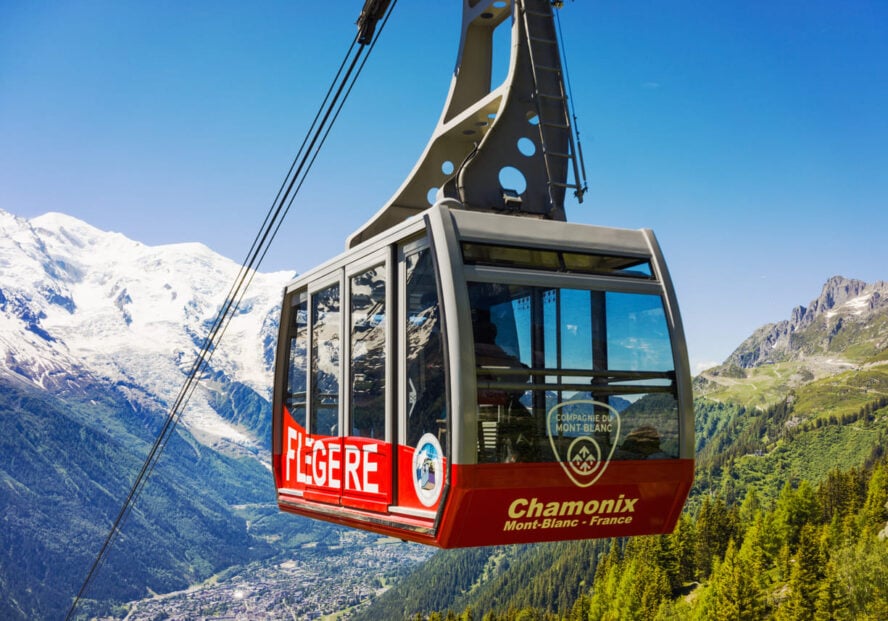
Yes, you can ski in the Alps in summer, and this is one of the unique things about Europe.
There are glaciers in the Alps, and some areas offer glacier skiing even when it’s summer down in the valleys. That’s one of the reasons skiing in the Alps is such a bucket-list experience for so many people.
Zermatt is a good example of a place where you can ski almost all year. And in the Mont Blanc range, you have glaciers too.
Now, I want to be honest about what summer skiing really is.
It’s not the same as mid-winter powder days. Summer skiing is usually early mornings, firmer snow, and limited terrain compared to peak season. It’s more about the experience of skiing high on a glacier when it feels impossible anywhere else.

No time like the present
And there’s another reason I talk about glacier skiing with guests.
I’ve seen it with my own eyes in Chamonix. The Mer de Glace glacier above town is a perfect example. Photos from the early 20th century compared to today show how much it has retreated.
We are lucky to have glaciers, and we are lucky to be able to ski on them. But it’s going to be less and less possible in the next decades.
So if you want that experience, don’t wait forever.
How much does it cost to go skiing in the Alps?
This is the question everyone asks now, and I don’t blame you.
Skiing has become expensive everywhere, but the price difference between North America and Europe has gotten huge.
In the Alps, even in the most expensive resorts in France, a day pass maximum is usually around 100 Euros. Switzerland can be more expensive, yes, but still, it’s often less shocking than what people are seeing in the US.
I was in Big Sky, Montana last spring, and the day pass was over 200 dollars. Just crazy.
And it’s not just lift tickets. The biggest money-saver is choosing the right base so you’re not stuck paying premium prices for bad conditions. Food, accommodation, and the overall cost of the trip can work out better in the Alps, especially if you plan it well.
The other thing you’re paying for in the Alps is variety.
You’re not just buying a ski trip. You’re buying access to multiple countries, multiple cultures, and an insane range of terrain in a small area.
For me, that’s part of the value, and it’s one more reason skiing in the Alps keeps pulling people back.
The types of skiing you can do in the Alps
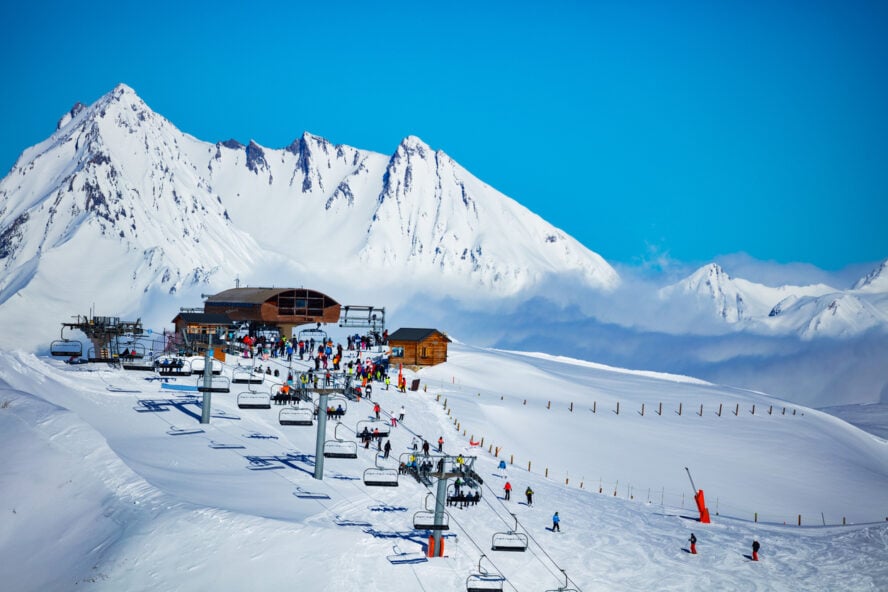
When people picture skiing in the Alps, they often picture deep powder and steep lines. And yes, that exists.
But the Alps are not only about powder. There are amazing days on piste, amazing days off-piste, and amazing ski touring days, depending on what you want and what conditions allow.
On-piste skiing
Piste skiing in the Alps can be incredible. Long descents, perfect grooming, huge views, and massive lift networks.
Some days, especially when visibility is poor or avalanche conditions are complicated, piste skiing is exactly what you want.
Off-piste skiing
Off-piste is when you leave the groomed piste but still use the lifts to access terrain.
It can be two meters (6.5 ft) next to the piste, or it can be much farther. But you’re not hiking for your turns, you’re skiing ungroomed snow accessed from the resort.
In Europe, you can often do this freely, but it’s your responsibility once you leave the piste.
Ski touring
Ski touring, or ski randonnée, means you climb uphill with skins and touring bindings, then ski down.
It doesn’t have to be extreme. You can do a one-hour tour, ski a great descent, then enjoy a long lunch. Or you can do a full-day mission and finish completely cooked.
Both are real ski touring days, and both can be unforgettable, and for a lot of people it becomes the best part of skiing in the Alps.
The glacier run you should do at least once
If you come to Chamonix, I think there’s one experience you should put on your list: the Vallée Blanche.
It’s a world-famous ski descent from the top of the Aiguille du Midi cable car. It’s a glacier run, completely off-piste, starting at around 3,800 m (12,467 ft).
Depending on conditions, you can ski down to Montenvers around 2,000 m (6,561 ft), or sometimes all the way back down to Chamonix. That’s about 20 km (12.4 mi) and almost 3,000 m (9,842 ft) of vertical.
But here’s what surprises people: the classic Vallée Blanche is not about steep, hardcore skiing. It’s pretty easy. It can be flat in places. You’re mostly following the glacier.
What to expect on the Vallée Blanche
The reason it’s famous is the scenery. You’re skiing through the heart of the Mont Blanc massif, surrounded by peaks, seracs, and ice. The start is iconic. You come out of the cable car and you’re on a ridge. We often rope up with harnesses and walk down before we ski.
And because it’s on a glacier, you need proper equipment and you need to understand the risks. I’m not going to tell you that you must hire a guide, but if you don’t know glacier travel and you don’t know the route, it’s a very good idea to go with someone who does.
If you’re comfortable on all the red pistes in the Alps, you can usually handle the Vallée Blanche in good conditions. But you always need to check locally, because wind and weather at 4,000 m (13,123 ft) can make the snow tricky.
And honestly, for me, this descent is one of the reasons skiing in the Alps feels so unique compared to almost anywhere else.
My best advice for finding the best skiing in the Alps
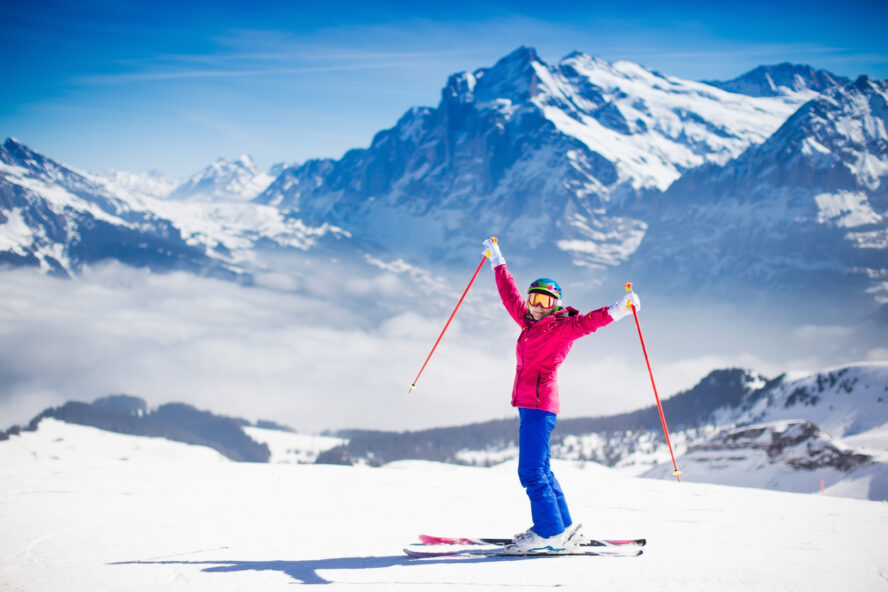
If you want the best skiing in the Alps, don’t chase one famous resort name. Chase conditions. Chase the experience you want. Give yourself the freedom to move.
The one decision most people get wrong is this: they lock themselves into one resort for the whole week and hope it works out, instead of choosing a base and building the trip day by day around the best conditions.
That’s why I love guiding from Chamonix. It’s not because it’s the biggest resort or the easiest place. It’s because it gives you options.
Why Chamonix is the perfect base for chasing conditions
Within an hour, I can choose between France, Italy, and Switzerland. I can play with the weather. I can find better snow. I can find better visibility. I can find a better day.
And that’s what the Alps reward. Flexibility, curiosity, and a little bit of local knowledge.
Come ski here. You have to feel it. And if you end up in Chamonix, I’ll show you exactly what I mean when I say you’re standing in the middle of one of the best playgrounds on earth for skiing in the Alps.
Right now, whether you’re dreaming of your first trip or you’ve already done a few seasons of Alps skiing, the best approach is always the same: stay flexible, follow the conditions, and let the mountains guide the plan.
If you’re the type of skier who loves the convenience of a big Alps ski resort, you’ll probably feel at home in the high, purpose-built areas of Savoie, where the whole place exists to make it easy to clip in and go.