Greenland has this way of making you feel small in the best possible way. The first time I skied here, I remember standing up high, looking out across a sea of mountains and glaciers, and thinking, this is ridiculous… How is this even real? It’s just raw Arctic scale in every direction.
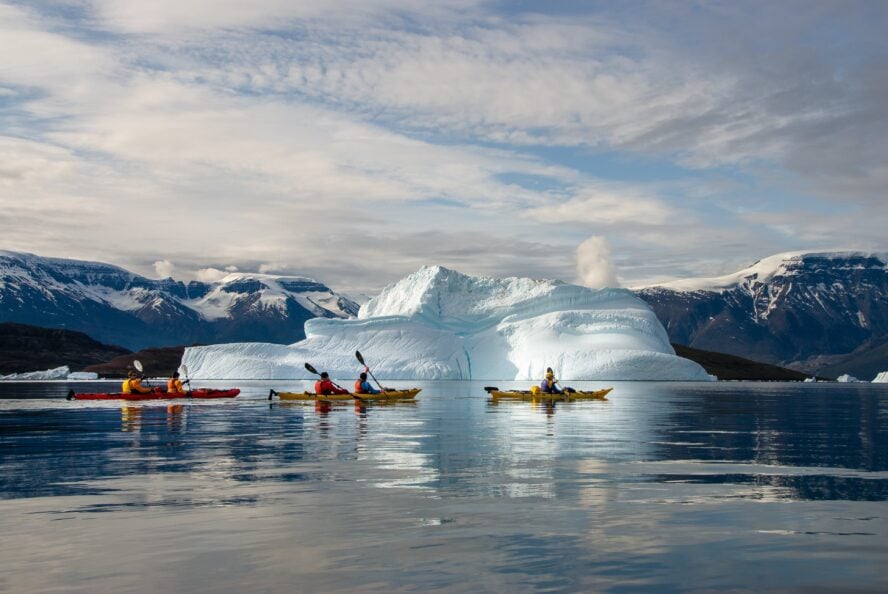
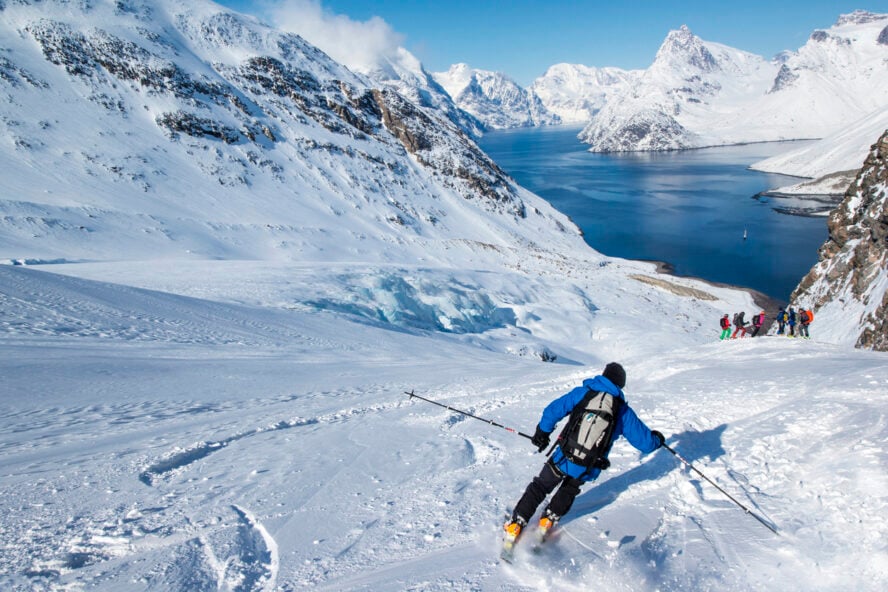
Then you drop in, and the whole thing gets even better. You’re linking turns with the ocean sitting right below you, icebergs scattered across the fjord like someone placed them there on purpose, and the light makes everything look sharper, cleaner, almost unreal.
Halfway down a run, I’ve caught myself laughing inside my helmet because it’s so beautiful it feels like a joke.
And the thing is, it never turns into a routine ski week. Greenland keeps you on your toes. We have an itinerary, but we rarely follow it, because the weather shifts, the ice moves, and the best days come from adapting. And the moment you start trusting the chaos, Greenland starts giving you days you couldn’t script if you tried.
Can you ski in Greenland
Yes. You can ski in Greenland, and it surprises people in the best way.
Greenland is a big place. It’s the largest island in the world if you exclude Australia, and it has the second-largest ice cap in the world. It’s wedged between Europe and North America, with Iceland to the east and Arctic Canada to the west.
One of the most unusual things about Greenland is there are no roads connecting communities.
If you want to go between one town and the next, you use an airplane, a helicopter (depending on distance), or a boat. In winter, if fjords are frozen and you’re trying to get between smaller settlements, you can use snowmobiles and dog sleds.
That lack of roads tells you what kind of place this is. It’s logistically challenging. But it’s also what keeps it wild. When you show up for skiing in Greenland, you’re stepping into something real.


What it looks like from the top
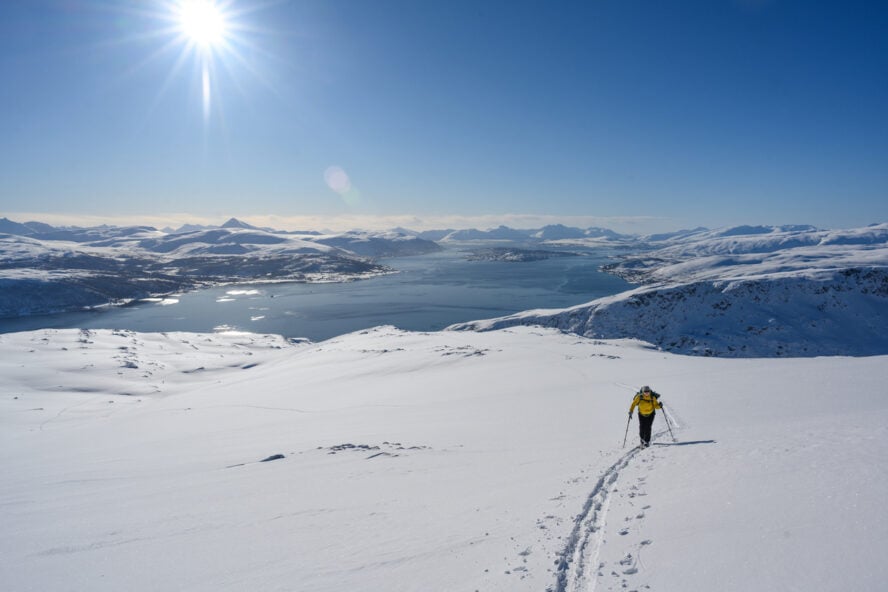
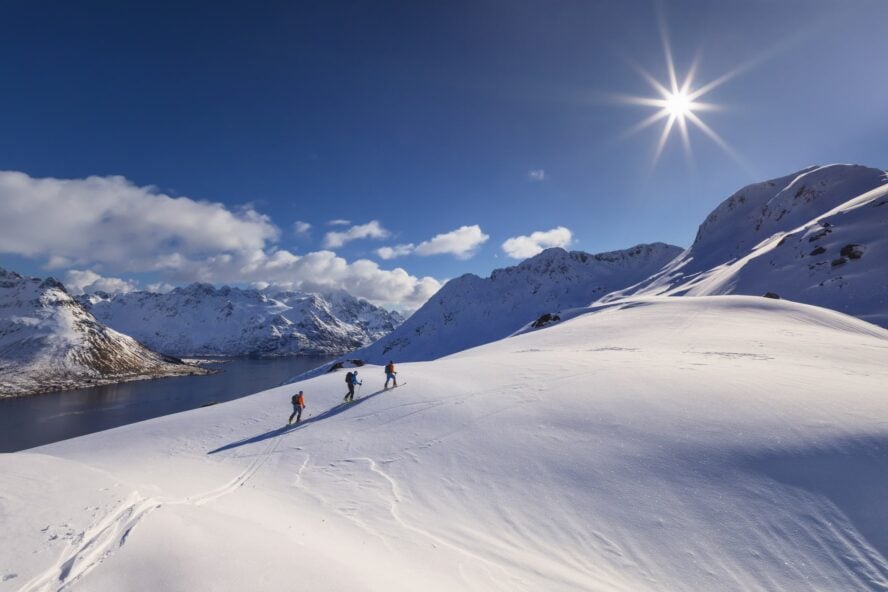
When you’re standing on top of a mountain here, you can see mountains for as far as the eye goes. You can see the ocean. A lot of the time you can see the Greenland ice cap in the distance. The water can be full of icebergs and glacier ice.
It’s vast. And that scale is a big part of why this place feels different.
Skiing to the ocean
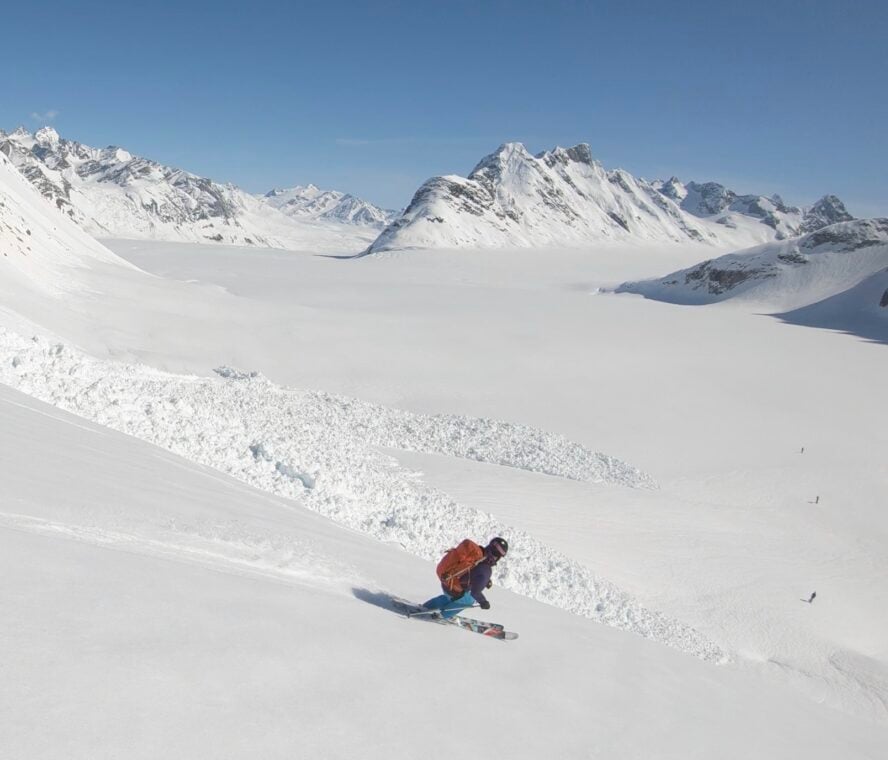
A big highlight is standing on a summit, looking down, and seeing the ocean. You ski or ride all the way down to the sea. Your line finishes at the water.
That changes the whole feel of a run. You’re not skiing toward a chairlift or a parking lot. You’re skiing toward the coastline. You finish and you look back up thinking, really? We just skied that all the way to the ocean?
That’s one of the reasons skiing in Greenland stays in people’s heads long after they leave.
Discovery is built in
We’ve been running trips here for about 10 years, and we’re still finding new places. We actively go out and look for them. We’ll ski zones we know are good, but we’ll also pick a day or two where we go somewhere new.
A lot of the time we find really cool things, like huge glacial caves we just happen to come across. That feeling of discovery is a big part of the adventure.
Is there good skiing in Greenland
Yes. It holds up day after day.
But “good” depends on what you’re chasing, so I’ll tell you what makes it work.
Terrain variety: mellow to steep
Greenland has a really good variety of terrain. You’ve got mellow glacier runs with a consistent pitch, and you’ve got steeps and couloirs when conditions allow.
We can make it work for different strong skiers because we run two guides on every trip. Quite often we split into two groups. One group can go after harder terrain, and another group can have an easier day on more mellow slopes.
And we really try to facilitate what you want, not what we want. If you want a mellow day, we’ll go have a mellow day. If you want to push it and conditions allow, we’ll go find something spicier.
Maritime climate and snow stability
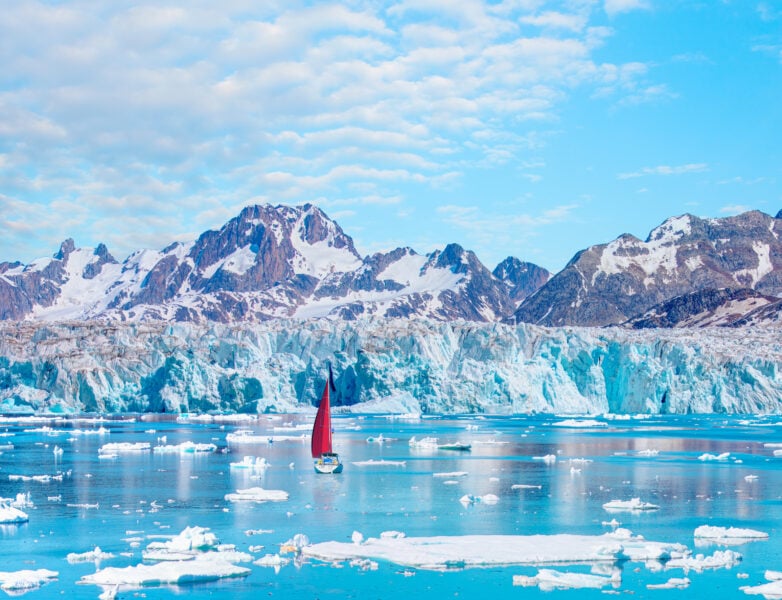
Greenland has a maritime climate, and most of the terrain we ski is close to the ocean. That gives you quite a bit of snow, and it often means pretty good stability avalanche-wise.
Generally, we’re not dealing with major avalanche problems all the time, which can open up steeper skiing options. It’s not always the case, but generally that’s what we find.
That’s a big reason skiing in Greenland can feel surprisingly consistent.
The scenery steals the show
The views are absolutely spectacular. You’re skiing down, boarding down, and you’re pinching yourself thinking, could this get any more beautiful?
You’ve got rugged peaks, glaciers, seracs, and icebergs in the fjords below. It’s the kind of skiing where you stop not because you’re tired, but because you need a second to take it in.
Does Greenland have ski resorts
Not in the way most people mean when they ask that.
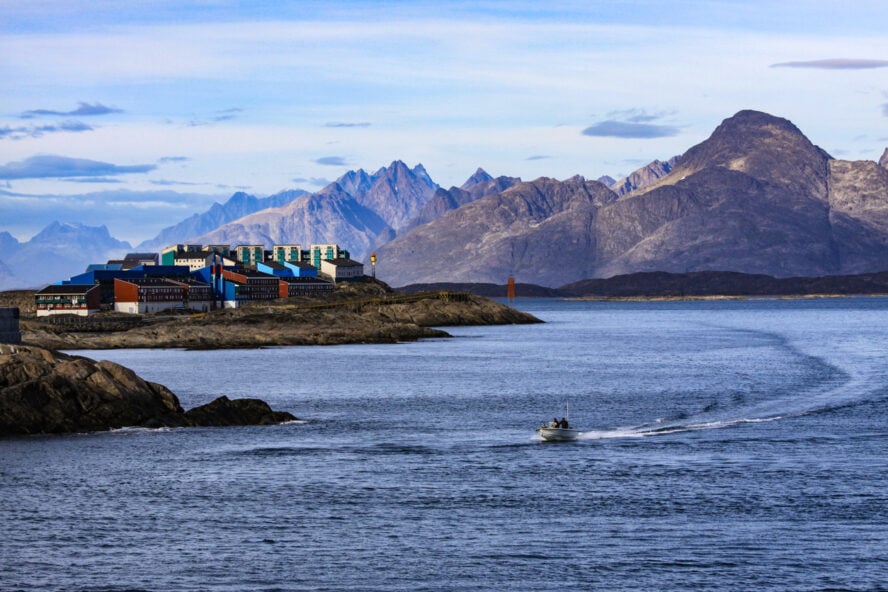
Greenland isn’t built around lift systems, resort villages, and roads connecting ski towns. It’s built around travel by air, boat, helicopter, and in winter, snowmobiles and dog sleds.
So the experience here is expedition-style. It’s about logistics, access, and being willing to adapt to weather and ice. If you want a resort week, Greenland isn’t that. If you want skiing in Greenland to feel like a real adventure, it delivers.
West Greenland vs East Greenland
Both coasts are incredible, but they feel different.
East Coast: ice and isolation
The West Coast was colonized much earlier than the East Coast, largely because of the ice. Ice comes across from the North Pole, hits the East Coast, and slides down. It blocks boat traffic and shipping.
That meant the people on the East Coast were basically cut off from Western civilization until about 1890. Even today, you can’t reach the East Coast for about six months of the year by boat. You can only fly in.
That isolation is one reason traditional culture has stayed so strong. Hunting, dog sledding, fishing, those are still major parts of life. The most revered man in a village is the best hunter.
West Coast: fjords and flexibility
The West Coast is largely ice-free in relative terms, so shipping can get in and it’s more developed. It’s a huge fjord system running up almost the entire coastline.
Mountains rise from sea level to around 2,500 m (8,202 ft), with big areas of glaciation. For skiing, it’s perfect for boat-based access because you can move through fjords and pick objectives as you go.
Skiing West Greenland: ski-and-sail touring from an expedition boat
Our West Coast trip is boat-based. It runs in April and early May. It’s eight days long, transiting through Maniitsoq, with 10 guests and two guides.
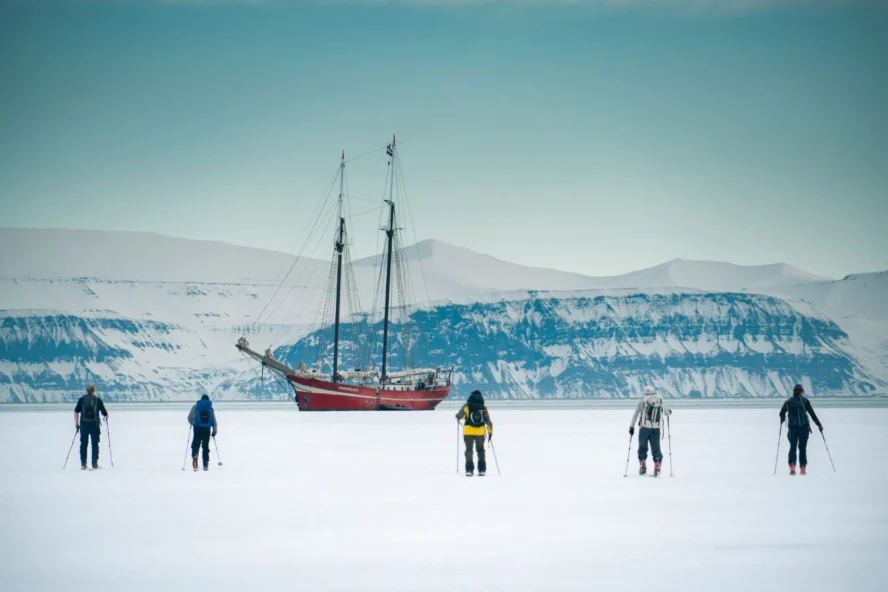
The boat we use is called the Kisak. It’s 90 ft (27 m) long and ice-strengthened. It’s cozy, warm, and set up well for ski touring. That comfort matters because you ski all day and you want to recover properly for the next day.
The fun part is how flexible it is. You’re cruising through fjords looking up at lines, and you’re basically choosing your objectives in real time. You tell the captain where you want to go, he drops you off, and you take a Zodiac to shore.

West Greenland is well set up for this because once you leave the beach, you’re straight into the terrain. It’s not long valley approaches. You climb, you ski, and when it’s good, you ski powder all the way down to the ocean.
You finish the run, unclip, step onto the beach, shoulder your skis, and walk back into the Zodiac. That’s skiing West Greenland at its best.
And because the crew is Greenlandic, you get a richer experience. You can ask questions about the place, the history, the fjords. It makes the trip feel connected to Greenland, not just “a boat trip with skiing.”
East Greenland skiing: heliskiing and village-based touring
East Greenland is where the logistics get trickier, but the rewards get bigger too.
We run two different trips there: a heli ski trip and a ski touring trip. Both go through Kulusuk, but they feel very different.
Heliskiing from Tasiilaq
The heli ski trip is hotel-based in March and late May. It’s eight days, with eight guests and two guides, and the goal is simple: ski every day the weather lets us.
If you’ve ever wanted to try Greenland heli skiing in a place that still feels truly remote, Tasiilaq is where it all comes together.
Day one always feels a bit surreal. You land in Kulusuk, we do the safety briefings, and instead of easing into the week, you’re basically getting changed right there at the airport and heading straight into the ski program. If the conditions line up, you’ll be skiing that afternoon.
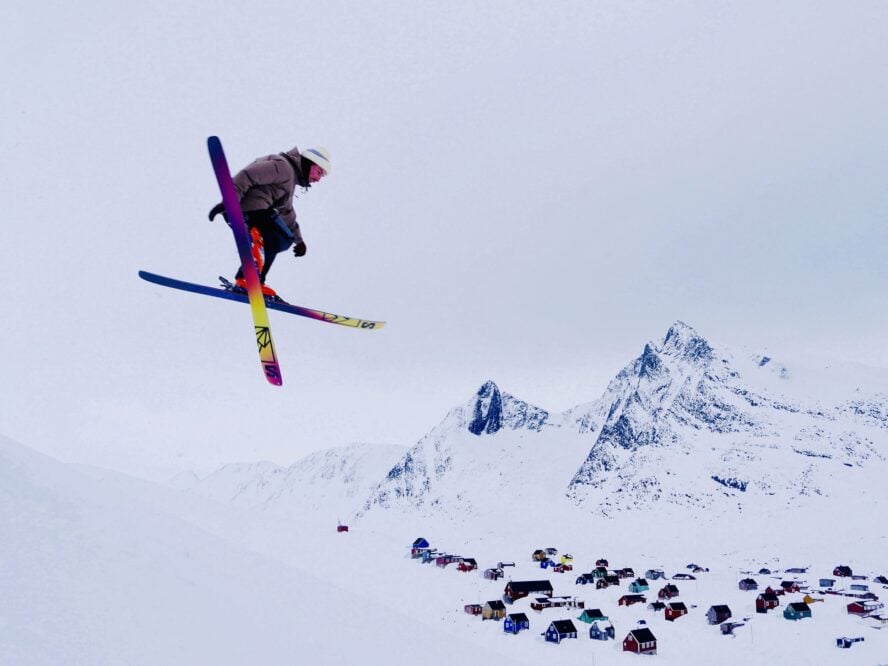
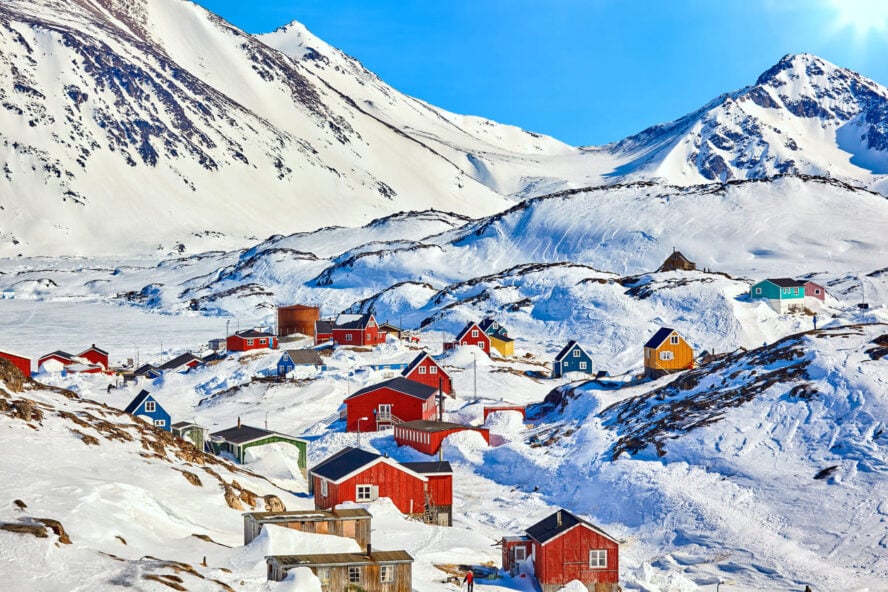
Tasiilaq is where we base ourselves, and it’s a pretty incredible place to wake up. You’ve got the town sitting there with a frozen fjord behind it and mountains rising up in every direction.

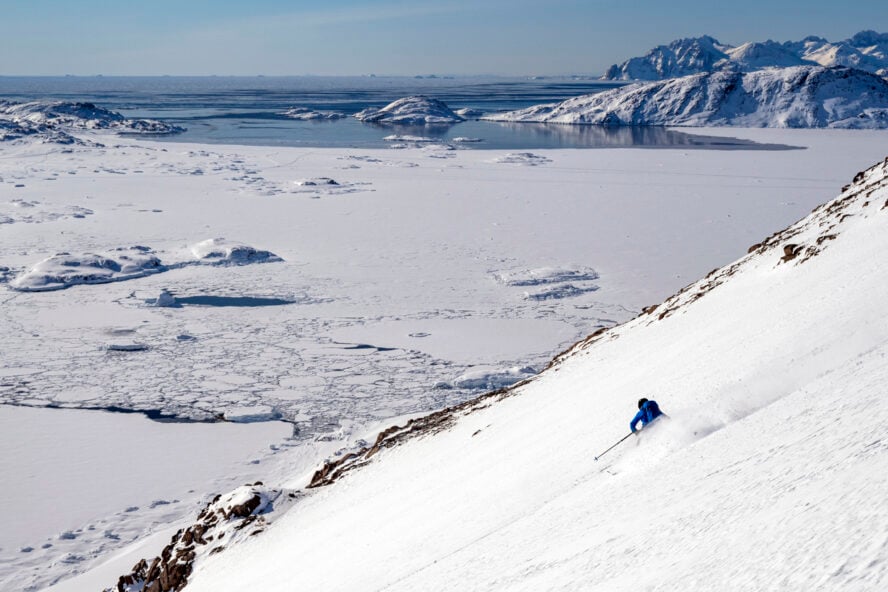
Most of the runs start around 1,000 to 1,500 m (3,281 to 4,921 ft), and almost all of them finish at the ocean. A lot of the time the snow is boot-top to knee-deep powder. It’s not always that classic waist-deep BC blower, but it’s consistently fun skiing and it suits the terrain perfectly.
The big advantage of a helicopter in East Greenland is access. It lets you get into places that would be extremely difficult, or sometimes basically impossible, to reach any other way. On the best weather days, I like flying further out into the glaciers and going looking for new zones, the kind of runs that have potentially never been skied before.
That’s the part that still gets me excited every single time.
Touring from Kuummiut
The ski touring trip runs later, in May and early June, and it’s a much smaller group: four guests and two guides. Part of that is the vibe we’re going for, and part of it is just reality. East Greenland touring is logistically challenging, and smaller groups move better out here.
We stay in Kuummiut, about 30 to 40 km (19 to 25 mi) from Kulusuk.
A village built for ski touring
Kuummiut is where Greenland ski touring clicks for me: step out the door, start climbing, and ski right back into town.
It’s a small settlement, tucked right into the mountains, and it’s reputed to get the most precipitation in the area, which usually means the best snow. What I love about it is how close everything feels. You’re not commuting to the skiing. You walk out the door and you’re already in it.
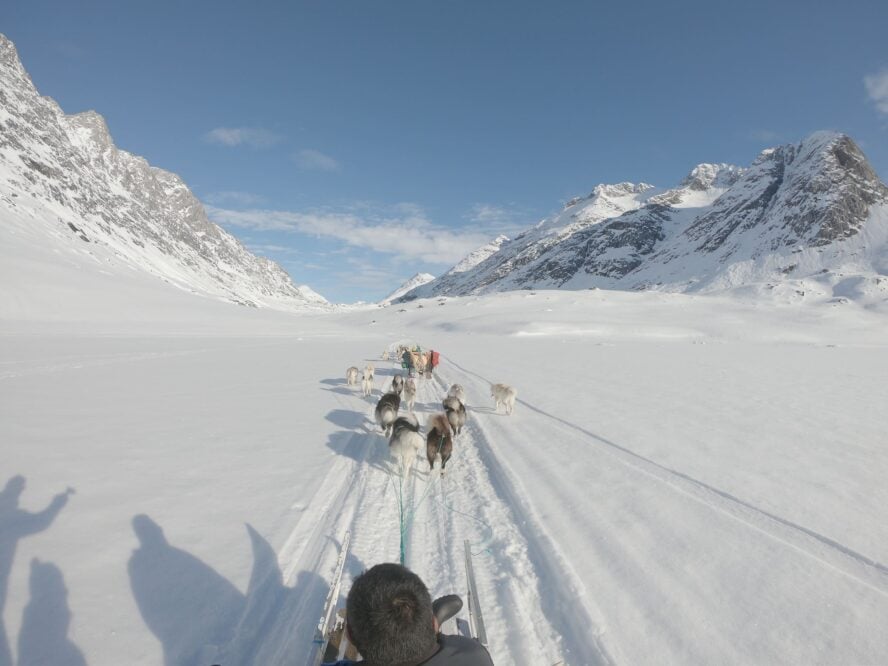
Some days we tour straight from the village. Other days we use boats or dog sleds to get into different zones, and those approaches end up being half the experience.

Dog sledding in particular is always a bit chaotic. You’ve got a team of about 10 dogs, every one of them with a different personality, and the musher is doing whatever it takes to keep them pointed in the right direction. You’re sitting there watching peaks slide past, thinking, how did this become my commute to a ski day?
By May and June, we’re skiing corn, and I’ll take that any day. It’s predictable, it’s smooth, and it’s comfortable. A lot of the time you’re skinning in a t-shirt, then dropping in with light layers on, carving turns with the ocean right below you. When you ski a full line from the summit down toward the sea, you finish the run, look back up, and just grin.
Arctic conditions: what to expect day to day
The biggest thing I tell people about skiing in Greenland is to come ready to adapt.
Greenland isn’t scripted. Weather changes. Ice shifts. Plans change. We have an itinerary, but we rarely follow it. We start at Plan A and work to Plan B and Plan C, and that flexibility is part of the experience.
On the East Coast, you might have one or two down days per week where you can’t fly because of weather. But we use those days. We’ll organize dog sledding, you can ski tour right from town, and there’s a museum where you can find out more about the culture and history.
One sunny day we decided to take a rest day. We went dog sledding out onto the ice, locals cut a hole in the ice for us, and we went fishing. We caught a bunch of fish, including wolf fish, brought it back, and cooked it up.
That’s Greenland. The skiing is the focus, but the days are full.
Who these trips are for
This is a remote part of the world, so I like to set expectations early, not to scare anyone off, but so you get the best possible experience out of the week.
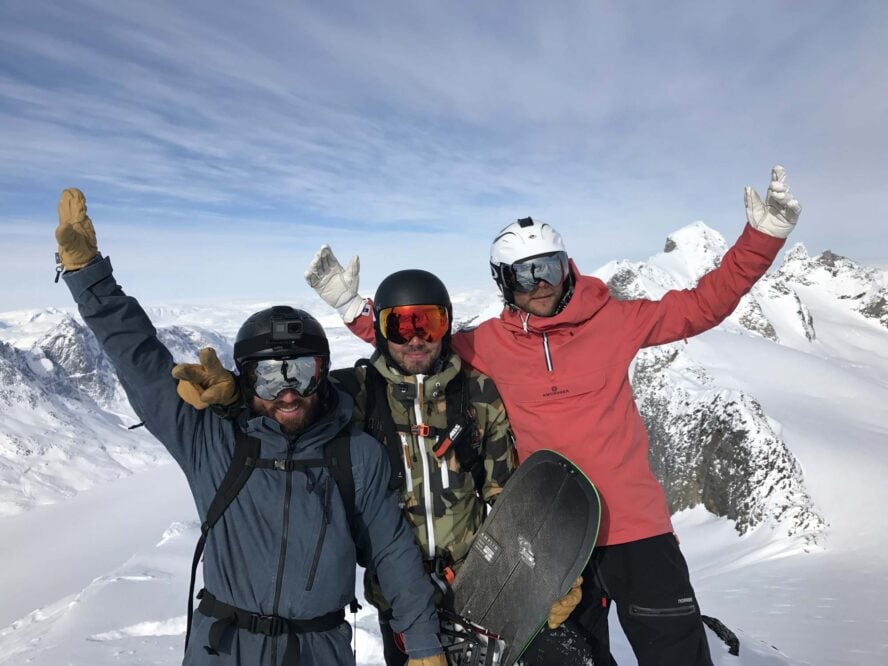
For these trips, we ask that you’re a confident, advanced skier who can handle Black Diamond terrain and stay in control in a mix of conditions. Greenland is much more fun when you’re confident in your skiing, because it’s remote and we want everyone feeling solid out there.
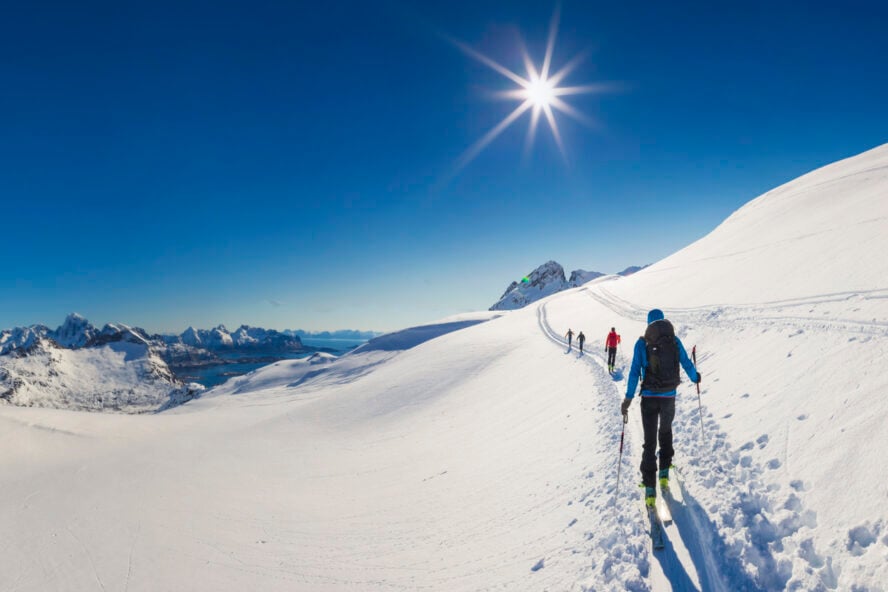
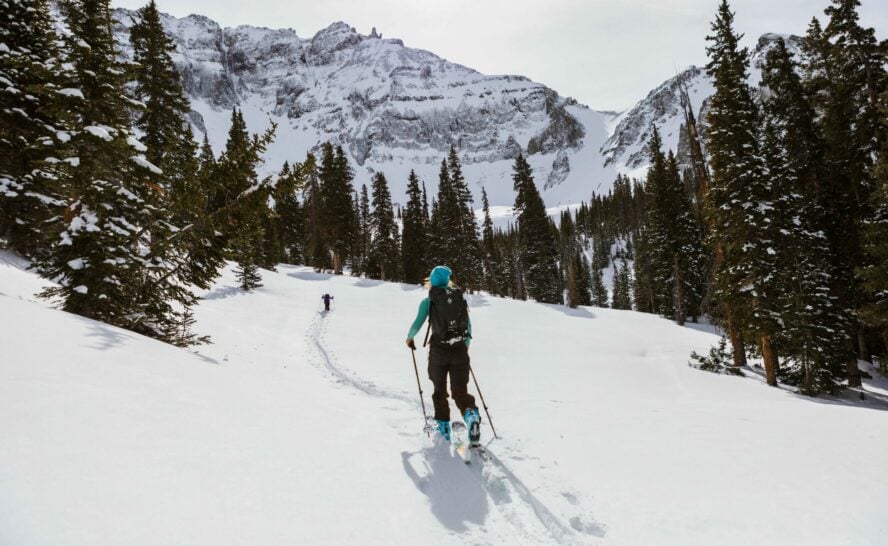
If you’re joining a ski touring trip, a good benchmark is being able to skin about 1,200 m (3,937 ft) in a day, and do that for consecutive days. We don’t always hit that number, sometimes it’s more, sometimes it’s less, but it’s a solid reference point for the kind of effort involved.
Most days you’ll be on your skis for around eight hours, and the fitter you come in, the more you’ll enjoy it, especially when the big days stack up.
The good news is we always have two guides, which gives us a lot of flexibility. If you want a more mellow pace and less vertical, we can absolutely do that. And if you’re feeling strong and want to go after bigger terrain, we can do that too, as long as conditions line up.
The Greenland extras: icebergs, wildlife, culture
The skiing is the focus, 100%, but Greenland gives you more than skiing.
In March and April, and sometimes into early May, it’s a great place to see the Northern Lights. You can be in a village or on the boat and watch them dancing overhead.
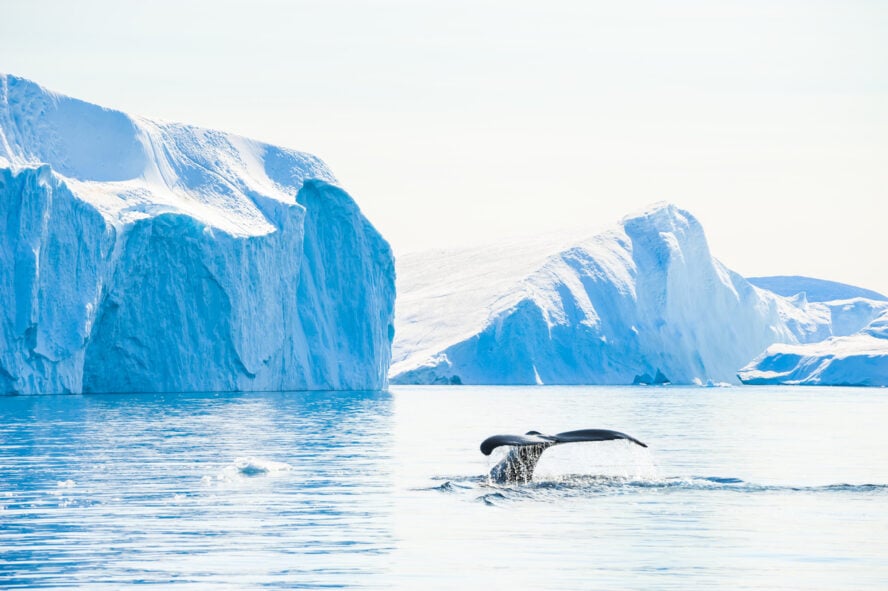
Icebergs are a constant feature too. Sometimes they’re embedded in the ice in frozen fjords and you can walk right up to them. Sometimes you’re transiting by boat and the water is full of them. A lot of the time you’re skiing down a run looking at a fjord full of icebergs that came off a glacier.
Wildlife and culture
We regularly see whales. Occasionally Arctic foxes. Very occasionally polar bears. We take precautions when we ski and guides carry a gun. We’ve never had to use it, thankfully, but it’s part of operating responsibly in polar bear terrain.
And one of the biggest things guests talk about is the culture. The people. We try to build an immersive experience. We encourage you to get to know people and understand how the land has shaped their lives.
That’s why skiing in Greenland never stays “just skiing.” You come home with stories you didn’t even know you were going to get.
Why skiing in Greenland stays with you
I’m not going to oversell it. Greenland isn’t easy, and it’s not meant to be. The logistics are real, the weather makes the calls, and you need to show up ready to adapt.
But if you do, skiing in Greenland delivers something most places can’t anymore: space. Real space. Big terrain, long lines, and the ocean sitting right there at the bottom, like the finish line of the whole day.
You’ll ski good snow.
You’ll ski steep when it’s smart.
You’ll ski mellow when that’s the right call.
By the end of the week, it won’t feel like you went on a ski trip. It’ll feel like you earned your turns in a place that doesn’t bend to anyone’s plans.