People think Chamonix is all about big objectives. I think it’s about good decisions—and I’ll show you how I make them.
I’ve been guiding in Chamonix for about 25 years, and I still love the mornings when the valley hasn’t fully woken up yet. The cafés are quiet, the streets feel almost too calm, and above the rooftops the whole massif is already lit up, like it’s been working for hours while we were sleeping.
That’s what Chamonix climbing feels like to me.
Immediate. Serious. Beautiful in a way that doesn’t ask for permission.
The rock here isn’t “a crag,” it’s a mountain face. The approach isn’t a warm-up, it’s part of the day. And when you finally touch the first holds, you can feel the difference straight away, because everything has weight up here: the altitude, the exposure, the history, even the silence.
You don’t come to Chamonix just to climb routes.
You come here because the valley has a way of turning a normal day into something you’ll replay in your head for years.
And the scary part is… it only takes one day to get hooked.
Why Chamonix works
Chamonix sits in a corner between France, Switzerland, and Italy, and that geography is not just a fun fact. It’s a tool. It’s one of the reasons climbing in Chamonix feels so varied day to day, even when you’re staying in the same town.
Geneva airport is close, and once you’re here, you can “play with the weather” in a way that makes the Alps feel generous. If the bad weather comes from the north, it can get stuck on the French side while Italy is clear. Other days it flips.
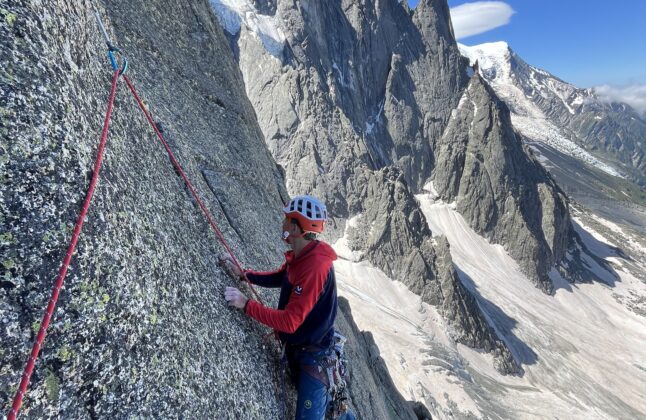
That means you’re not locked into one plan. You can shift valleys, change aspect, and find better conditions without turning it into a full travel day. Courmayeur in Italy is roughly 30 minutes away by car, and Switzerland is often about 45 minutes, depending on the passes.
It’s one of the reasons so many guides are based here. The mountains are famous, sure, but the real advantage is that Chamonix gives you options, and options are everything.
Altitude changes the game
Chamonix town sits around 1,000 m (3,281 ft).
Aiguille du Midi rises to 3,800 m (12,467 ft).
Mont Blanc is 4,800 m (15,748 ft).
Those numbers explain the mood swings you can get in a single day. The valley can feel like summer while the upper mountain feels like winter, and the rock can change personality depending on aspect and time of day.
The snow line moves every season, roughly between 2,500 m (8,202 ft) and 3,500 m (11,483 ft). North-facing terrain holds on longer, and glacier approaches change constantly through summer as crevasses open and snow bridges thin.
In summer, the best days start early, because glaciers and loose rock don’t get friendlier with heat.
If you want Chamonix climbing to feel smooth, the secret is flexibility: have a few objectives in mind, and choose the one that matches conditions today, not the one you promised yourself six months ago.
Crampons first, granite later
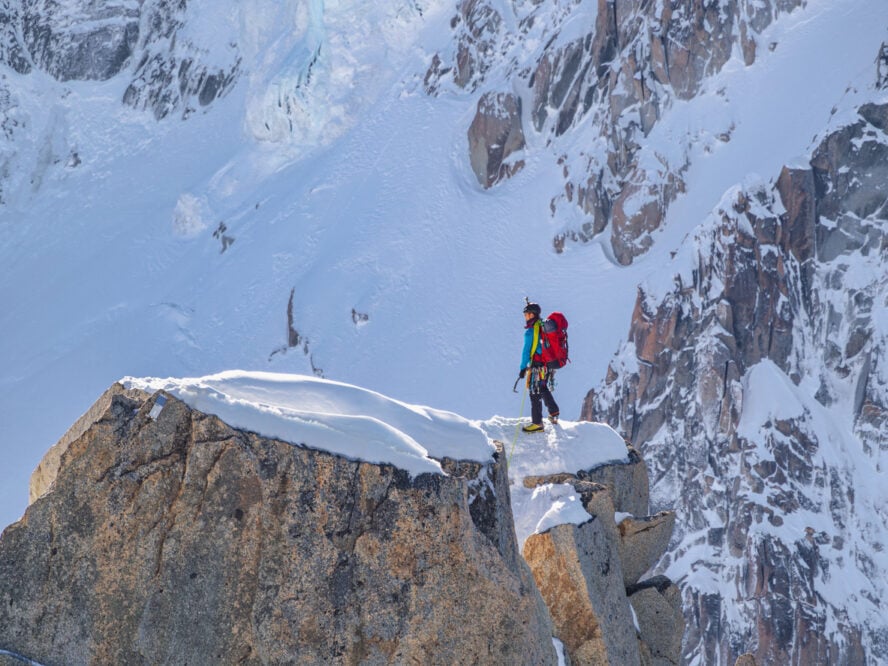
A lot of people come here thinking, “I only want rock.” I understand. Granite is addictive. But glacier access means crampons, and crampons mean you need to be comfortable moving on snow and sometimes ice.
That’s why I like to start progression with basic ice and crampon technique. Not because everyone wants to climb steep ice, but because it unlocks safer access to the best terrain.
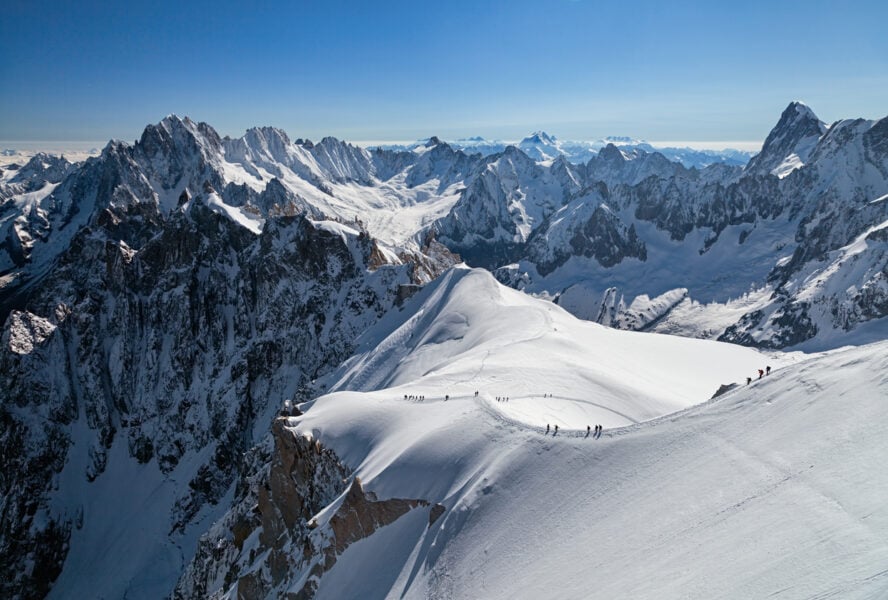
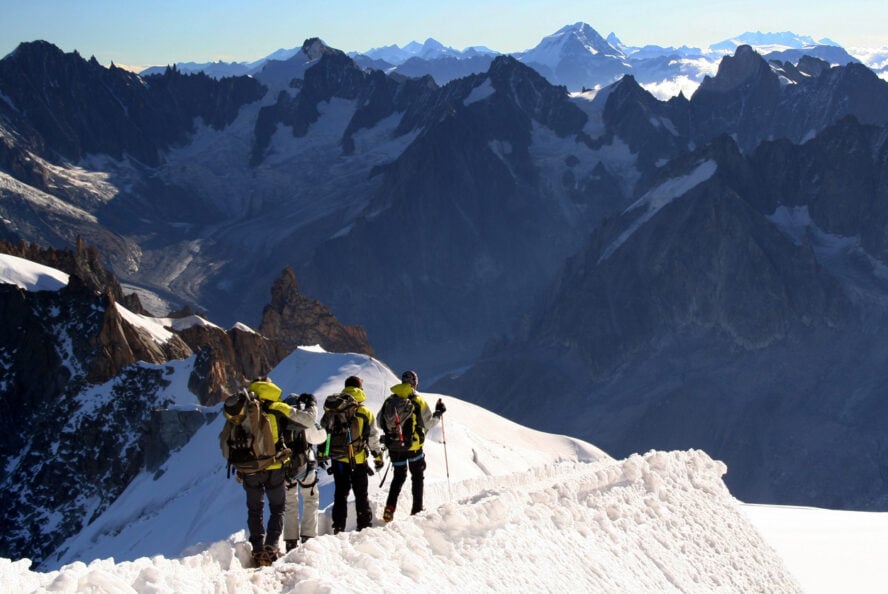
There’s also one moment that proves the point. The arête descent from the top of Aiguille du Midi to the glacier is not technically hard, but it is very impressive. One side drops toward the valley, the other into the high basin. If you can move calmly there, the rest of your day opens up.
If I had to sum up Chamonix climbing in a sentence, it would be this: the door to the best rock often starts with snow.


How I break down the valley
When I plan a day, I sort the valley into four “toolboxes.” Each zone has a different type of rock, a different level of commitment, and a different kind of learning curve.
This is how I keep Chamonix climbing from feeling overwhelming.
I start most people in the Aiguille Rouge, move them onto the needles, and only then take them onto glaciers when the movement is calm and efficient.
1) Aiguille Rouge
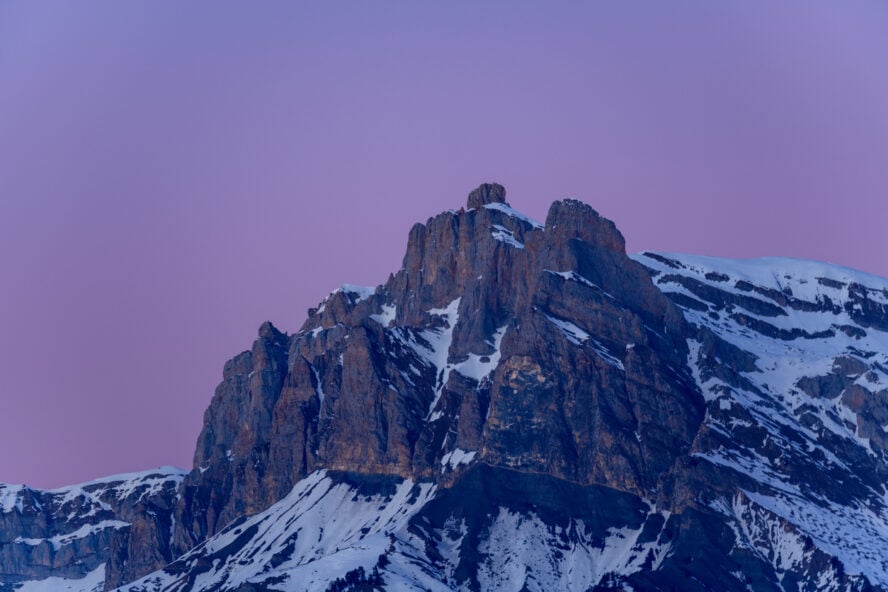
Aiguille Rouge is the smaller range opposite Mont Blanc. It’s not granite, it’s gneiss.
Sometimes it’s a bit more fragile, sometimes more broken, but it can also be steep and athletic. The big advantage is access. Lifts put you close to routes, and you can climb a real multipitch day without feeling like you’re committing to an expedition.
2) Needles above town
The Aiguilles de Chamonix are those sharp granite needles that you see from the street café, and they’re a big part of why Chamonix climbing has such a myth.
The rock is compact, the lines are clean, and the scenery is not subtle. The middle station of the Aiguille du Midi lift is a game changer because you can reach major terrain quickly, which is rare in the Alps.
3) High glacier pillars
Higher up, you get into glacier approaches and big red granite pillars. This is the world of Mont Blanc du Tacul basins, where the rock quality can be outrageous and the setting feels properly alpine.
The climbing may be “only” 5.8 or 5.10, but the approach is on glaciers, and that changes everything. Timing, route choice, and efficiency matter.
4) Les Drus and friends
Les Drus is iconic, and not because people talk about it a lot.
It’s iconic because of shape and scale. The faces rise over 1,000 m (3,281 ft), and the mountain has collected stories for generations. The serious walls here are committed, and the easier way is still a proper alpine undertaking.
Start smart
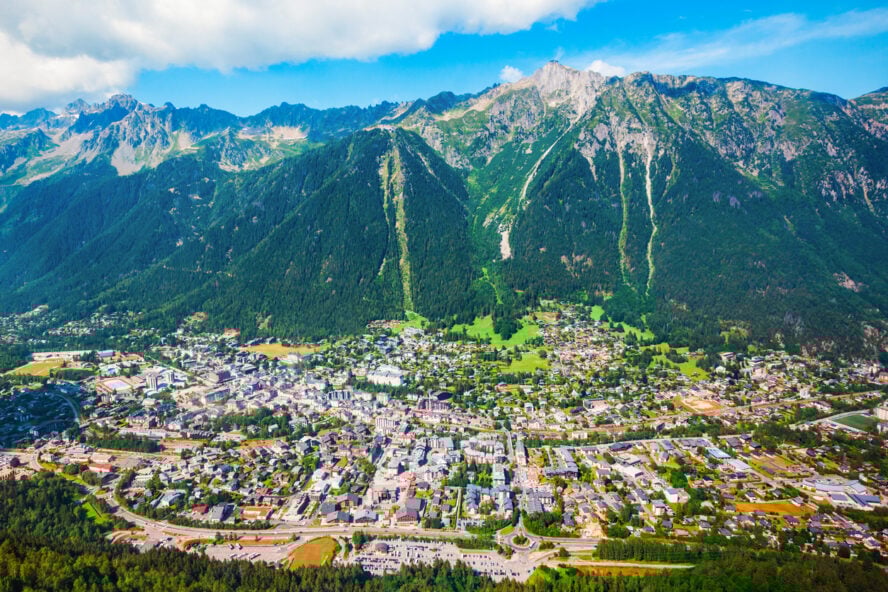
A mistake I see is people arriving and immediately chasing the biggest objective. I’d rather use the first day to build confidence and sharpen systems. When I’m guiding, a good first-day goal is simple: move well, manage transitions, and finish with energy left.
On the Brevent face, for example, you’ve got a wall around 200–250 m (656–820 ft) high and classics like La Frison around 5.10a/5.10b.
It’s valley-accessible but still “real.” You learn to climb with space under your heels, and you get a clean view down to town that reminds you where you started.
This kind of day is why Chamonix climbing works for so many levels. You can make it as chill or as spicy as you want, and you’re still plugged into the big mountains all day long.
Ridge days, alpine lessons
I love ridge traverses in the Aiguille Rouge because they let you practice “alpine movement” without glacier risk.
Traversée des Perrons is a great example. It’s not technically hard, often done in hiking shoes, but it’s still a real day: scrambling, a bit of abseiling, and that constant up-and-down rhythm.
These are the days where you learn to pace yourself, manage exposure, and stay calm when the rock is not perfect. Learning that is valuable because Chamonix climbing is not always gym-style granite.
Sometimes the mountain reminds you it’s still a mountain.
Papillon Ridge: the perfect first needle
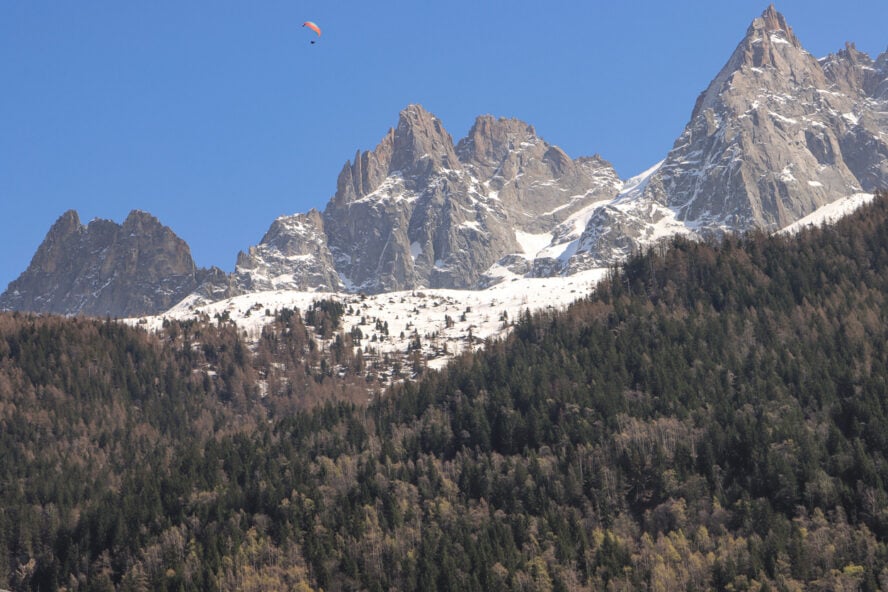
If someone wants a first proper needle outing, I love taking them onto the Papillon Ridge on Le Peigne.
It sits around 3,000 m (9,843 ft), and it’s the kind of route where the difficulty is reasonable but the atmosphere is very real. The hardest moves might be only a few meters, something like 3 m (10 ft) of 5.9-ish climbing, but it’s north-facing, often cold early, and you’re on a ridge where your brain is awake in the best way.
I always say it out loud on days like this: in the Alps, the descent is part of the climb. If you add the summit, the route becomes longer and more committed, even if it doesn’t get harder. In Chamonix climbing, that’s one of the first lessons people learn. Grades are only one piece of the puzzle.
And sometimes, the mountains give you weird magic.
I’ve seen the brocken spectre up there, our shadow projected into clouds with a halo around it. It’s not why you go climbing, but it’s the kind of moment that sticks in your memory as much as the crux.
Envers: long granite days
On the south-facing side, especially around the Envers des Aiguilles, the rock feels endless. Routes can run for hundreds of meters, and the walls can feel like a full day of granite above a glacier world. This is a place for early starts, solid systems, and a real appetite for moving all day.
When people ask me what makes Chamonix climbing different from a normal rock trip, I point to days like this. You don’t just “send a route.”
You travel through terrain.
You manage time.
You read the sky.
You commit, and you earn the summit.
Pyramide du Tacul: the first big one
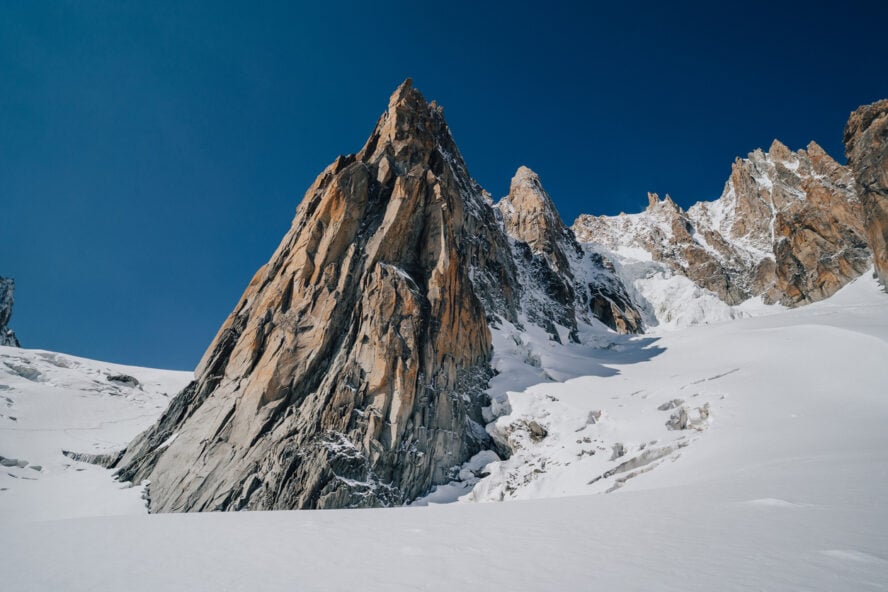
If you want one objective that captures the feeling of high-altitude rock with an accessible grade, Pyramide du Tacul is hard to beat. The climbing is around 5.8, very reachable for a lot of people with solid multipitch experience.
The rock is excellent, the views are absurd, and the summit is a perfect shape.
The catch is not the rock. It’s the glacier. In summer, crevasses open, and that means rope travel, good decisions, and moving early. Here, Chamonix climbing becomes a combined skillset: rock climbing plus glacier travel skills.
When you top out on that perfect pyramid, it’s the kind of summit that makes you grin even if you’re exhausted. You touch the point, take the photo, and then usually downclimb a couple meters because the true tip is sharp and awkward.
That’s alpine honesty.
Grand Capucin: the red icon
Grand Capucin is the famous red pillar, about 400 m (1,312 ft) of steep granite that looks like it was carved to intimidate you. Most routes are hard, but the Swiss Route around 5.10+ is the “classic doorway” for strong climbers who want that experience without living in 5.12.
It’s steep, it’s beautiful, and it’s serious.
You don’t climb it for the grade. You climb it for the line, the color, the space, and the feeling that you’re moving on something iconic.
It’s Chamonix climbing at its most photogenic, but also at its most demanding in terms of efficiency and composure.
Dent du Géant: a 4,000 m (13,124 ft) summit with teeth
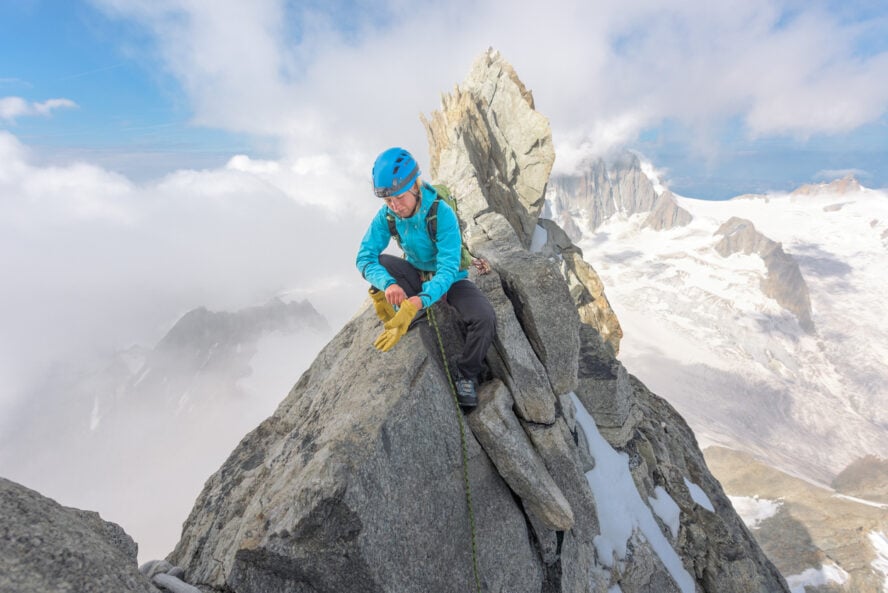
Dent du Géant is a famous 4,000 m (13,123 ft) peak, and it has a very specific personality. The final rock section is about 150 m (492 ft), and the route is equipped with fixed ropes, which makes the climbing feel more “protected” than the exposure suggests.
But the tricky part is often lower: mixed or loose terrain, crampons, timing, and conditions. You don’t want it too warm, and you don’t want the rock to be too loose under your feet. When it’s right, it’s a brilliant alpine day and a summit that feels properly earned.
It’s another reason I say Chamonix climbing isn’t just rock or just ice. It’s the blend.
Les Drus: the serious classic
Les Drus is one of the most famous mountains in the valley, probably the most famous after Mont Blanc. The west and north faces are legendary and hard. The usual “normal” way for most climbers is the south face traverse because it’s the most reasonable line on a very unreasonable mountain.
You climb to the ridge, move along a pillar between shade and sun, tag the Petit Dru and Grand Dru, then descend by abseil down the south face.
To do it, you sleep at the Charpoua hut. The old hut was tiny, wooden, maybe 10–12 beds, and built over 100 years ago. It has been rebuilt, but the feeling remains: you’re sleeping in a place that exists only because people want to be on those walls.
This climb is rarely a casual two-day outing now. Often it’s closer to three days unless you’re very fast. For me, that is Chamonix climbing in its committed form: long, exposed, and deeply memorable.
How I build progression
When I’m guiding beginners or intermediates, the goal is simple. Learn, be safe, and do it in a nice environment. I want you to understand movement, safety systems, and decision-making, not just “follow me.”
A common progression I like is a day on snow and crampons, a day on rock in the Aiguille Rouge, then a higher objective like Arête des Cosmiques (Cosmiques Ridge) or a classic needle route. If you extend it, you finish with a summit day like Aiguille du Tour, which is a perfect first true mountaineering experience.
That kind of structure is exactly what people mean when they look for a Chamonix mountaineering course. It’s not classroom learning. It’s learning the skills the terrain demands, one step at a time.
And if your focus is mostly rock, we can tune the plan. Day one gneiss mileage, day two granite needle technique, day three glacier-access granite. That’s often the cleanest way to step into Chamonix climbing without biting off too much too soon.
Logistics that matter
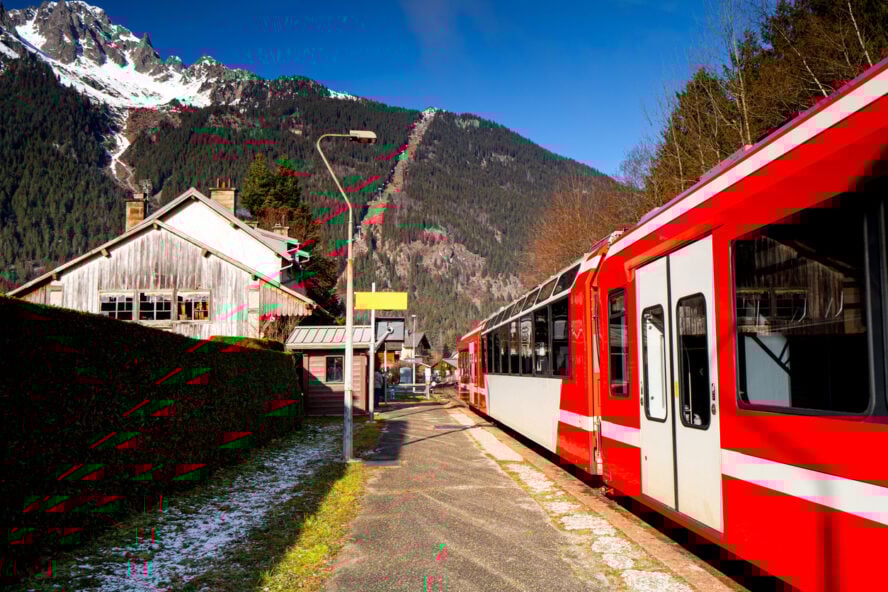
Getting to Chamonix is easy. Geneva is close, transfers are straightforward, and once you’re here you’ve got lifts, huts, gear shops, and a valley built around mountain life.
The harder part is choosing the right objective on the right day.
If you want your trip to feel smooth, keep your schedule flexible and let conditions guide the plan. Some days you’ll stay local. Some days you’ll drive to Italy. That’s not a compromise, it’s the game.
And if you don’t know where to start, you’re not alone.
That’s why Chamonix climbing guides exist. We don’t just take you up a route. We help you pick the right zone, the right line, and the right timing for your level and for the conditions you actually have today.
My advice before you come
If you want the short version, here it is. Chamonix climbing is not one style. It’s a spectrum.
You can start with lift-access gneiss and valley multipitch.
You can move to granite needles with real alpine ridges.
You can step onto glaciers and climb red granite pillars.
You can commit to iconic mountains like Les Drus.
And the best part is that it can all happen in one trip, if you build it in the right order.
So if you’ve been daydreaming about climbing in Chamonix, I’ll put it the way I say it to clients at the bar after their first big day: come with curiosity, come with humility, and come ready to adapt. Do that, and Chamonix climbing will give you more than you came for.
If you’ve ever dreamed of steep granite above a glacier, with Italy on one side and France on the other, trust me—it’s not marketing.
That’s a normal Tuesday here, when the weather behaves.
You just have to show up and try. The mountains will do the rest.