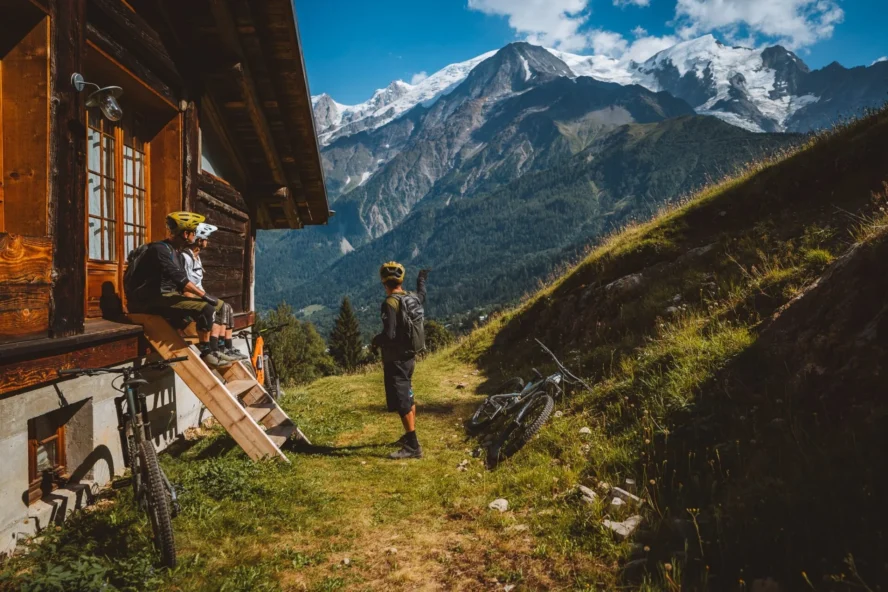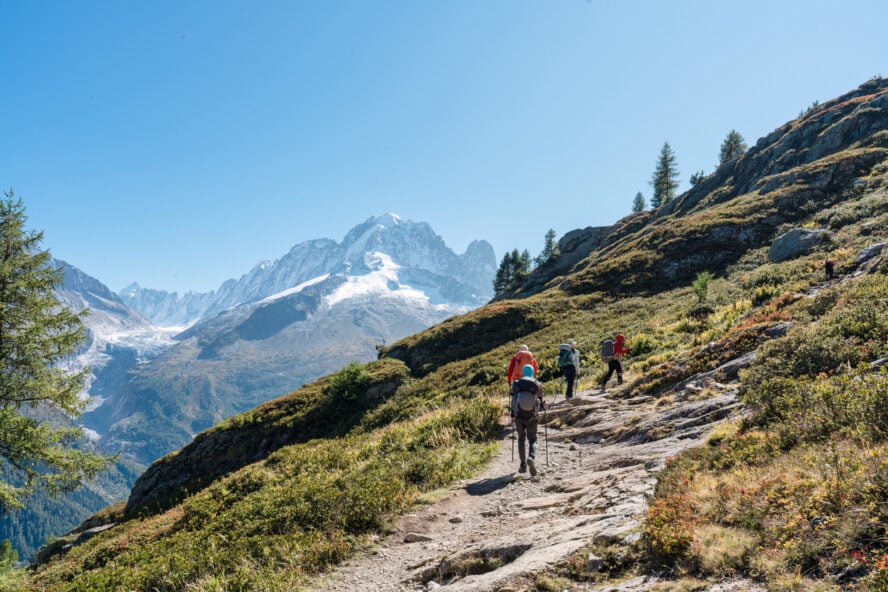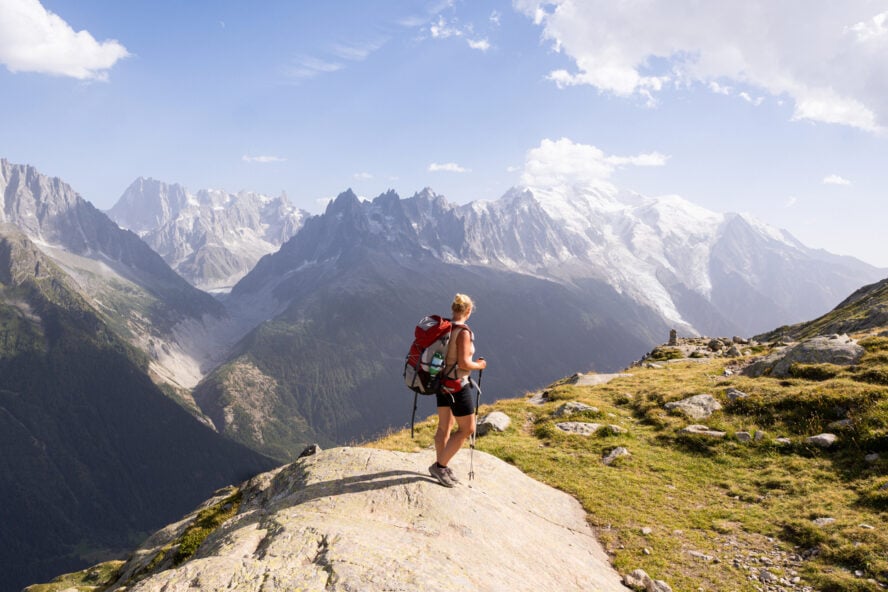

People often ask why hiking Tour du Mont Blanc continues to excite me. The answer is simple. It never repeats itself.
Light transforms valleys in minutes. Weather rewrites the day without warning. A familiar trail feels completely different depending on who you are walking with. That sense of uncertainty and discovery is what draws people to Tour du Mont Blanc hiking in the first place.
I was born in Chamonix, at the foot of Mont Blanc, where the mountains never fade into the background. They shape the weather, the rhythm of life, and the people who grow up among them. I followed my father into them before I could properly walk, and more than 25 years later, after circling Mont Blanc dozens of times, they still refuse to feel predictable.
A luxury hiking Tour du Mont Blanc trip does not make the mountains easier. It gives you the time and space to truly step into them, and once that happens, you realize this journey is not about finishing a route at all.
It is about discovering how far the mountains can pull you in.
Why hiking Tour du Mont Blanc is more than a trek
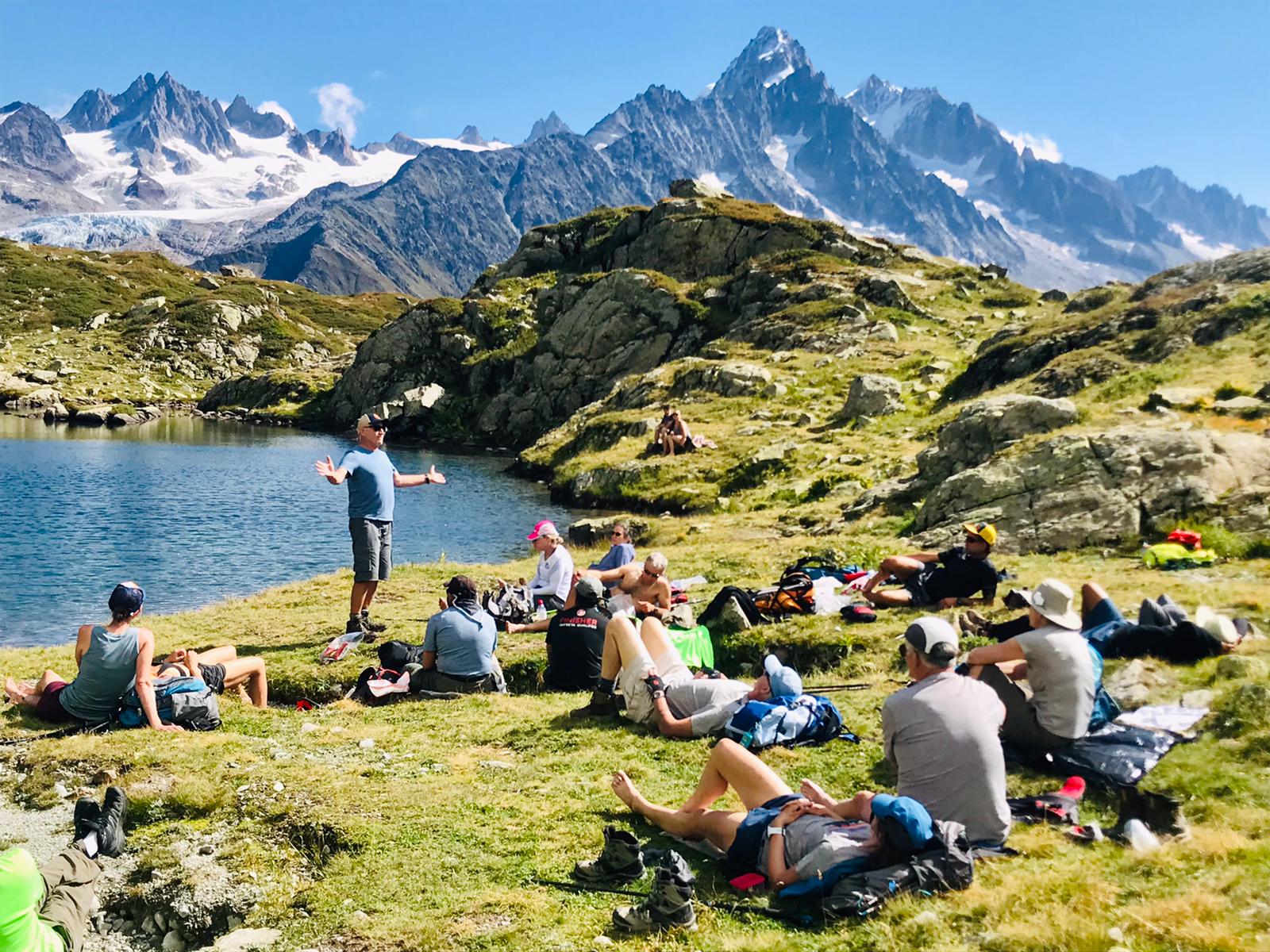
Hiking Tour du Mont Blanc is often described as one of the most famous long-distance hikes in Europe. That description is accurate, but it does not fully explain what it feels like to walk it.
This is not a single trail. It is a loop made of valleys, passes, balconies, and old routes that have connected people for centuries. You cross France, Italy, and Switzerland entirely on foot. You hear three languages. You eat differently in each country.
You notice how villages are built, how farms are organized, and how people relate to the mountains around them. That diversity is part of what makes the network of Tour du Mont Blanc hiking trails so distinctive.
A journey shaped by geography and culture
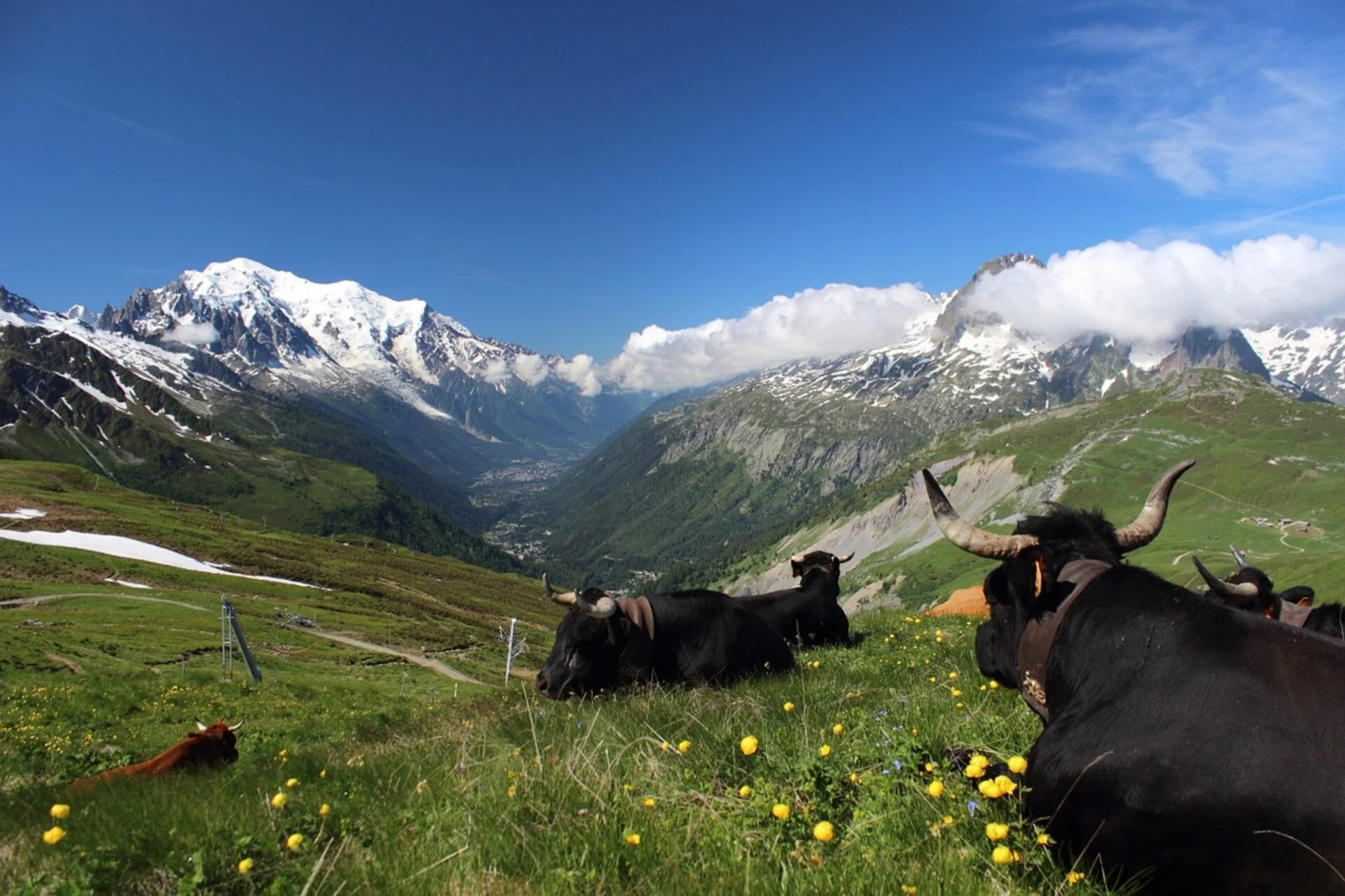
One morning you might be drinking coffee in a French hamlet. A few days later, you are sharing cheese and bread in Italy. Then suddenly you are walking through Swiss pastures, surrounded by Hérens cows, their bells echoing across the valley.
The mountains stay the same, but the culture shifts around them. That combination of landscape and human presence is rare. It is one of the reasons hiking Tour du Mont Blanc feels complete rather than repetitive.
How long is Tour du Mont Blanc
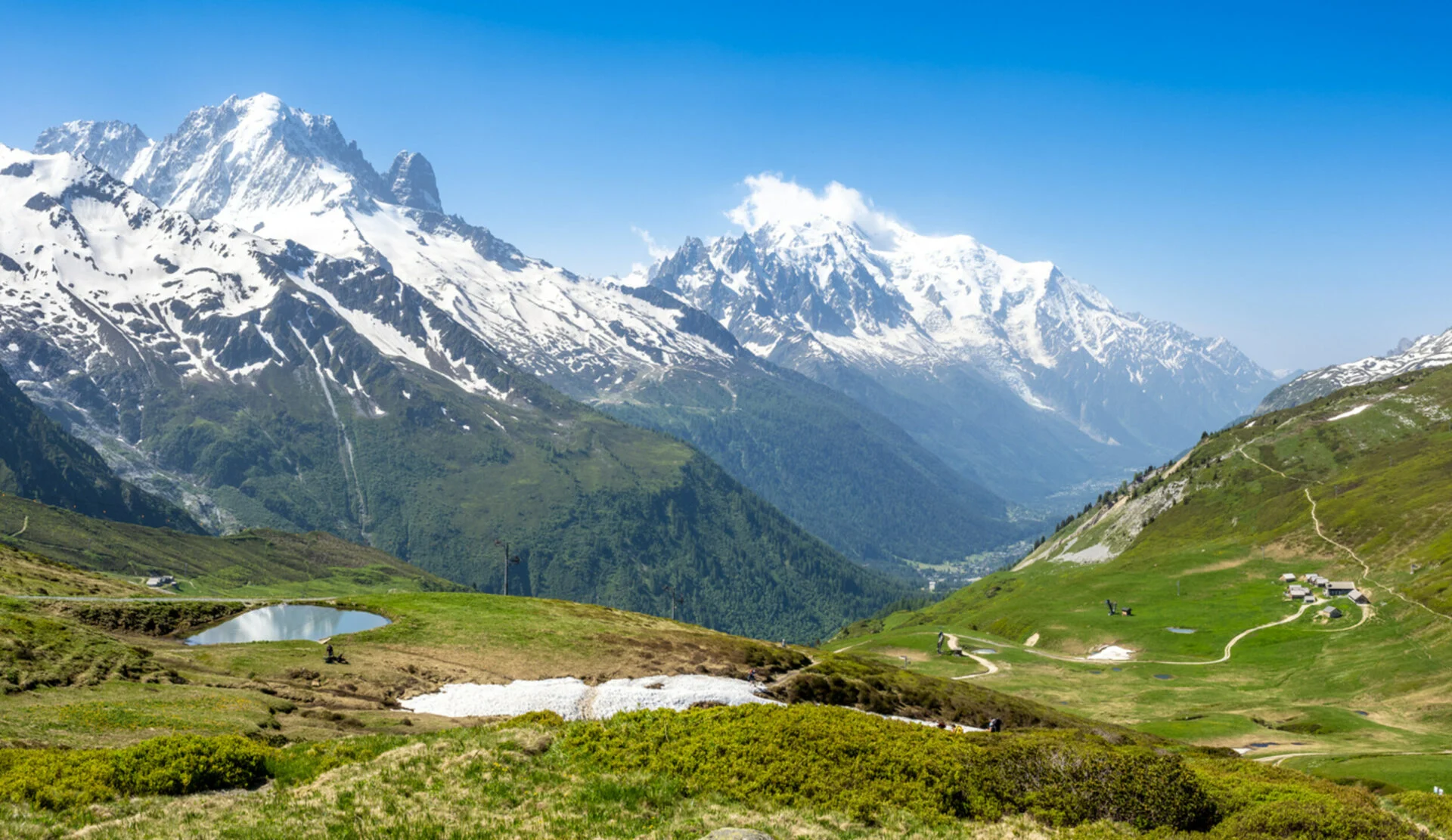
The full loop of hiking Tour du Mont Blanc measures roughly 200 km (124 mi). Over that distance, you gain and lose close to 10,000 m (32,800 ft) in elevation.
Those numbers sound impressive, but they do not tell the whole story. What matters is how the effort is distributed.
You are constantly climbing and descending rather than tackling one single massive ascent. Each day has its own rhythm, its own challenges, and its own rewards, something that becomes much clearer when studying a detailed Tour du Mont Blanc map before arriving.
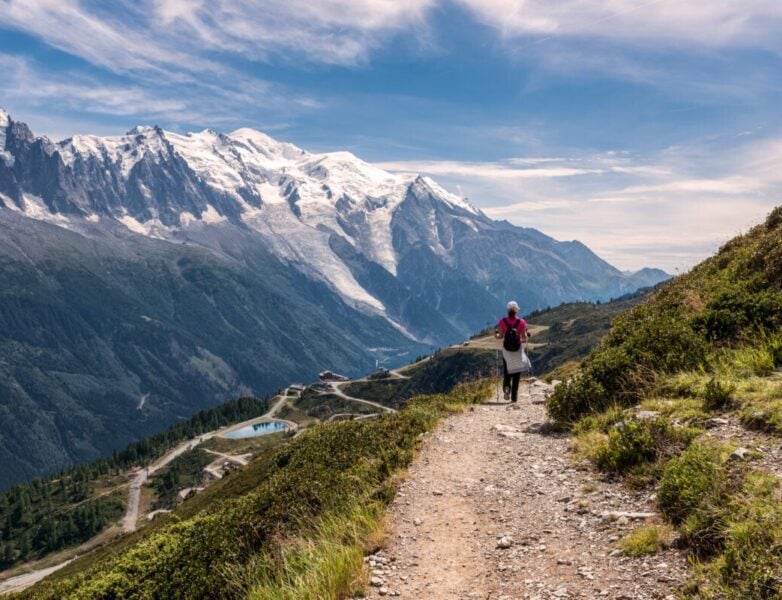
Why descent matters as much as ascent
Most people focus on elevation gain, but the descent is just as important. The repeated downhill sections place real strain on knees and ankles over time. This is one of the reasons proper preparation and pacing are essential, especially on a multi-day itinerary.
How many days does a luxury hiking Tour du Mont Blanc take
I have guided hiking Tour du Mont Blanc in six days. It is possible. It is also intense. You shorten stages. You skip variants. You arrive tired at the end of each day.
On a luxury itinerary, we usually plan around ten days. This pace allows us to walk full stages, take quieter variants, and still arrive at comfortable hotels each evening.
That balance between effort and recovery is what makes the experience sustainable, and what often distinguishes it from a Tour du Mont Blanc self guided approach.
Why time changes everything
With more time, the body adapts. Legs feel stronger instead of weaker. Small aches fade instead of accumulating. Just as important, the mind slows down. You stop thinking about distance and start paying attention to details.
That shift is where hiking Tour du Mont Blanc becomes something deeper than a physical challenge.
What is the best time to hike Tour du Mont Blanc
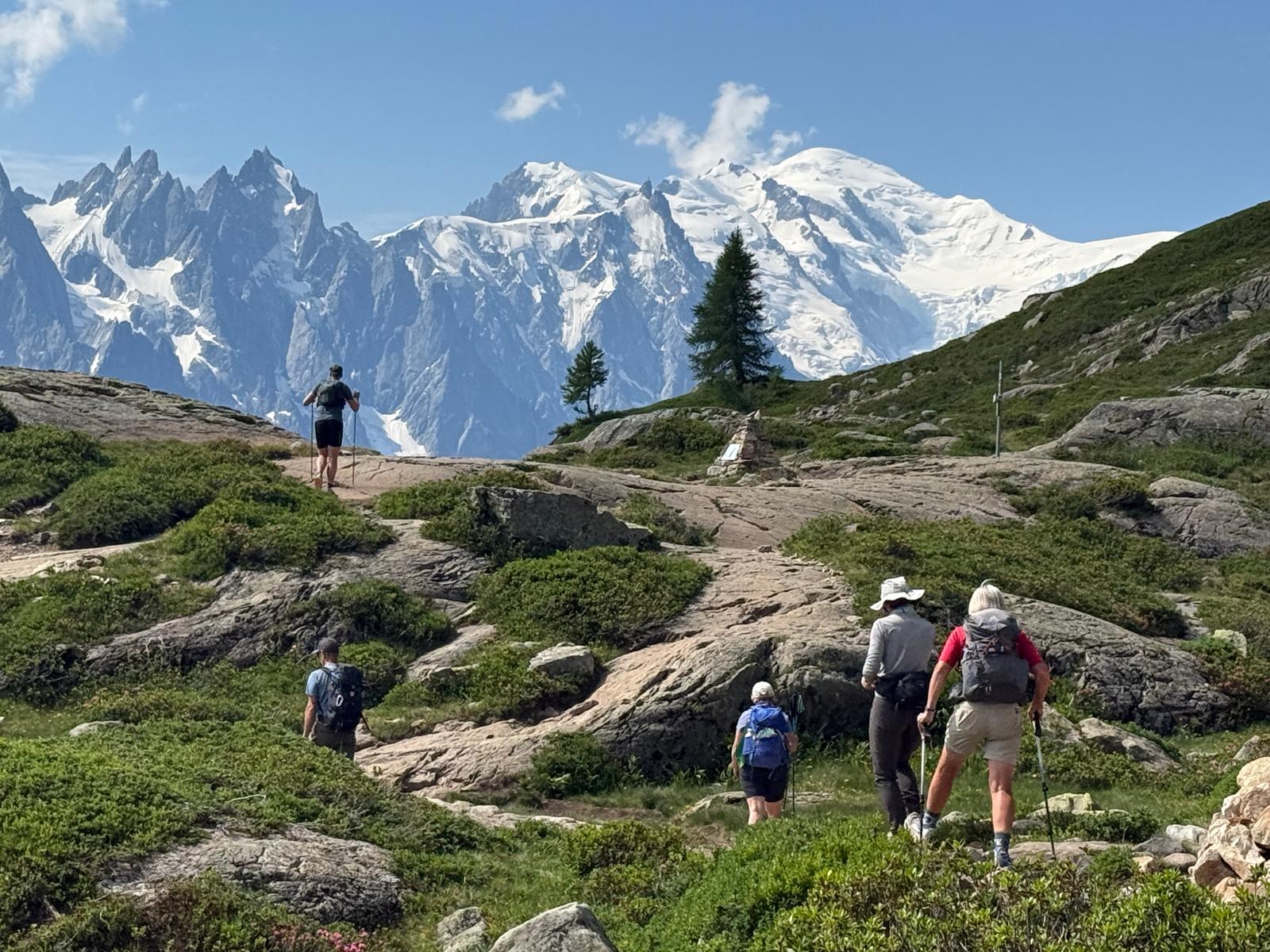
The best time for hiking Tour du Mont Blanc is generally from late June to early September. During this period, most high passes are accessible and mountain services are open.
June: flowers and freshness
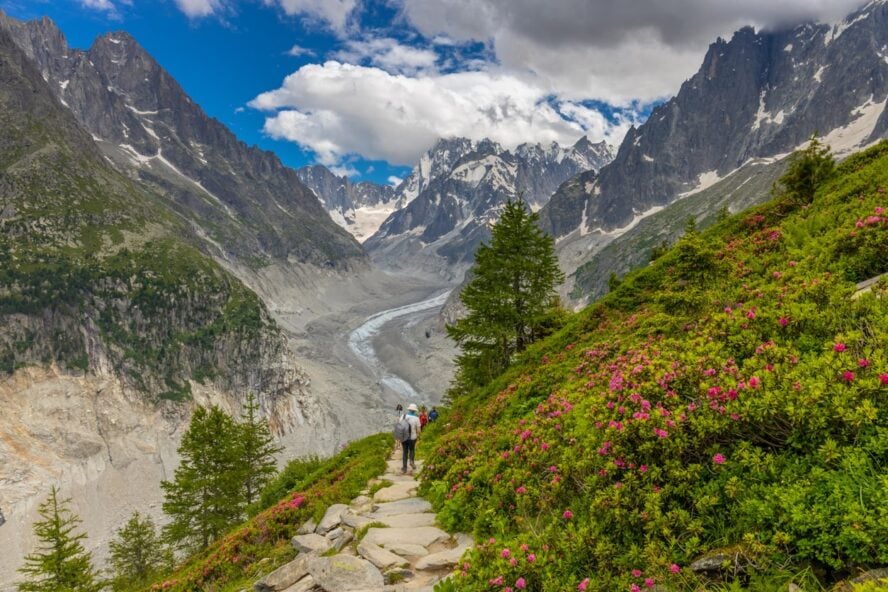
June is my favorite month for flowers. Rhododendrons, gentians, and alpine lilies cover the slopes. The valleys feel alive. Snow may still linger in places, but the contrast between white peaks and green meadows is beautiful.
July and August: stability and access
July and August offer the longest days and the most consistent access. Weather tends to be more stable, but these months are also the busiest. Trails, refuges, and villages are lively.
September: quiet and contrast
September is quieter. The light softens. Colors deepen. Snow becomes more likely above 2,400 m (7,900 ft), and conditions can change quickly. I have guided September trips with perfect weather and others with fresh snow on the trail.
The Alps always require flexibility.
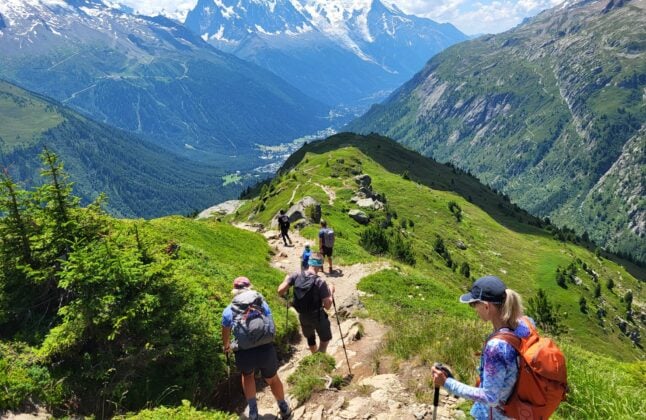
Starting hiking Tour du Mont Blanc in the Chamonix valley
Most itineraries begin in the Chamonix valley. This is where I live, and it is a natural hub for the route.
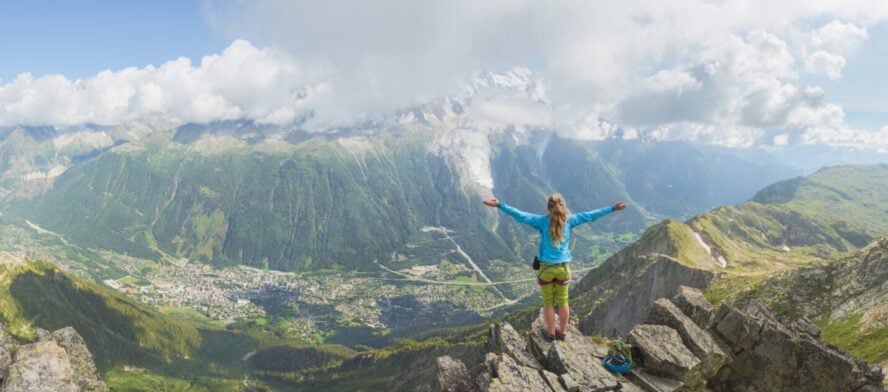
From the first day, the scale of the mountains is obvious. Glaciers hang above the valley. Sharp granite peaks frame the horizon. Mont Blanc dominates everything when the weather is clear. For many travelers, this first stage sets the tone for what becomes a memorable Tour du Mont Blanc walking holiday.
Choosing quieter starts
I often avoid the busiest trail at the start and take a south-facing balcony above the valley.
The views arrive immediately, and the atmosphere is calmer. This sets the tone for the journey ahead, especially on a classic Mont Blanc guided tour, where route choices can adapt to conditions.
Early stages and the reality of alpine weather
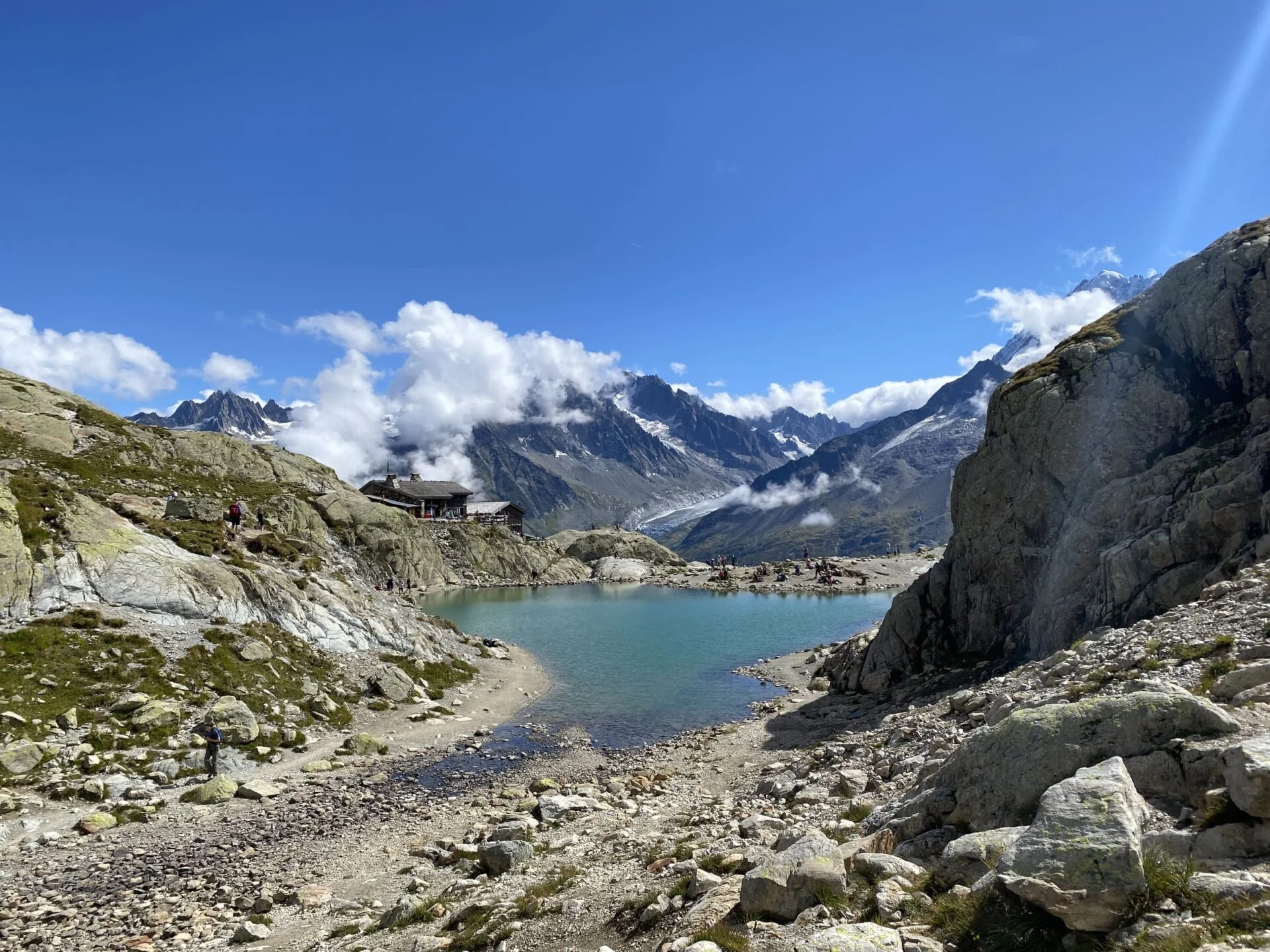
The early days ease you into the rhythm of hiking Tour du Mont Blanc. Meadows, rivers, and forested paths lead gradually toward higher ground. In good weather, these stages feel welcoming.
But the Alps do not promise comfort. Weather changes quickly here. I have guided trips where it rained for six days in a row. I have started September hikes with snow underfoot. Wind, fog, and cold are part of the environment.
Preparing for all conditions when hiking Tour du Mont Blanc
You dress for sun, wind, rain, and snow, sometimes all in the same day. Carrying proper layers is not optional. It is how you stay comfortable and safe.
Col du Bonhomme and the importance of variants
Col du Bonhomme rises above 2,400 m (7,900 ft) and marks one of the first major transitions on the route. From late morning onward, you walk through a protected nature reserve.
Leaving the main path
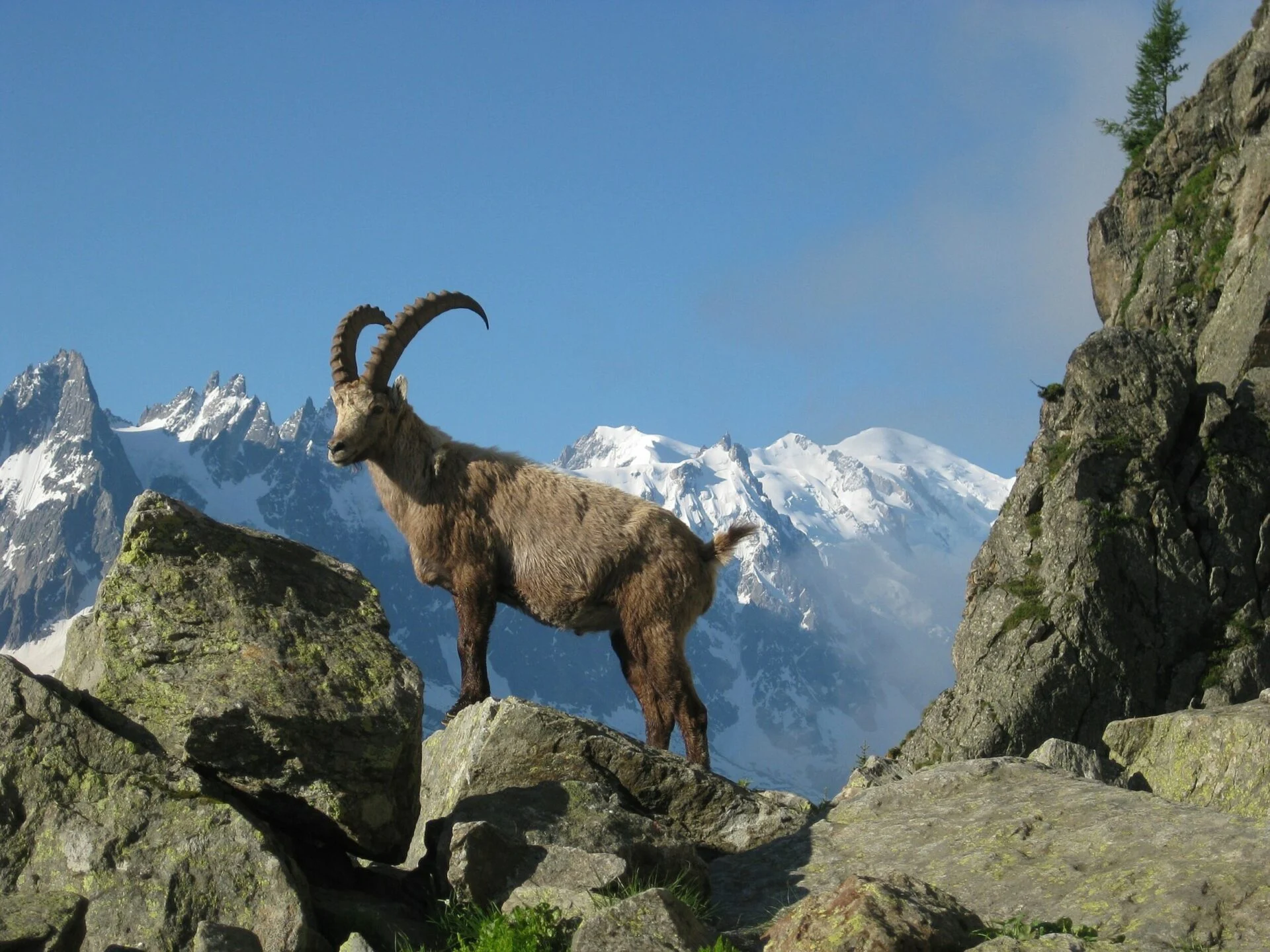
This is one of the sections where taking variants makes a real difference. The main trail can be busy, especially in the high season. As soon as you step onto a quieter route, the experience changes completely.
Silence returns. Wildlife appears. Chamois move along ridgelines. Ibex stand calmly above the trail. Eagles and bearded vultures circle overhead.
These moments are not guaranteed. They happen when you slow down.
Ville des Glaciers and mountain heritage
The walk through the Ville des Glaciers is one of my favorite days on the entire loop. The valley is wide, open, and deeply connected to mountain life.
Encounters that explain the landscape
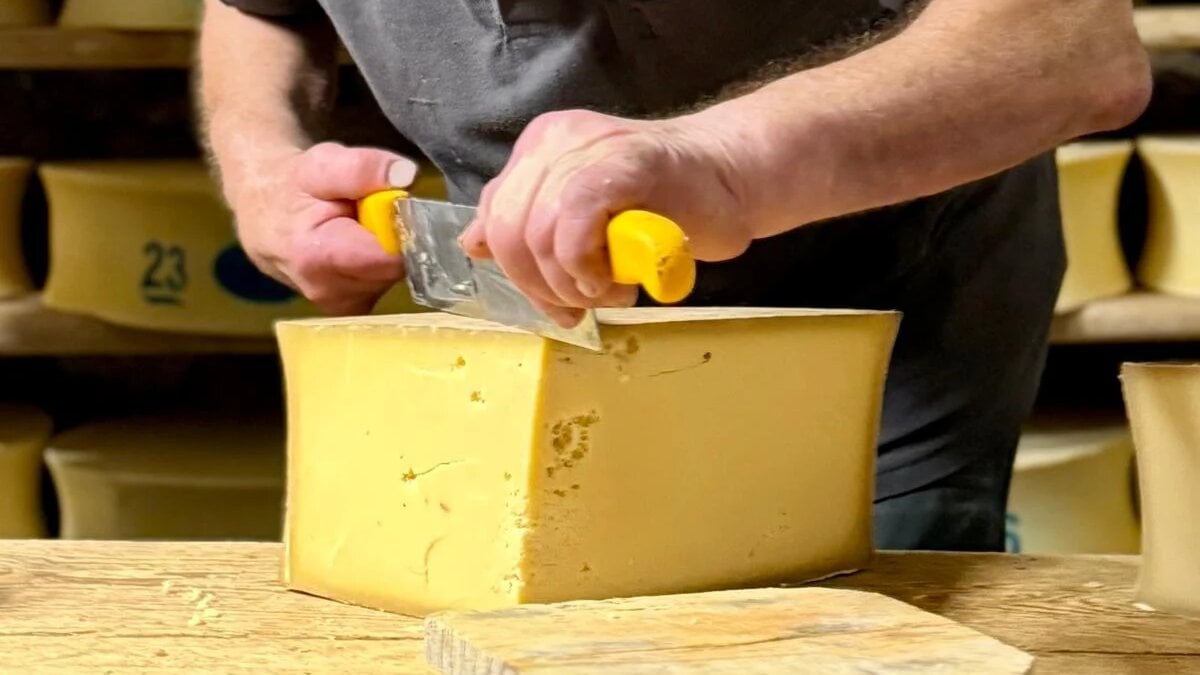
There is a local cheese maker here who has lived in the valley since childhood. When we stop, he talks about his cows, his work, and the seasons. Milk arrives warm from the pasture. Cheese is made in front of you.
Before these mountains became a playground for hikers and skiers, they were places of survival. Pilgrims, merchants, and soldiers crossed them long before tourists arrived.
Hiking Tour du Mont Blanc makes more sense when you understand that history.
Crossing into Italy and the southern aspect of the massif
After crossing Col de la Seigne, the atmosphere shifts immediately. You enter Italy, and the landscape opens up. Courmayeur appears below, bright and welcoming.
Balcony trails and southern light
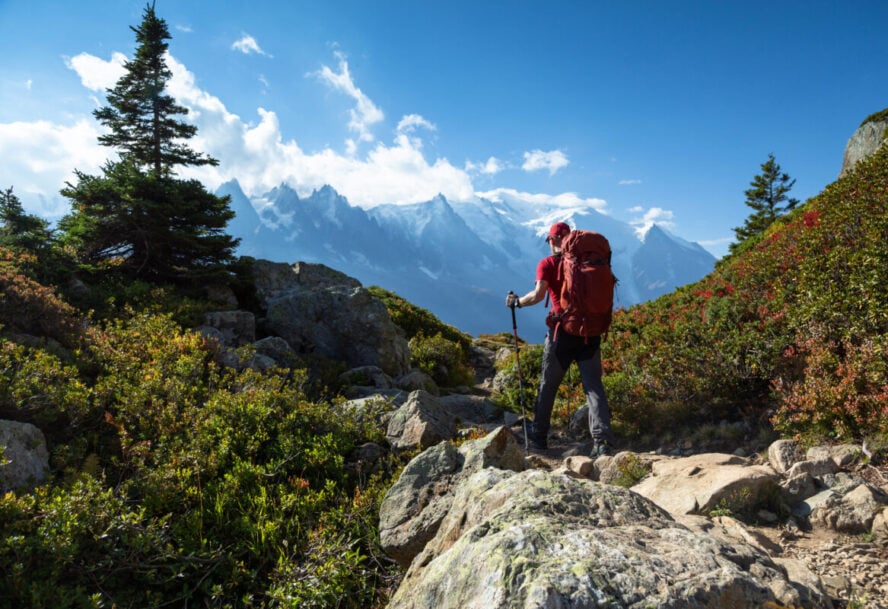
The Italian balcony trails face the southern aspect of the massif. The light feels warmer. The views stretch across the entire south face of Mont Blanc. Long traverses allow you to settle into a steady rhythm.
Food becomes part of the experience.
Lunch is not rushed.
Coffee stops feel earned.
This part of the route often surprises people with how relaxed it feels.
Food, recovery, and everyday comfort on the trail
One of the things people remember most from luxury Tour du Mont Blanc trips is the food. Eating well is not a side note here. It is part of daily life in the mountains.
Every valley has its own cheese, shaped by altitude, pasture, and tradition. In France, Beaufort appears at almost every stop, nutty and complex, made from milk collected high in summer pastures. In Switzerland, alpine cheeses are firmer, and often aged longer.
Local products are everywhere, and they are not presented as specialties for visitors. They are simply what people eat.
Charcuterie made nearby. Fresh bread picked up in the morning. Simple meals taken slowly at midday refuges. After long climbs, food tastes different. It feels earned. These moments, sitting at a table with tired legs and a clear head, often become some of the strongest memories of the entire journey.
Why comfort matters over time
On a luxury itinerary, daily comfort is not a bonus. It is what allows you to keep enjoying the hike day after day. Sleeping well, eating well, and carrying a lighter pack change how your body responds to the effort, especially when supported by Tour du Mont Blanc luggage transfer.
You still walk the same terrain. You just do it with more energy.
The Grand Col Ferret and entering Switzerland
The Grand Col Ferret is one of the steeper climbs on the route. It demands steady pacing and patience. Trekking poles are especially helpful here, particularly on the descent.
A new landscape below
From the top, Switzerland opens below in wide, orderly valleys. Farms are carefully maintained. Trails feel precise. Champex-Lac is one of the most scenic overnight stops on the entire loop.
A small lake sits at the edge of the village. Mornings are quiet. Reflections on the water slow everything down.
By this stage, groups usually find a shared rhythm. Conversations deepen. People help each other without being asked.
Returning to France and the final stages
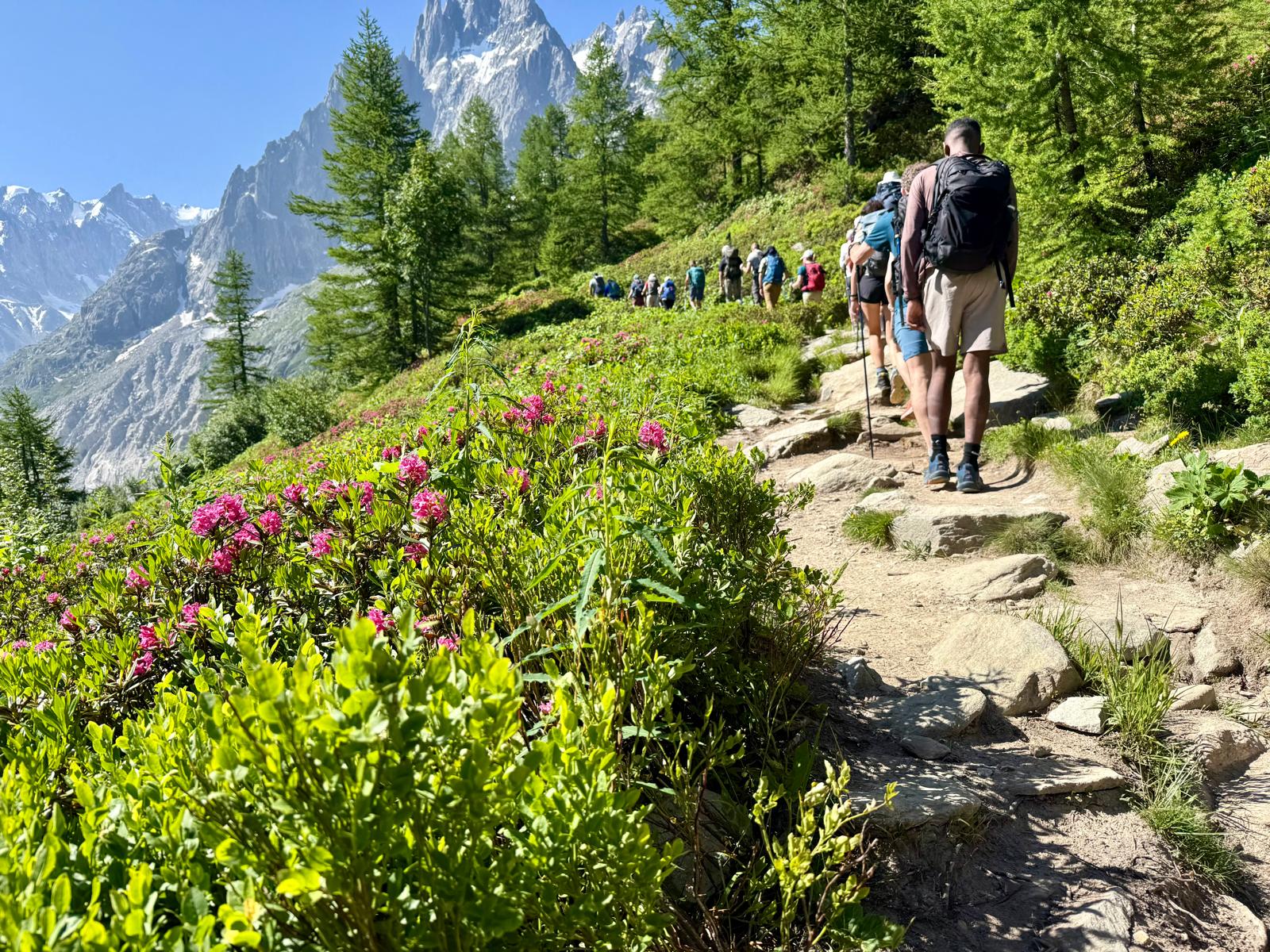
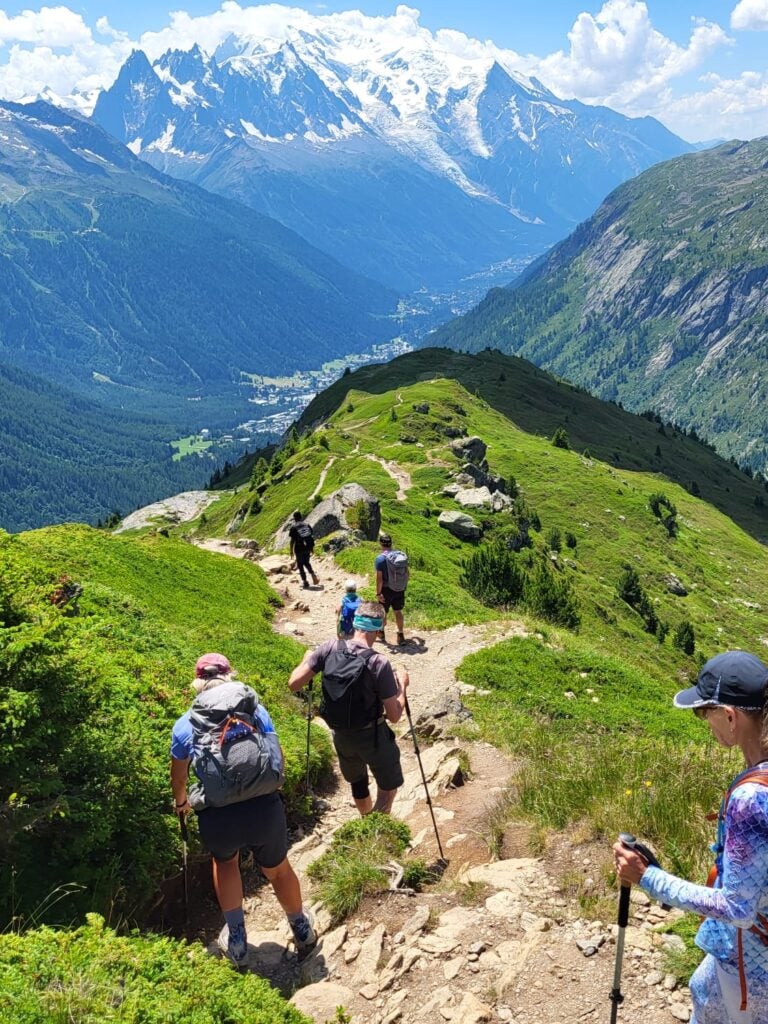
As you move back toward the Chamonix valley, the terrain changes again. Trails become more rocky. Descents grow longer and more sustained. By this point, legs feel the accumulated effort of many days on foot.
This is where preparation pays off. Poles matter. Foot placement matters. Pacing matters. These final stages are not the hardest technically, but they demand concentration. Fatigue makes small mistakes more likely, so slowing down is often the smartest choice.
Seeing Mont Blanc again near the end feels completely different than at the start. At the beginning, it is an objective, something distant and imposing. At the end, it feels familiar. You have walked around it. You have seen it from every angle.
You have earned that perspective through effort, patience, and time.
Wildlife, flowers, and seasonal change
Hiking Tour du Mont Blanc changes with the seasons in very noticeable ways. Early summer is defined by flowers and freshness. Meadows explode with color. Rhododendrons, gentians, and alpine lilies line the trails, especially in June and early July.
Valleys feel alive, almost loud with movement, insects, birds, and running water. Snow may still linger high on the passes, but lower elevations are soft and green.
Seasonal change
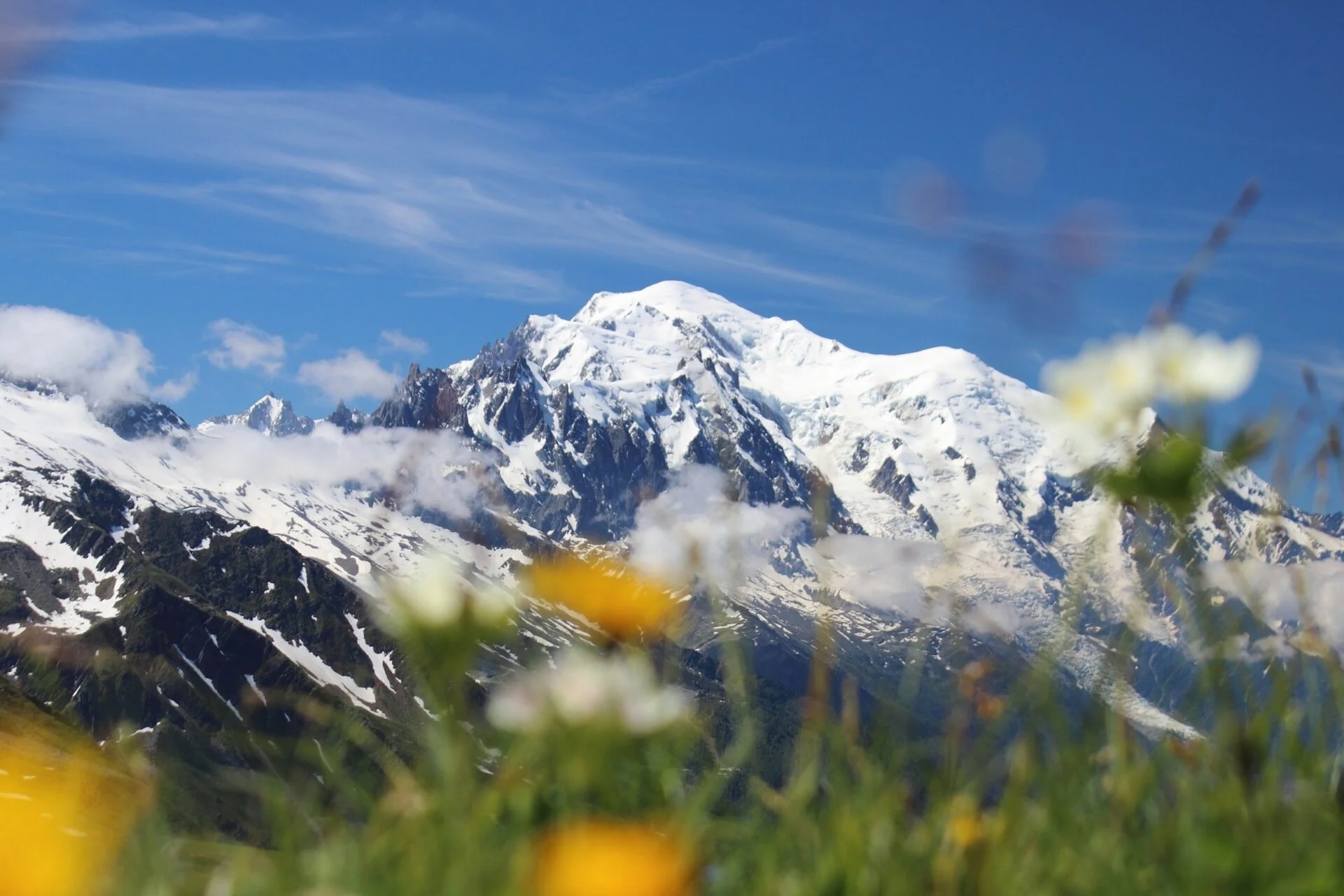
As the season progresses, the landscape shifts. Late summer brings contrast instead of color. The flowers fade, and the terrain becomes sharper. Rock, ice, and sky define the scenery. Light plays a bigger role.
Shadows stretch longer across the valleys, and the mountains feel more dramatic, more sculpted. September often feels calmer, quieter, and more introspective, even though conditions can be more demanding.
Animals are always present, but only if you slow down enough to notice them. Cows and sheep dominate the pastures, moving slowly across land their families have used for generations. Great Pyrenees dogs guard the flocks. They are calm but alert, doing the job they were bred for.
Chamois and ibex appear on ridgelines, often above the trail, watching quietly. Birds of prey circle overhead. Learning how to move calmly through these spaces, respecting both animals and people, is part of hiking responsibly in the Alps.
Ladders, exposure, and trail reality
Some videos make hiking Tour du Mont Blanc look effortless. Smiling faces. Perfect weather. Smooth trails. Those moments exist, but they are not the whole story.
The reality is more nuanced. There are ladders bolted into rock. There are exposed sections where the trail narrows and drops away. There are long, steep descents that demand focus, especially when legs are tired.
None of this is technical climbing. You do not need ropes or harnesses. But it does require attention, balance, and respect for the terrain.
Weather can amplify everything. Rain makes rock slippery. Fog reduces visibility. Wind changes how secure a narrow section feels. These elements are part of the mountain environment, not exceptions. Hiking Tour du Mont Blanc is accessible, but it is not casual.
Decision-making on the trail
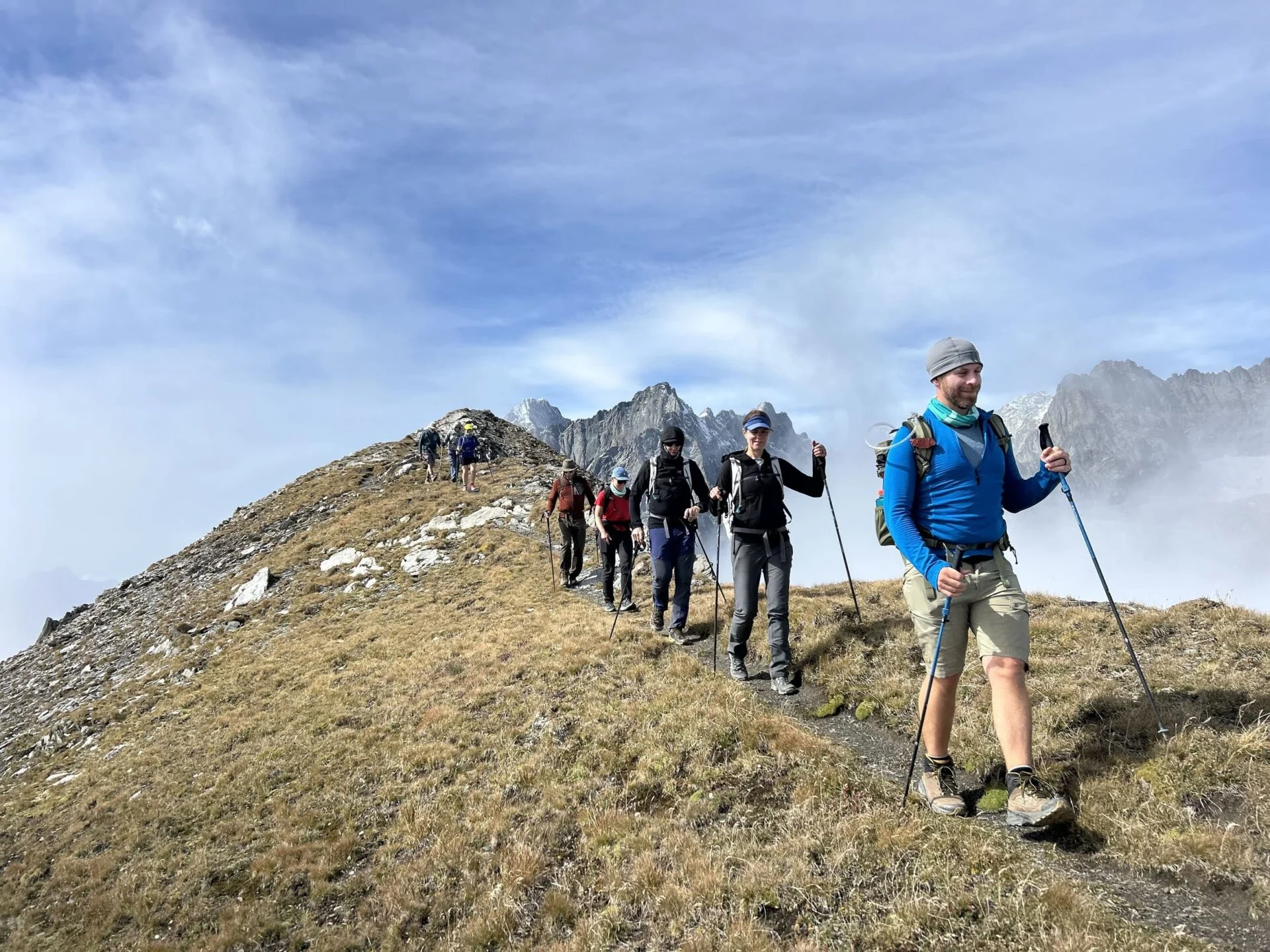
One of the most important skills on hiking Tour du Mont Blanc is decision-making. Not every section is mandatory. Some ladder sections can be avoided with alternative trails. Others cannot. Knowing the difference matters.
On a guided itinerary, these decisions are made together. Weather forecasts, trail conditions, group energy, and comfort levels all play a role. Some days call for ambition. Others call for caution. The goal is not to prove anything. It is to keep the experience enjoyable and safe for everyone.
This flexibility is one of the quiet advantages of a well-planned itinerary. You are not locked into a single plan. You adapt. That ability to adjust is part of what keeps people relaxed, even on more demanding days.
The human side of hiking Tour du Mont Blanc
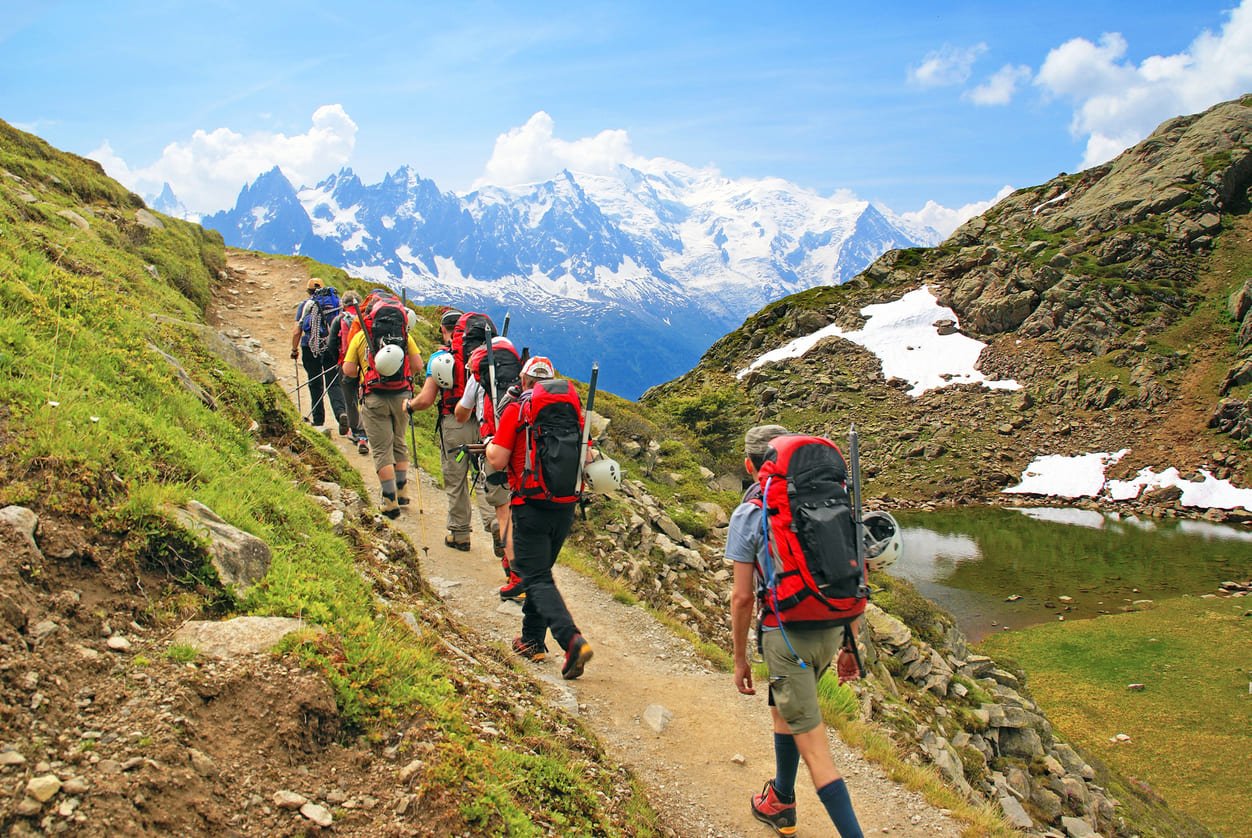
One of the most powerful parts of hiking Tour du Mont Blanc has nothing to do with scenery. It is the people.
Groups often arrive as strangers. Different backgrounds. Different reasons for being there. Over eight to ten days, something shifts. Shared effort creates connection. Long climbs open conversations. Quiet stretches allow reflection. Small challenges are solved together.
You learn a lot about people when you walk with them for hours every day. You see how they handle fatigue, uncertainty, and success. Friendships form naturally, without pressure. No one is performing. Everyone is simply moving forward.
By the end of the trip, saying goodbye is always hard. That is usually the clearest sign that the journey mattered.
What luxury really means when hiking Tour du Mont Blanc
Luxury does not remove challenge from hiking Tour du Mont Blanc. You still climb. You still descend. You still work for every view.
What luxury adds is margin.
Better sleep at night in comfortable hotels rather than crowded huts, often in well-run three- and four-star properties in the valleys. Better food that actually helps recovery. Flexibility when weather or conditions change. You are not rushing to meet reservations or worrying about logistics.
Most importantly, luxury adds presence. You are not distracted by planning or stress. You are walking, observing, listening, and experiencing the mountains as they are.
Why I still guide hiking Tour du Mont Blanc
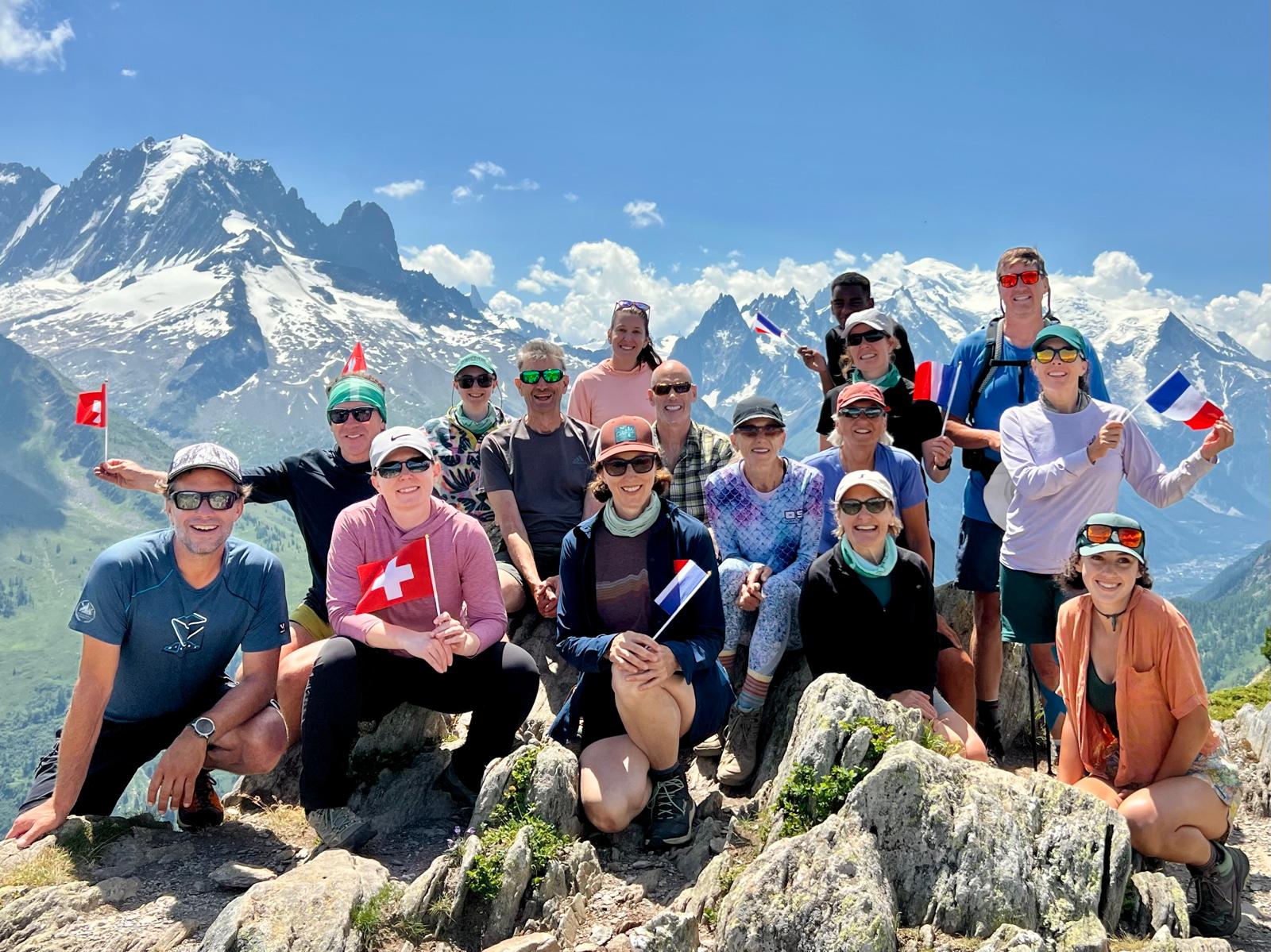
I have guided people on their very first mountain hike and people with decades of experience. I have watched doubt turn into confidence over the course of a week. I have seen exhaustion give way to pride at the end of a long descent.
Every group brings something different. Every season teaches me something new. Even after dozens of loops, I still notice details I missed before. A change in light. A quieter trail. A new conversation. Many guests go on to explore other Mont Blanc treks after this experience.
That never gets old.
Tour du Mont Blanc is not just a famous route. It is a long conversation with the mountains, with history, and with the people walking beside you. If you take the time to do it well, it gives back far more than it asks.