Somewhere on the second day, a stranger you’ve never met will look you in the eye, nod, and say: Buen Camino. Good journey. And for a reason you won’t be able to fully explain, it will mean something.
That’s the Camino de Santiago. A thousand-year-old pilgrimage route across Spain and Portugal, walked and ridden by millions of people, for millions of different reasons. Some come for religion. Some for the challenge. Some because a friend dared them. Most leave wondering why they waited so long.
I started guiding the Camino in 2006. Nearly 20 years of watching people arrive with full bags and uncertain faces, and leave lighter in ways that have nothing to do with luggage. I’ve cycled the French Way, the Portuguese Coastal Way, the Via Francigena in Italy. But the Camino is the one I keep coming back to. The one I keep bringing people back to.
Cycling the Camino de Santiago is not just covering ground. It is moving through one of the great journeys on earth at exactly the right speed to feel it. Let me show you how it works.
The History That Makes This Journey Different
The Way of Saint James
The word Camino simply means ‘the way.’ Santiago, in Spanish, translates to Saint James. So what you’re riding is the Way of Saint James, one of the Twelve Apostles, who according to tradition traveled as far as northwest Spain to preach before returning to Jerusalem, where he was beheaded by King Herod.
His followers placed his remains on a stone boat, which legend says sailed back to Galicia in the northwest of Spain. When those remains were rediscovered around 820 AD, the Moors controlled much of southern Europe. The Catholic Church declared a plenary indulgence for every Christian who made the pilgrimage to Santiago, and what followed was centuries of travelers, armies, and a slow political transformation that eventually drove the Moors from the Iberian Peninsula.
A pilgrimage that shaped a continent
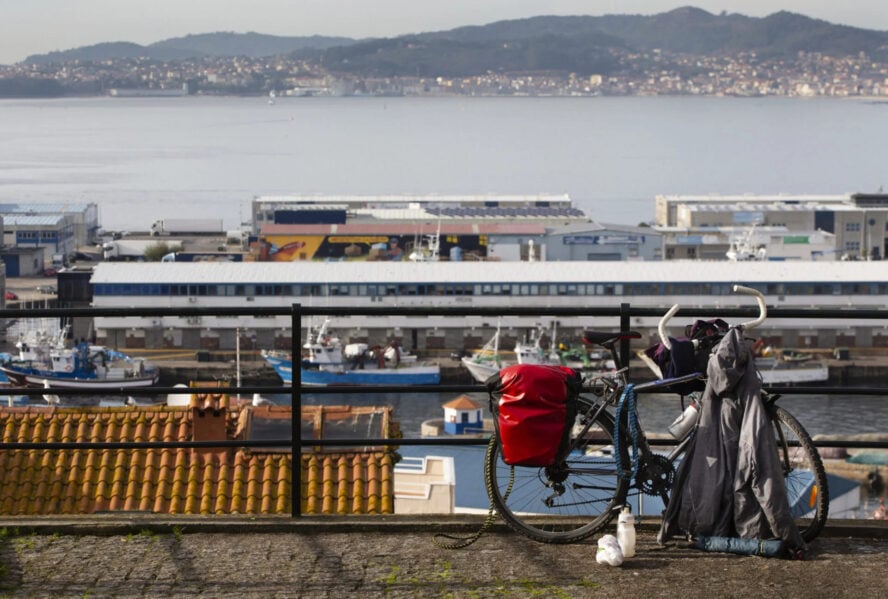
That is the history under your wheels when you are cycling the Camino de Santiago. The Americas were not discovered until 1492. Before that, Santiago was the westernmost point on the known European map. People walked toward the edge of the world to get there. Some say they want to do the real Camino. There is no such thing. Medieval pilgrims left from wherever they lived. The route was different for everyone. It still is. There is no right Camino. There is only yours.
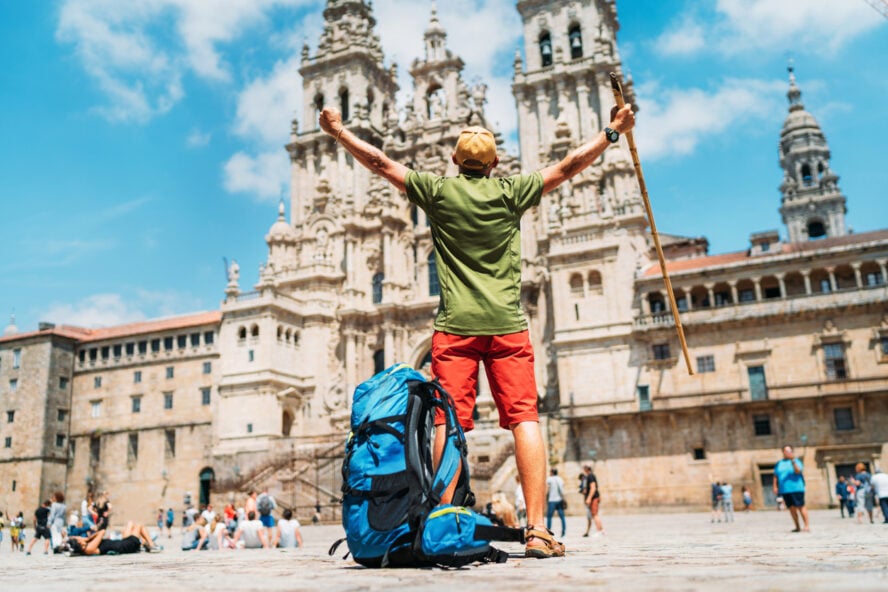
There is a fountain on the French Way that dispenses free red wine to passing pilgrims. There are yellow arrows painted on lampposts and bridges, guiding you every single kilometer to Santiago. There is a cathedral at the end that will stop you cold the first time you see it across the square.
And there is that feeling, somewhere in a Galician forest with your legs working and your mind finally quiet, that you are exactly where you are supposed to be.
What You Need to Know Before You Start
How long is the Camino de Santiago?
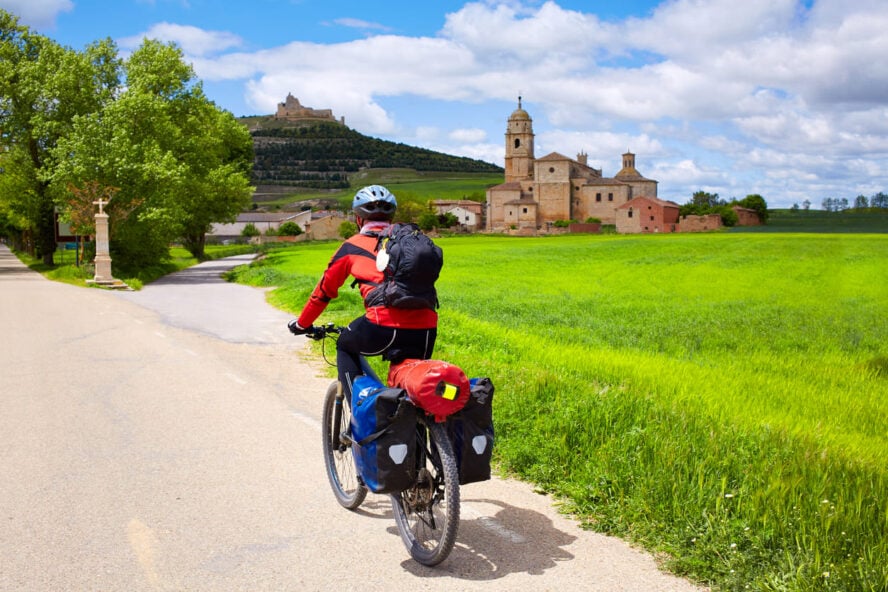
The full French Way covers approximately 800 km (497 mi) from the French Pyrenees to Santiago de Compostela. Walking it takes most people 30 to 35 days. Cycling it, depending on the section and your pace, typically takes 7 to 15 days.

The Portuguese Coastal Way is shorter at around 210 km (130 mi) and is comfortably done by bike in one week. For most of our cycling trips, we cover 200 to 230 km (125 to 143 mi) per trip, which fits a full week at a relaxed and consistent pace of 50 to 65 km (31 to 40 mi) per day.
Where does the Camino de Santiago start and end?
All routes end in the same place: the Plaza del Obradoiro in Santiago de Compostela, in the northwestern Spanish region of Galicia. Where they begin depends entirely on which route you choose. The French Way traditionally starts in Saint-Jean-Pied-de-Port, just across the French border in the Pyrenees. The Portuguese Coastal Way starts in Porto, Portugal’s second city and one of Europe’s most beautiful.
Other routes begin in Seville, Lisbon, or even people’s own front doors, since medieval pilgrims walked from wherever they lived. For our cycling trips, we always choose start and end points connected to international airports, so the logistics stay clean and simple.
Can you bike the Camino de Santiago?
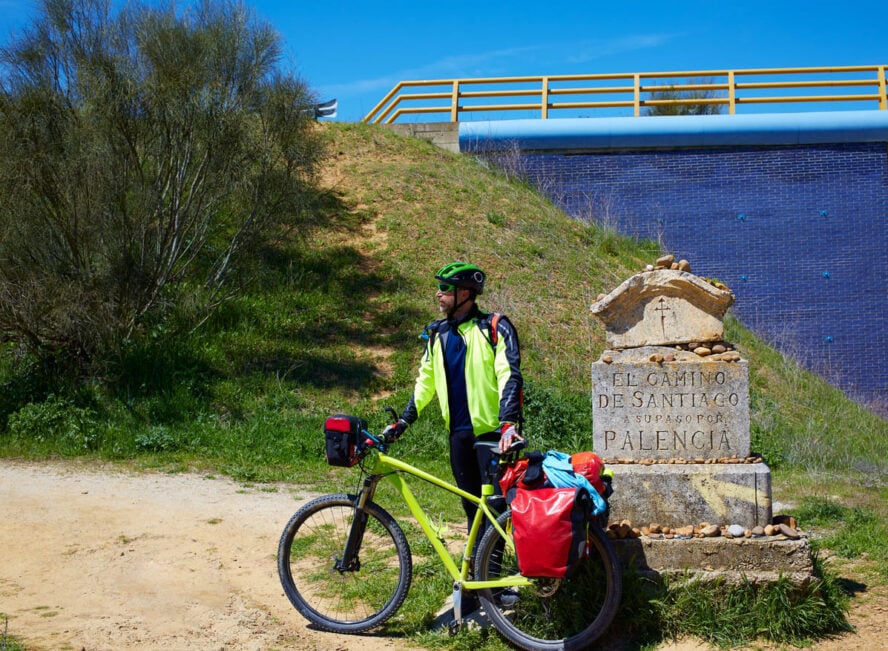
Absolutely, and it is brilliant. Cycling the Camino de Santiago is completely established, well supported, and increasingly popular. You share the trail with hikers, so awareness and respect matter. Most sections are accessible by mountain bike or e-bike, the trail is well marked, and the guidebooks are detailed.
The one thing I always say: make sure you have actually spent real time on a bike before you go. Cycling for five to seven hours a day, across multiple consecutive days, is a very different experience from your usual weekend ride. If you have not done it before, go out this weekend. Cycle for three or four hours. See how you feel.
If you don’t enjoy that, a full week of cycling the Camino de Santiago might not be the right trip for you.
The Best Routes for Cycling the Camino de Santiago
There are nine major routes across the Camino network. All of them have something to offer. But when it comes to cycling the Camino de Santiago specifically, two routes stand clearly above the rest. One for its history and cultural depth. One for its coastline and accessibility.
Cycling the Camino Francés: The most iconic route
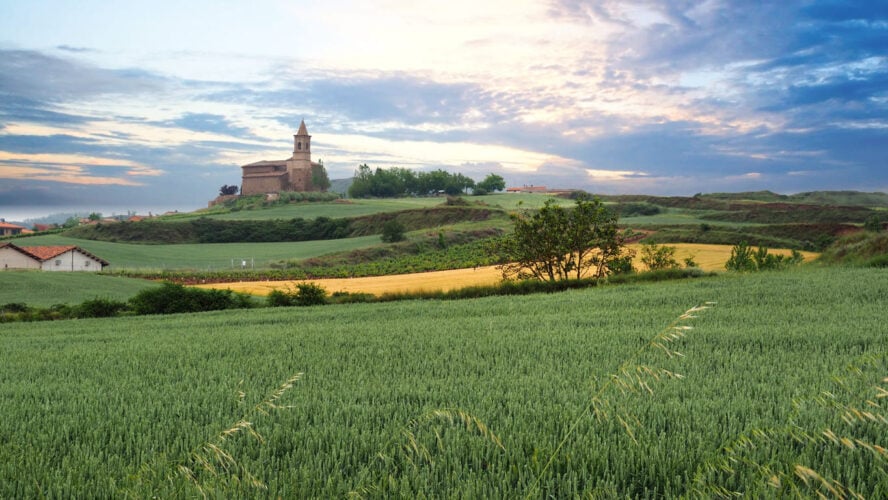
Cycling the Camino Francés is the one most people dream about first. It is the most famous of all the Camino de Santiago cycling routes, covering around 800 km (497 mi) of trail across some of the most varied landscape in Europe.
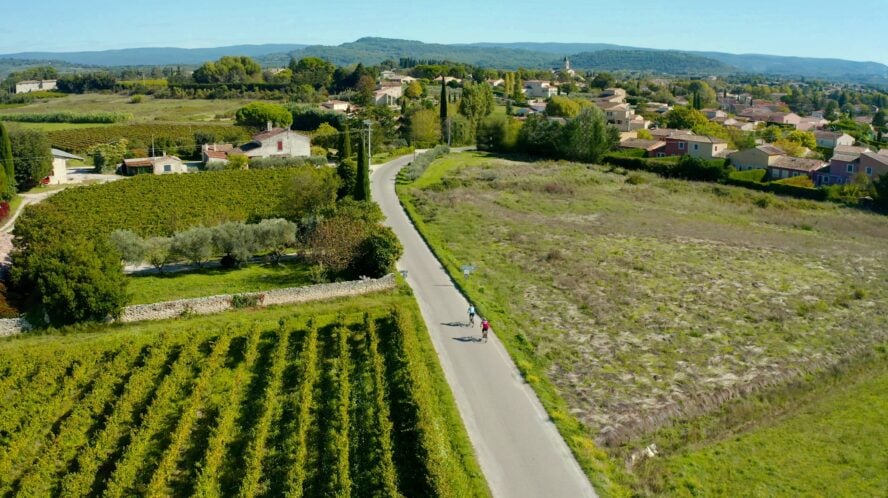
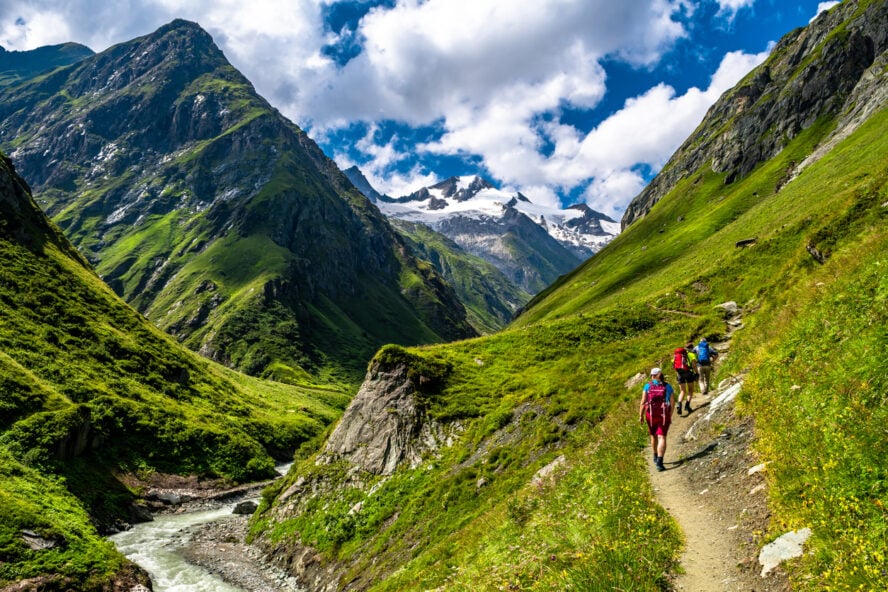
You start in the Pyrenees with a dramatic mountain crossing, then descend through the Basque Country and the vineyards of La Rioja, across the wide meseta of Castile, and finally into the green and rain-softened hills of Galicia.
For a full two-week cycling trip, you can start from Burgos or León and ride through to Santiago. For one week, we begin in Sarria or O Cebreiro and cover 200 to 230 km (125 to 143 mi) with daily stages of 50 to 65 km (31 to 40 mi).
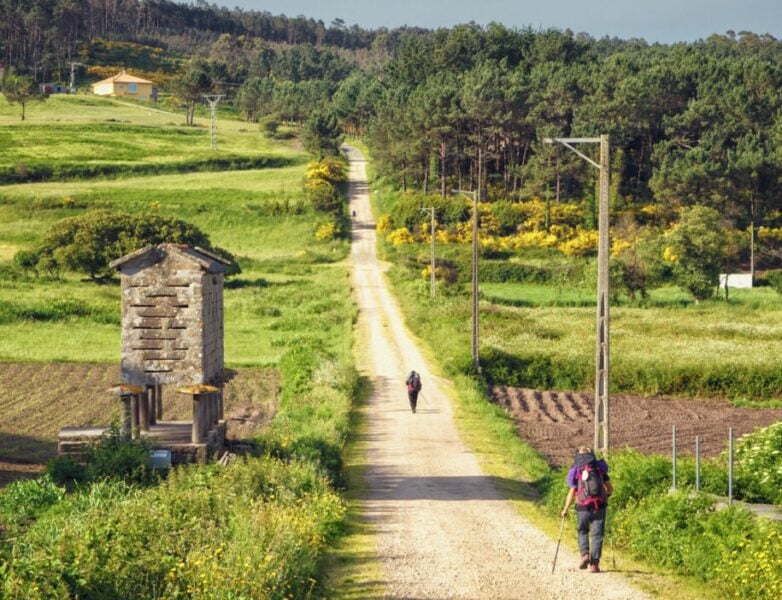
There are real climbs on this route. The mountain approach near Roncesvalles involves around 1,000 m (3,280 ft) of ascent, and there will be moments where you are off the bike and pushing. That is not a warning. That is part of the experience.
One of the most memorable stops along this route is the Cruz de Ferro, the Iron Cross, which marks the highest point before Santiago. Tradition says you carry a stone from home and leave it there, as a way of leaving a worry or burden behind. I have watched hundreds of people do this. Every single one of them pauses longer than they expected to.
Cycling the Portuguese Camino: My personal favorite
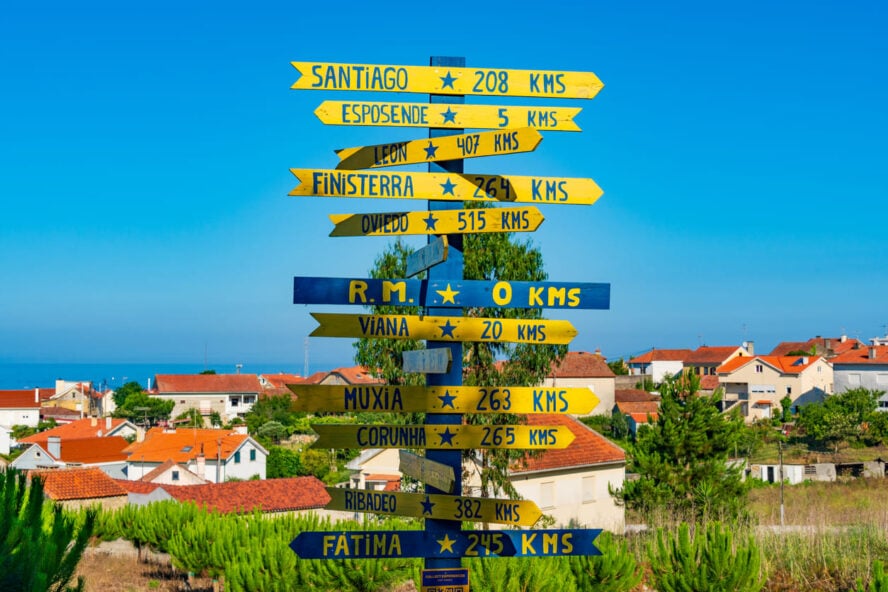
If I am being honest, cycling the Portuguese Camino is the route I recommend most. It covers around 210 km (130 mi), runs for two thirds of the journey along the Atlantic coast, and in a single week you get to experience two extraordinary cities. Porto at the start. Santiago de Compostela at the finish.
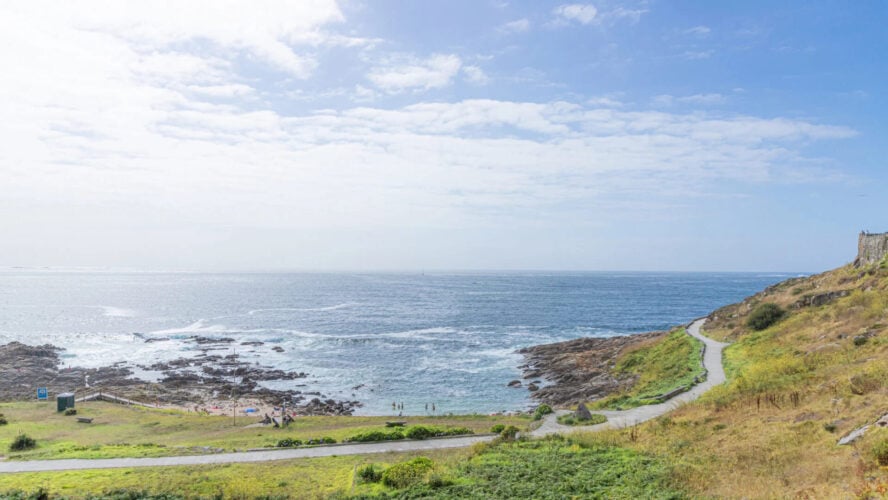
It is less busy than the French Way, which I love. Quieter trail. More personal pace. You cycle past fishing villages, estuaries, sea walls, and coastal cliffs. At one point you pass through Baiona, where there is a hotel right on the waterfront.
If the timing is right and the weather holds, you finish your riding day, walk down to the beach, swim in the Atlantic, and fall asleep with the sound of the ocean outside. That is a hard case to argue against.
The terrain is also gentler than the French Way, which makes it a strong choice for first-time Camino cyclists or for groups where fitness levels vary.
If you have never been to Portugal and want to include Porto in your trip, the Portuguese Coastal Way is the obvious answer. If the French Way is what you have always imagined, that is your route. You will have a great time on either.
Trail or Road: How Cyclists Navigate the Camino
Following the yellow arrows
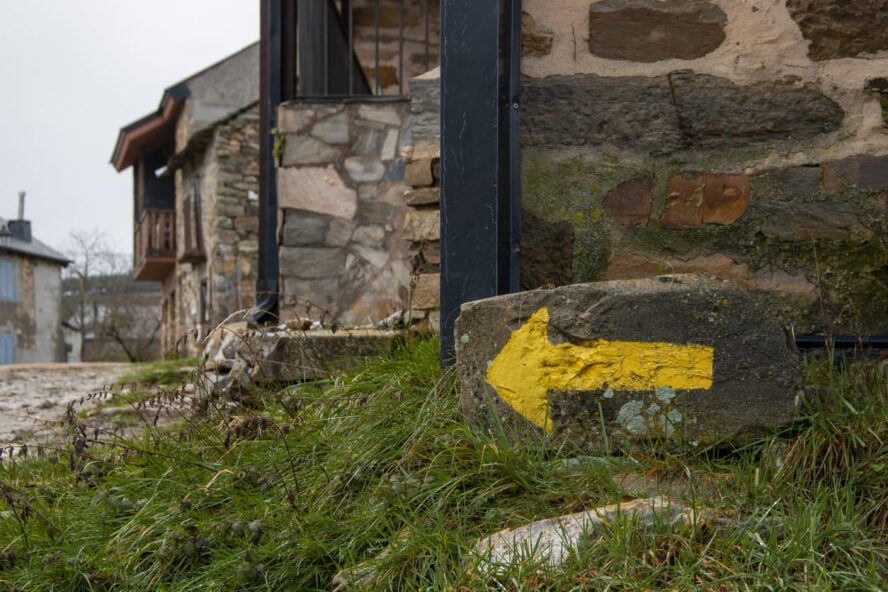
The Camino is marked throughout with yellow arrows. On lampposts, bridges, curbs, walls, and stone milestones. Once you are tuned into them, they appear everywhere. You also get a guidebook that shows both the walking trail in red and the road alternative in blue for every section, plus a mobile app with a live GPX track. You are never lost.
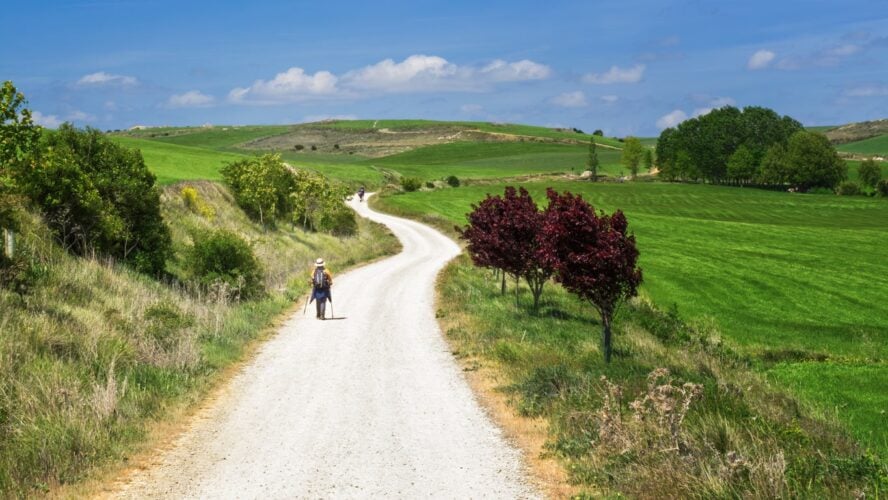
The trail itself follows farmland paths, forest tracks, dirt roads, and old stone ways. It was not designed for cyclists. It evolved as a walking route and we adapt to it. But that is part of what makes cycling the Camino de Santiago different from a standard bike trip. You are not on a designed cycling circuit. You are on a living pilgrimage route and you fit yourself into its rhythm.
When to take the road instead
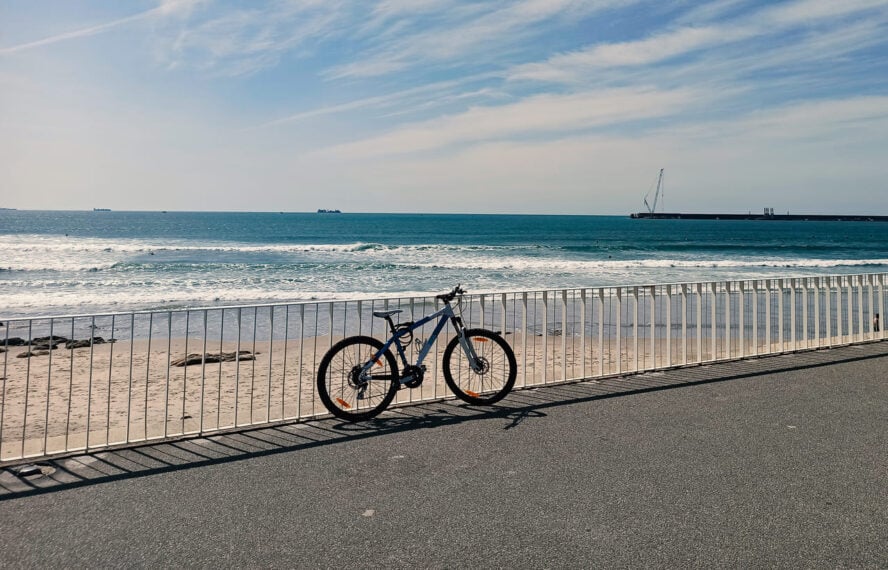
When I first cycled the Camino with my friend Mathieu, we started on the walking trail because we wanted the adventure of it. The dirt, the trees, the way the path cuts through farmland. That was right for us.
But there were evenings when we would look at the trail veering right over a hill and the road running straight ahead, with our hotel 8 km (5 mi) away and our legs already done. On those evenings, we took the road.
There is no right or wrong here. The trail is never more than 1 km (0.6 mi) from the road, so you are always safe and accessible. On a wet day, choosing the road is not a compromise. It is a sensible decision.
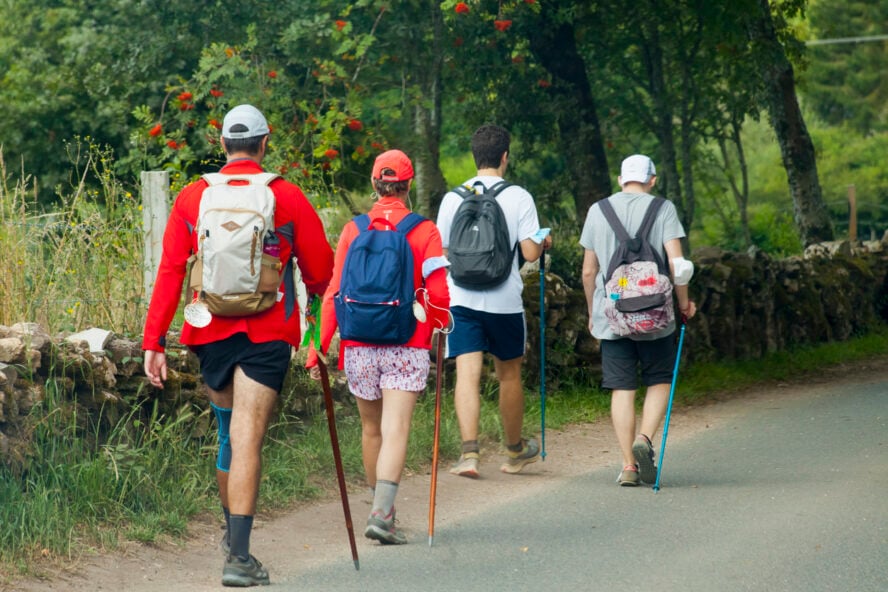
One thing that never changes either way: you are sharing the Camino with hikers. They do not see you coming. Slow down, call out, give them space. The Camino has a culture of generosity and mutual respect. Cyclists are part of that. Treat it that way.
What to Expect on the Bike Each Day
The daily rhythm on the trail
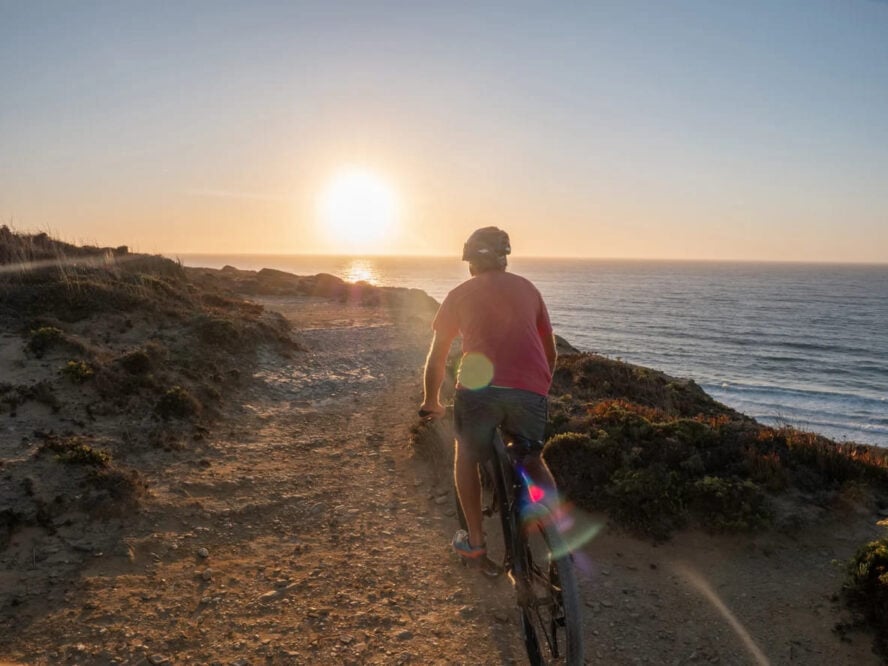
A typical cycling day covers 50 to 65 km (31 to 40 mi), which is roughly four hours in the saddle at trail pace on a mountain bike. This is not a training ride. You stop in small villages for coffee. You sit at a bar and eat a proper lunch.
You take photos at the Cruz de Ferro or the old stone bridges or wherever it is that day that stops you in your tracks. The cycling is how you move through the day, not the point of it.
Terrain and what ‘mostly flat’ actually means
One thing surprises almost everyone when cycling the Camino de Santiago: the terrain. People hear ‘linear route’ and assume it means flat. It does not. Over 100 km (62 mi) or 200 km (124 mi), there are always a couple of hills and at least one serious climb.
The French Way starts with a mountain crossing and finishes with the hills of Galicia. The Portuguese Coastal Way is gentler overall but still has climbs as you move inland and back toward the coast.
When you arrive at a town, you often have to climb into it. When you leave, you descend out. Even on the flattest stretches, expect undulation. Do not plan this trip thinking it will feel like cycling in the Netherlands.
Food and culture along the way

This is Spain and Portugal. The food is part of the journey. In Galicia, you are eating pulpo (octopus) and Tarta de Santiago, an almond cake that has been baked here for centuries. In the Basque Country it is pintxos and hearty stews.
La Rioja means red wine, full stop. You will also pass the Fuente del Vino near Pamplona, a fountain where a local bodega pipes free red wine directly to passing pilgrims. Nobody cycles past that without stopping.
Along the Portuguese coast, it is grilled fish, fresh bread, and pastéis de nata. Pimientos de Padrón, small green peppers that are mostly mild and occasionally very fiery, are a standard bar snack and a perfect mid-ride stop.
Bikes, Gear, and How to Prepare
What kind of bike do you need?
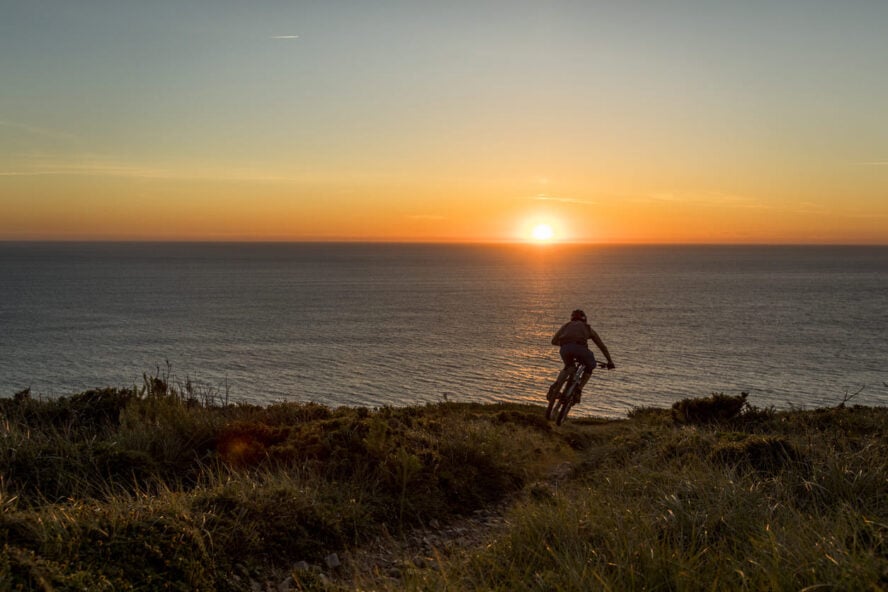
The Camino is not a road cycling trip. The surface is a mix of dirt tracks, gravel, cobblestones, and old stone paths. A road racer is the wrong tool.
We provide quality aluminum frame mountain bikes as standard, versatile, robust, and appropriate for everything the trail throws at you. We also offer gravel bikes for people who prefer them, and high quality BH e-bikes made in Spain for those who want motor assistance.
If you are comfortable on a mountain bike, you are sorted. If you have only ever ridden a road bike, it is worth getting some time on a mountain bike before you arrive. The handling is different, particularly on descents and loose surfaces.
E-bikes and mixed groups
The e-bike option has genuinely changed who can cycle the Camino de Santiago. I have guided groups where one person rides a standard mountain bike and their partner rides an e-bike, with completely different fitness levels, on the same daily route, having the same conversations at dinner.
When fitness gaps in a group are real, the e-bike levels things out without anyone having to hold back or push beyond their limits. It makes the access possible. The Camino does the rest.
How your bike is delivered
Bikes arrive at your starting accommodation the day before you begin, packed flat in cardboard boxes. Assembly takes 10 to 15 minutes: straighten the handlebars, adjust the saddle height, attach the pedals.
We provide a small toolkit and a repair kit. All tubes are self-sealing gel tubes, which significantly cut down on puncture stops. If something bigger goes wrong, a broken chain or a mechanical failure, our partner service handles the repair and transport to the nearest bike shop at no extra cost to you.
Training before you arrive
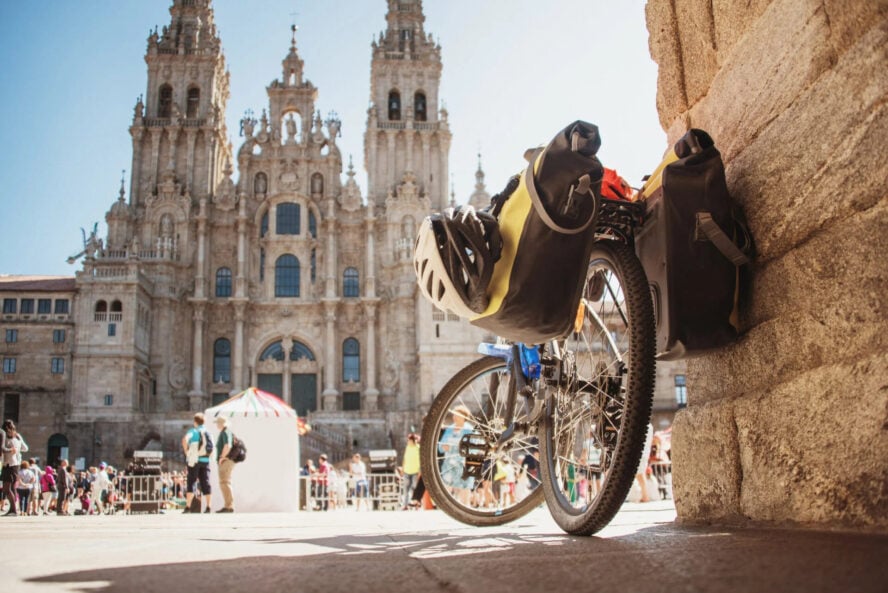
The best preparation for cycling the Camino de Santiago starts weeks before you arrive. Get out on the bike regularly. Two or three times a week, a long ride on the weekend, and two consecutive days back to back. Your body needs to understand what sustained saddle time feels like before you arrive.
Sorting that out at home is far more enjoyable than sorting it out on the trail. On the trail, dress in layers. A light waterproof jacket lives in your daypack at all times, especially in Galicia where rain is part of the deal.
Logistics: What We Handle
The Camino pilgrim passport
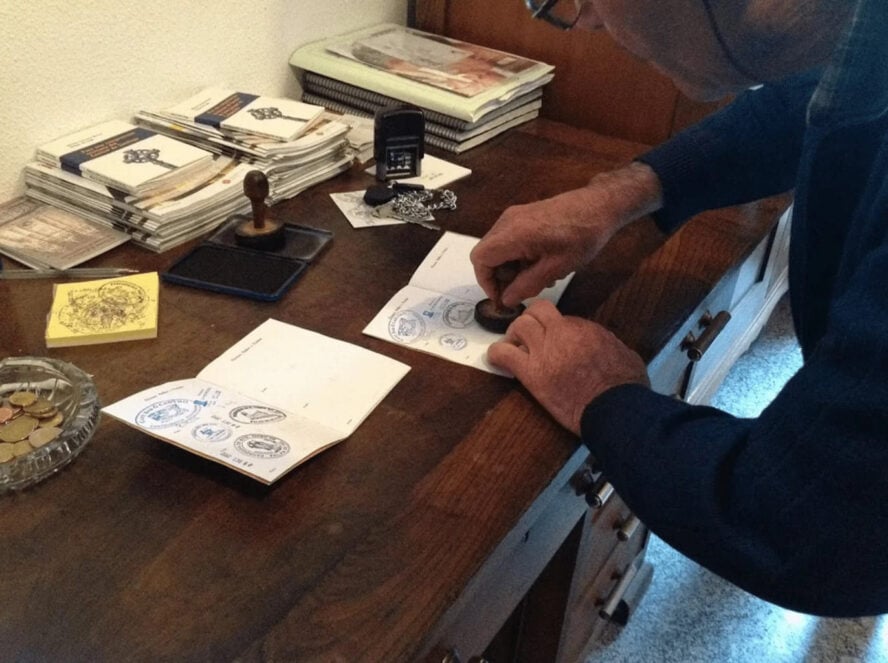
One of the most satisfying physical parts of the journey is the Camino pilgrim passport, a small booklet you carry throughout. At each stop, you collect a stamp: from churches, monasteries, cafés, albergues, and hotels.
Each stamp is a small anchor to a specific place and moment. The monastery at Samos before Sarria. The café in Arcade where you stopped in the rain. The albergue in O Cebreiro at the top of the mountain.
When you arrive in Santiago having covered 200 km (124 mi) or more by bike and collected enough stamps to prove the journey, you present the passport at the Pilgrim Office and receive the Compostela, the official certificate of completion. It is a piece of paper. It also means quite a lot.
Luggage transfer and accommodation
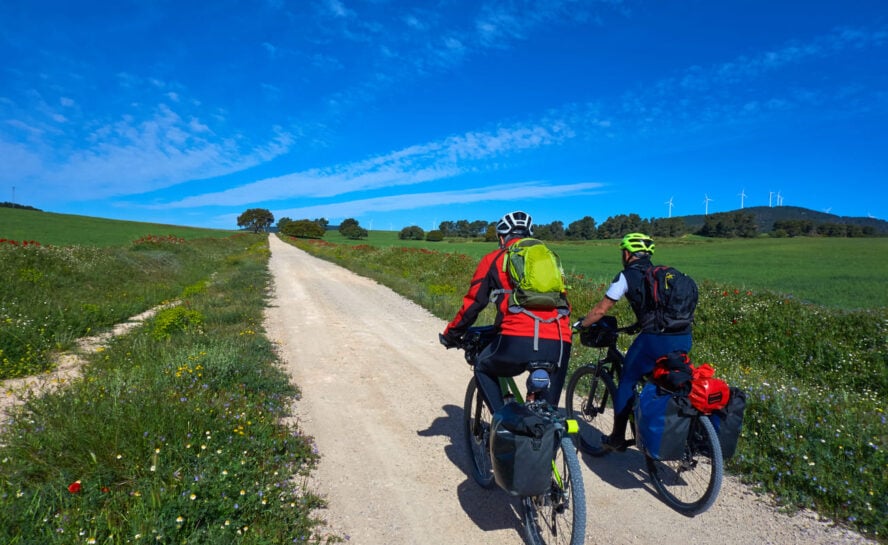
We handle luggage transfer from accommodation to accommodation every single day. You ride with a small daypack containing water, a snack, a rain jacket, and the essentials. Your main bag travels ahead and is waiting at the hotel when you arrive.
This makes a real practical difference. Carrying a heavy pack on a bike across 50 km (31 mi) of trail changes the experience completely and not in a good way.
Accommodation is two and three-star hotels with private bathrooms throughout. We specifically look for hotels with secure bike storage because your bike needs to be looked after overnight. We work with over a thousand accommodations across the network, covering a range of budgets. Simple and authentic, or a little more comfort. We build the trip around what you prefer.
Choosing your route length
Start with two questions: how much time do you have, and how many rest days do you want? From there, we work backwards to find your starting point. One week gives you roughly 200 to 230 km (125 to 143 mi).
Two weeks opens up 400 to 450 km (250 to 280 mi) of the broader Camino de Santiago cycling routes network. We always begin and end at cities with international airport connections, so there is no finishing in the middle of the countryside and trying to work out how to get home.
Why Cycling the Camino de Santiago Gets Under Your Skin
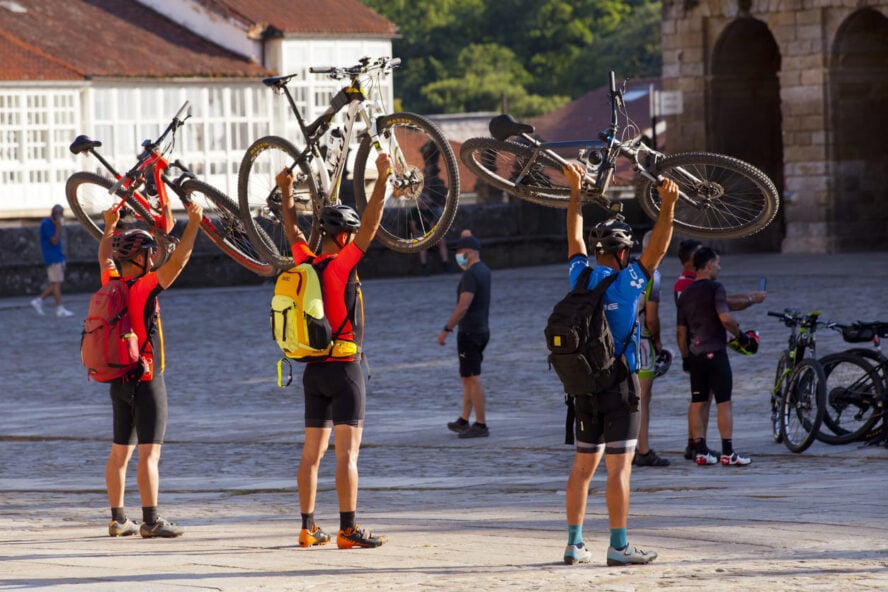
I have been asked many times why I keep coming back after nearly 20 years. The honest answer is that cycling the Camino de Santiago is one of the few journeys that actually delivers on what it promises. People arrive expecting scenery and exercise. What they get is something harder to name.
The bike gives you range. The Camino gives you depth. You cover more ground per day than a walker, but you still stop at the same village squares, eat at the same bars, collect stamps in the same passport, and arrive at the same cathedral. Nothing about the experience is diminished. It is just faster to get to the good parts.
A thousand years of pilgrims made this journey before you. Kings and peasants, soldiers and priests, people carrying stones from home to leave at a cross on a mountain. Not one of them regretted it.